Rajib Nandy
The landscape of global communication has transformed into what Manuel Castells once described as the Network Society – a social structure based on information networks rather than hierarchies of control. In this society, power no longer flows only from governments or traditional media institutions; it flows through interconnected digital nodes such as Facebook timelines, YouTube channels, TikTok feeds, and encrypted WhatsApp groups. This transformation, often called the rise of New Media, is not merely a technological change but a deep restructuring of power, politics, and meaning itself. The story of new media, particularly in South Asia, can be understood through four distinct eras: liberation, revolution, surveillance, and the rule of algorithms. Each era marks a shift in the balance between freedom and control, between voice and silence.
The people become the media
The early days of the internet in Bangladesh, much like in other parts of the world, were filled with the euphoria of liberation. Individuals discovered that they no longer needed the gatekeeping of editors or newsrooms to tell their stories. Blogs, Facebook pages, and YouTube channels became new spaces for expression. According to Castells, power in the network society is “the power to program and reprogram networks.” For a brief period, this power belonged to ordinary people. The rise of Bangla blogging culture in the late 2000s reflected this democratisation of communication. People from outside Dhaka’s media and political elite began shaping public conversations on religion, politics, and culture. This was a digital awakening what might be called the “Liberation Phase” of new media. Every post felt like a small act of rebellion.

When networks become movements
The true political capacity of new media emerged during the Arab Spring (2010–2012). The same digital tools that once enabled expression now enabled mobilisation. Castells calls this “mass self-communication”- a form of networked action that bypasses traditional power structures. In Bangladesh, the Shahbag movement of 2013 exemplified this transformation. A single Facebook post could bring thousands to the streets. In Sri Lanka and the Maldives, similar digital mobilisations challenged state power. The network society, once a platform for speech, became a platform for revolution. At this stage, new media symbolised empowerment and participatory democracy. The collective digital voice could now question, resist, and reimagine authority.




From freedom to fear
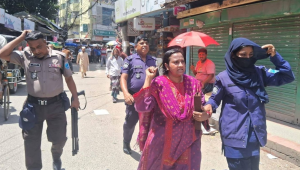
Every revolution triggers a counter-revolution. The state, once caught off guard, began to reassert control. Thus began the era of surveillance. Governments realised that controlling networks meant controlling narratives. In Bangladesh, the Digital Security Act became a tool of monitoring rather than protection. In Sri Lanka, internet blackouts silenced protest movements. Across South Asia, journalists, students, and ordinary users began facing legal and digital intimidation. From the lens of network theory, this is the phase when power reprograms the network. The open web becomes a controlled grid. Users learn to self-censor; the “liberation” of voice transforms into the “discipline” of silence.
The invisible hand of control
We have now entered the most complex phase, the algorithmic era. Here, the network itself has become the new sovereign. Platforms like Facebook, YouTube, and TikTok no longer merely host content, they govern visibility. Algorithms decide what becomes viral, who gets heard, and which truths gain legitimacy. This is a subtler, corporate form of control. It is not the government censoring a post, it is a machine learning system deciding that your critical content will not appear on someone’s feed. Political and analytical content in Bangladesh, for instance, increasingly struggles for reach, while entertainment flourishes. In Castells’ terms, this is the “programming of human attention.” The network that once empowered citizens now shapes their perceptions. The power of communication has migrated from the people to the platform.
The paradox of empowerment
The four eras of new media mirror the four stages of power in the network society: voice, mobilisation, suppression, and algorithmic governance. In each transition, communication technology has both liberated and constrained us. The mythic cycles of the Mahabharata might serve as an allegory: the early era of truth and purity (Satya Yuga) mirrors the innocence of the first phase; the age of justice and revolution (Treta Yuga) reflects the second; the confusion of right and wrong (Dvapara Yuga) aligns with surveillance; and the final age of darkness (Kali Yuga) resonates with our algorithmic present, where information abounds, but meaning erodes.
Yet, history also reminds us that no network remains static. In every dark age of communication, new spaces of resistance are born. The youth of Bangladesh, Nepal, and Sri Lanka continue to invent languages of dissent and creativity online. Thus, the question remains central to both media theory and the democratic future: Will the networked society empower citizens, or will it enslave them in invisible systems of control?
The writer is an Associate Professor at the Department of Communication and Journalism at University of Chittagong