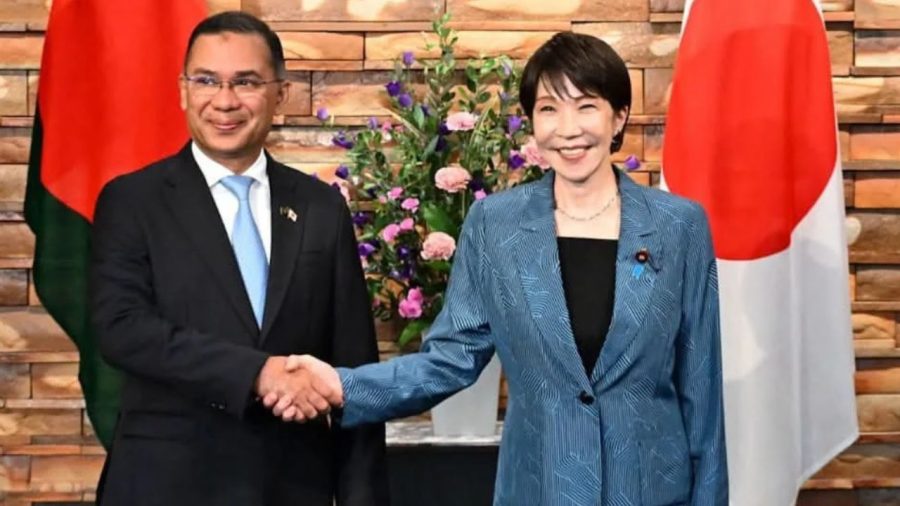



Prime Minister Tarique Rahman’s visit to Japan aims to strengthen bilateral strategic ties and align priorities with Japan’s updated vision of a ‘Free and Open Indo-Pacific (FOIP)’. The Prime Minister has called for deeper cooperation to build a stronger and more prosperous future, highlighting opportunities for Japanese investment in energy, technology and infrastructure, job creation, and human resource development.
Following his summit with Japanese Prime Minister Sanae Takaichi, Tarique Rahman called for closer bilateral relations to achieve shared prosperity. His visit marks an important step towards consolidating the longstanding friendship and strategic partnership between the two countries.
Japan views Bangladesh not merely as a recipient of development assistance or a market for its products, but as a strategically important country on the Bay of Bengal, connecting maritime routes, supply chains and markets across South and Southeast Asia. Bangladesh should therefore use this visit to strengthen its national capabilities, maximise economic benefits and expand its foreign policy options.

In recent years, the two countries elevated their relationship to a strategic partnership, emphasising freedom of navigation, regional connectivity, quality infrastructure, resilient supply chains and maritime cooperation. These priorities extend beyond trade and investment, encompassing financing conditions, technical standards, commercial networks and regional security.
Bangladesh must ensure that such connectivity serves its own economic interests rather than merely functioning as a corridor for other countries. Japanese investment should contribute to domestic production, technology transfer, employment and long-term economic resilience.




The success of this visit should not be measured by the number of agreements signed or diplomatic gestures exchanged, but by tangible outcomes. In maritime cooperation, both countries should establish practical programmes for training, maintenance, disaster response and information sharing. Bangladesh should identify the institutions responsible for implementing these initiatives and coordinating their activities. Given the rising interest rates on Japanese loans, Dhaka should also negotiate more favourable financing terms to ensure the sustainability of development projects.
Economically, implementing the Bangladesh-Japan Economic Partnership Agreement (EPA) should be a priority. Export regulations must be simplified, smaller suppliers should receive assistance in meeting certification requirements, and infrastructure investments should be linked to industries capable of generating local production and employment.
Regional diplomacy must also remain integral to this partnership. Stability in the Bay of Bengal is closely connected to the situation in Myanmar, the Rohingya displacement crisis, climate change and the interests of India and Southeast Asian countries. Japan’s diplomatic experience and humanitarian engagement could complement Bangladesh’s firsthand understanding of regional challenges, creating opportunities for stronger cooperation.

During the visit, Bangladesh and Japan signed four memorandums of understanding (MoUs) and two grant agreements. Discussions also covered Japanese investment, renewable energy, digital transformation, agricultural modernisation, human resource development and implementation of the bilateral EPA.
We believe this visit can further strengthen bilateral relations and expand economic cooperation. However, diplomatic goodwill must translate into measurable gains. Attracting productive Japanese investment, developing skilled human resources, creating employment for young Bangladeshis and expanding opportunities for skilled workers in Japan should be central priorities. With effective implementation, the partnership can deliver lasting benefits to both countries while strengthening Bangladesh’s economic capacity and regional standing.