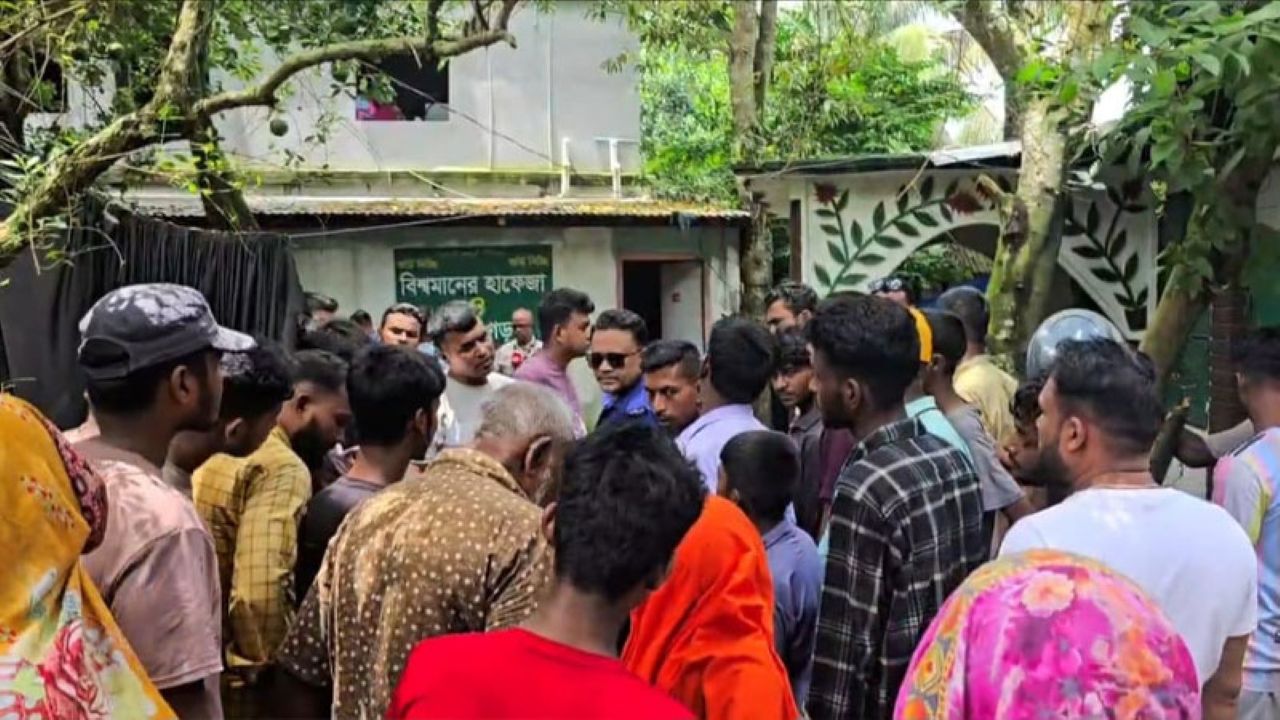







Abdur Razzaq left home on an empty stomach with only Tk70 in his pocket. He rented a rickshaw, and like every day, he wanted to earn some money, so that he would be able to eat with his family at night.
But Razzaq’s rickshaw suddenly stopped as he reached Science Lab intersection. The road was blocked. There was no way forward and no chance to turn back.
As the day progressed, fatigue showed up on Razzaq’s face, and hunger burned in his stomach. He was stuck in the same place for almost four and a half hours. He did not have the courage to spend the remaining Tk70.
Like hundreds of thousands of rickshaw pullers who live day-to-day in the capital, Razzaq knows one thing. If he cannot earn, he will not eat today.
Again and again, he begged the protesting students with a shaking voice, showing his empty stomach. “Son, we are poor people. I have not eaten anything since morning. Please clear the road.”
But the students, firm on their demands, did not move. Hunger and helplessness pushed Razzaq to a breaking point. He told the protesters, “Tell us what your demands are. If needed, we will go to [Chief Adviser Muhammad] Yunus for you.”
At one point, Razzaq even held a student’s hand and asked him to choke him to death. He said he no longer had the strength to endure hunger in this city.
This scene on Thursday was not just about one rickshaw puller. It reflected the suffering of thousands of people trapped in the capital. Every day, hundreds of thousands of people travel across Dhaka for work, education, and medical care.
When one key road point is blocked, the effect spreads across the entire city.
In the same blockade, Nafiz, a university student traveling from Sadarghat to Mirpur, was also stuck at Science Lab. After waiting for hours, he expressed his anger.
“This city is no longer livable. Anyone blocks roads whenever they want. Our lives are miserable. Neither the government nor the administration cares,” he said.
The frustration grew stronger in the voice of Shovon. He was on his way to the hospital to see his sick father and was stuck for a long time.
Voicing anger, Nafiz said, “These students are a disgrace to the name of students. Causing public suffering for personal demands is wrong. Protest after protest. Doesn’t the Yunus government have any responsibility?”
Behind this human suffering lies a long-unresolved academic crisis of seven government colleges. On Thursday, students of the seven colleges blocked Science Lab intersection from noon, demanding the issuance of an ordinance for Dhaka Central University.
As announced earlier, students from Dhaka College, Eden Mohila College, and Begum Badrunnesa Government Women’s College marched and took position at Science Lab. As a result, the entire area became almost paralyzed.
Vehicle movement stopped in Science Lab and nearby areas.
Ordinary commuters faced extreme hardship. Traffic police said that although alternative routes were tried, heavy congestion developed in Dhanmondi, New Market, Kalabagan, and Azimpur after noon.
During the blockade, students chanted slogans such as, “The state, your time is over, issue the ordinance,” The slogans further heated the situation.
During the protest, no active measures were seen to be taken by the police personnel on duty. When asked, several officers present at the Science Lab intersection said, “We cannot lay hands on the students unless the general public becomes agitated and takes action against them.”
In the aftermath of the July 24 uprising, repeated public and student criticism has placed law enforcement under pressure. Observers say this has led to a cautious stance in recent protests, as police avoided direct intervention.
Throughout the blockade, officers were seen mostly standing by, a situation that worsened public hardship due to limited enforcement on the ground.
Students demanded the immediate issuance of the “Dhaka Central University” ordinance, warning that the blockade would continue. More than two lakh students in the seven colleges face ongoing academic uncertainty due to delayed exams and results.
Education Ministry sources said a revised draft was sent to the Public Administration Ministry on 13 January and will go to the Advisory Council after legal vetting, but students want formal approval without delay.
In this context, Professor AKM Elias, interim administrator of the proposed university, urged patience noting that the ordinance is still in the administrative process. Students rejected this, returning to the streets for a second day.
Amid this blockade, the days of people like Abdur Razzaq come to a halt. Between the politics of demands and rights, the city’s poorest people, for whom one day’s meal is the biggest demand of all, suffer needlessly.

