With cardamom skyrocketing to Tk5,500 a kg, cumin soaring to a punishing Tk900, and cloves breaching the Tk1,900 mark, a silent, heartbreaking surrender is underway in kitchens across Bangladesh.
The rich, heady orchestra of these spices — the very DNA of Bengali cooking — is being forced into exile, priced out of existence by a relentless wave of inflation. What was once a sensory birthright has transformed into an unattainable luxury.
Faced with these brutal price spikes, countless households are doing the unthinkable: stripping Bengali cuisine of its soul. Recipes passed down through generations are being quietly and painfully rewritten, not by choice, but by the dictates of economic survival.
Every day, the familiar hiss of the curry pot still echoes in homes across the country, but it is a muted performance.
With a pinch less cumin and the complete absence of cardamom, a devastating realisation is settling across the nation: it is not just flavour evaporating from the pot, but heritage itself, stolen one expensive gram at a time.
The rising cost of flavour
For ordinary families, the escalating price of essential spices has become one of the most tangible burdens of the current economic climate. Cumin, cardamom, cinnamon and black pepper — ingredients that define the soul of Bangladeshi cuisine — are now being rationed or omitted entirely.
“I used to cook flavourful meals for my family regularly,” shared a Chattogram housewife, who preferred to remain anonymous. “Now I use much less spice in everyday cooking, and in some cases, I have stopped using expensive spices altogether.”
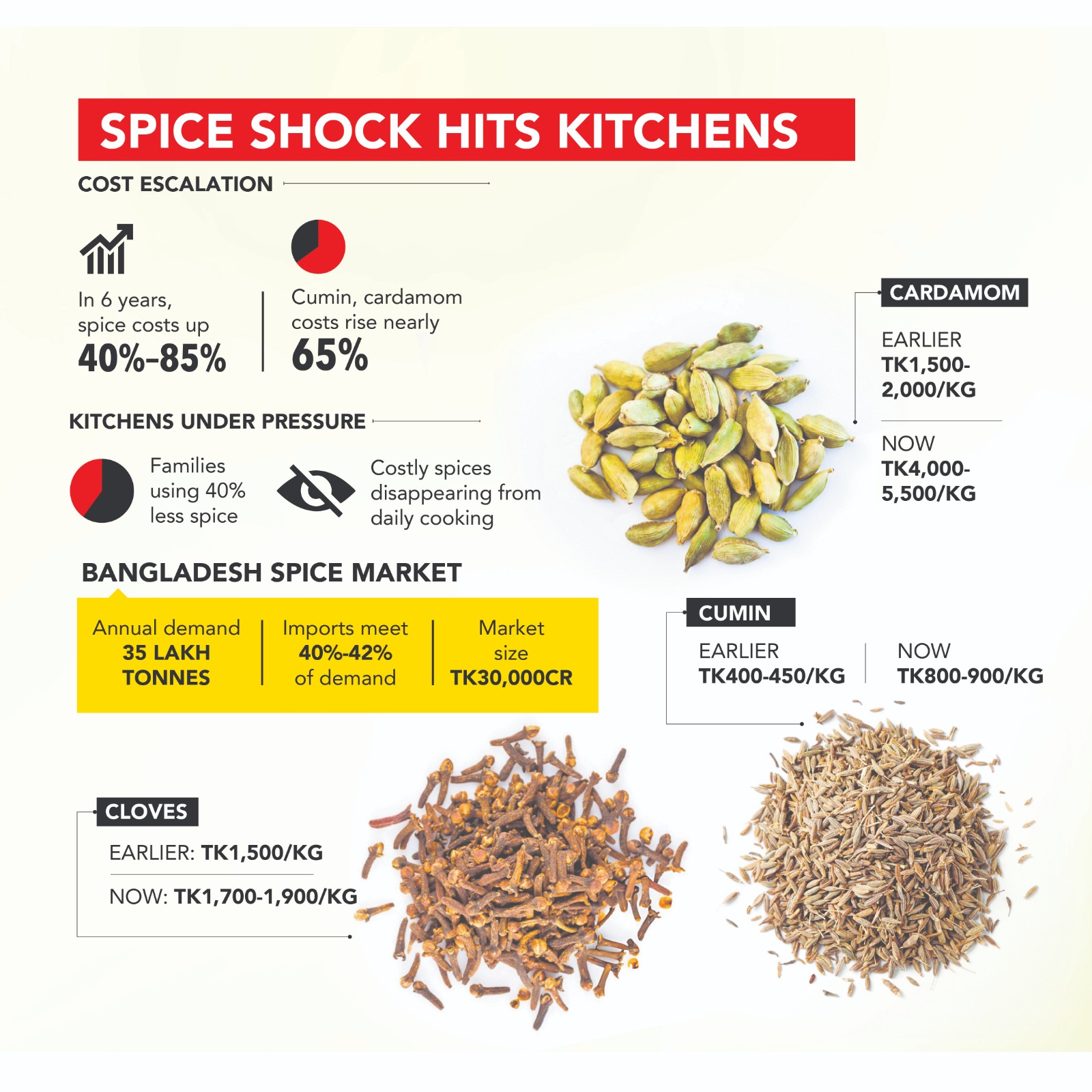
Her experience is increasingly common. Many households report using nearly 40 per cent less spice than before, a shift that not only alters the taste of traditional dishes but also adds pressure to monthly budgets already strained by broader inflation.
In Dhaka’s Mirpur, Fatema Begum’s kitchen never ran short of spices, as she once bought them in 200-gram portions. Now, squeezed by soaring prices, she asks the grocer for a Tk100 assorted mix that yields barely 50 grams.
Importers detail the price surge
On the ground in Khatunganj, Bangladesh’s largest wholesale spice hub, traders are witnessing the crisis firsthand. Mohammad Sekandar Hossain, a spice importer and proprietor of leading wholesale firm M/s Haji Ishaq Saudagar, said prices of almost all spices have witnessed an unusual surge over the past five years in both local and international markets.

According to him, prices of most spices have increased by nearly 50 to 100 per cent on average during the period.
“But cardamom has recorded the highest price hike,” he said. “Five years ago, cardamom sold for Tk1,500 to Tk2,000 per kilogram, but now the price has climbed to Tk4,000 to Tk5,500 depending on quality.”
He also noted that cumin prices have almost doubled.
“Earlier, cumin was available at Tk400 to Tk450 per kilogram. At present, it is being sold at Tk800 to Tk900 per kilogram,” he added.
Sekandar further said the price of cloves has increased from around Tk1,500 to between Tk1,700 and Tk1,900 per kilogram. Although cinnamon prices fluctuate comparatively less, they also remain significantly higher than in previous years.
He added that spices such as black pepper have also seen prices nearly double due to global production shortages and ongoing supply chain disruptions.
With Eid ul-Adha only weeks away, traders fear prices may rise further.




Import data reveals a stark paradox
An analysis of National Board of Revenue (NBR) data spanning six years exposes a striking imbalance in Bangladesh’s spice trade. While import volumes have fluctuated and recently declined sharply, the financial burden on importers — and ultimately consumers — has climbed relentlessly.
In 2021, Bangladesh imported 9,41,792 tonnes of 14 types of spices with a total value, including duties and taxes, of approximately Tk6,926 crore. The following year saw volumes rise to 10,68,754 tonnes and values climb to around Tk8,080 crore. The peak came in 2023, when imports reached 13,67,609 tonnes valued at roughly Tk13,495 crore.
The trend, however, shifted dramatically thereafter. In 2024, import volumes dropped to 9,47,799 tonnes, yet the total assessed value still increased to around Tk13,678 crore.
By 2025, imports had fallen further to just 5,73,812 tonnes, but the import value, including taxes, remained as high as Tk11,187 crore.
As of 14 May 2026, the country had already imported 1,93,706 tonnes of spices worth more than Tk4,203 crore, including customs duties.
These figures tell a clear story: despite importing less, Bangladesh is paying more.
Industry experts point to two primary drivers behind the paradox: the sharp depreciation of the taka against the US dollar and repeated increases in customs assessment values imposed by authorities.
In 2021, the dollar traded at approximately Tk85 to Tk86. Now, it has surpassed Tk120 in the local market.
At the same time, customs authorities have repeatedly raised minimum assessment values for imported spices, even when international market prices remained stable.
The combined effect has been substantial. Landed costs for spices in Bangladesh have surged by 40 to 85 per cent over the past six years, with high-value items such as cumin and cardamom seeing increases of nearly 65 per cent per tonne.
The escalating cost structure is being passed directly to consumers through higher retail prices, intensifying pressure on households and businesses already grappling with broader inflationary trends.
Restaurants feel the heat
The ripple effects extend far beyond home kitchens. Bangladesh’s vibrant restaurant industry, where spices are the backbone of dishes ranging from biryani to traditional meat curries, is under severe strain.
“Restaurant operating expenses have gone up significantly because of rising spice prices,” said Barcode Restaurant Group Managing Director Monjrul Hoque. “We have been forced to increase food prices for some items, but it is impossible to fully adjust prices according to market reality because customers are already under pressure.”
Bangladesh Restaurant Owners Association Chittagong Metropolitan Senior Vice-President Syed Abdul Hannan Babu echoed the concerns.
“The prices of cumin, edible oil, onion — everything has increased. But we cannot raise food prices proportionately. As a result, profit margins have dropped sharply.”
He noted that some establishments have raised menu prices by 10 to 15 per cent due to spice costs alone.
“A plate of biryani that sold for Tk180 last year now has to be sold for Tk200. Even after that, many restaurants are still facing losses.”
The smuggling shadow
Compounding the crisis is a thriving illicit trade. Importers in Khatunganj, Bangladesh’s largest wholesale hub, report that significant quantities of spices are entering illegally from neighbouring India. Because smuggled goods bypass customs duties and taxes, they can be sold at lower prices, undercutting legal importers.
“We are now selling cumin at a loss of more than Tk60 per kilogram,” said Chattogram Spice Importers Association President Amar Kanti Das.
“Cardamom, fennel seeds and other spices are entering through smuggling routes from India. If the government cannot stop the illegal flow, legal importers will gradually reduce imports.”
Amar Kanti warned that such a scenario could destabilise the entire spice market, creating shortages and further price volatility.
The bigger picture
According to the Bangladesh Trade and Tariff Commission (BTTC), annual spice demand in the country exceeds 3.5 million tonnes, with imports meeting 40 to 42 per cent of the requirement. The domestic spice market is valued at approximately Tk30,000 crore.
While Bangladesh cultivates around 50 types of spices, only a limited number are produced in sufficient quantities locally. Even staples such as onion, garlic, ginger and turmeric require imports to meet national demand.
There is, however, a note of cautious optimism. Department of Agricultural Extension horticulturist Md Moynul Hoque noted that Bangladesh produced 6.38 million tonnes of spices on 643,830 hectares during the 2024-25 fiscal year.
Encouragingly, the country has recently begun cultivating previously import-dependent spices such as black pepper and cinnamon, potentially reducing future reliance on volatile international markets.
What lies ahead?
For now, the spice market remains in flux. With the taka under pressure, customs policies evolving and smuggling difficult to curb, consumers and businesses alike are adapting as best they can. Some families are rediscovering local alternatives, restaurants are re-engineering recipes, and importers are calling for policy clarity.
One thing is certain: in a country where food is culture, the cost of flavour is no longer just a line item on a grocery receipt. It is a barometer of economic resilience, a test of policy effectiveness and a daily reminder of how global forces can simmer their way into the most intimate spaces — the home kitchen.
As the monsoon approaches and markets prepare for the next cycle of demand, all eyes will be on Dhaka’s policy decisions. Will stronger enforcement curb smuggling? Can local production scale up meaningfully? And most pressingly, will relief reach the millions of households that simply wish to season their meals without financial anxiety?
For now, the answer — like a perfectly balanced curry — remains a work in progress.