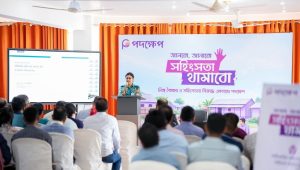
A “Sexual Harassment Response Protocol” aimed at ensuring safe working environments in Bangladesh’s media industry was launched in Dhaka on Wednesday.
Developed by BBC Media Action Bangladesh under the project “Strengthening Women Journalists Network to Tackle Sexual Harassment” with support from FCDO, the protocol was unveiled at a hotel in the capital.
Speaking at the launch, senior journalists and media personalities said institutional weaknesses in addressing sexual harassment remain a major challenge. Beyond mere policy, they stressed the need for strong institutional will to ensure effective accountability.
Matiur Rahman Chowdhury, president of NOAB and chief editor of Daily Manab Zamin, said sexual harassment has become a social epidemic. “The protocol cannot remain confined to paper; it must be discussed and implemented in every newsroom. Owners, editors, and everyone involved must take responsibility and build a social movement.”

Saiful Alam Chowdhury, faculty member at Dhaka University’s Department of Mass Communication and Journalism, said the protocol applies to the entire system. “Positive change will come if gender-friendly media houses are recognised,” he added.
Mir Masrur Zaman Rony, Channel i’s chief news editor, said the protocol is an important milestone but must be incorporated into HR policies. “In many cases, the perpetrator remains while the victim loses their job – this culture must change,” he said.



Nazrul Islam Mithu, president of OCAB (Overseas Correspondents Association Bangladesh), noted that while laws exist, implementation gaps remain. “Such guidelines will bring change through effective practice,” he said.
Shararat Islam, communications analyst at UN Women Bangladesh, called the protocol a simple and effective document. “Implementation is the key challenge. If major media houses take the lead, others will be encouraged to follow,” she said.
BBC Media Action Country Director Md Al Mamun said women journalists make up less than 10 percent of the media workforce. “Without a safe environment, achieving this balance is not possible. The protocol will serve as a framework for accountability for owners and management,” he said.
Arafat Siddique, presenting the protocol, said it aims to establish zero tolerance, raise awareness, clarify disciplinary provisions, and build an effective protection network.
Citing a recent survey, he said 15 percent of media workers in Bangladesh have directly experienced workplace sexual harassment. The survey found 51 percent of women and 8 percent of men reported verbal harassment, while 21 percent of women and 4 percent of men reported physical harassment. Seven women and two men reported being raped.
Participants collectively pledged to implement the protocol in media organisations. Women Journalists Network Bangladesh Coordinator Angur Nahar Monty, who moderated the event, said the protocol aims to ensure safety for both women and men.