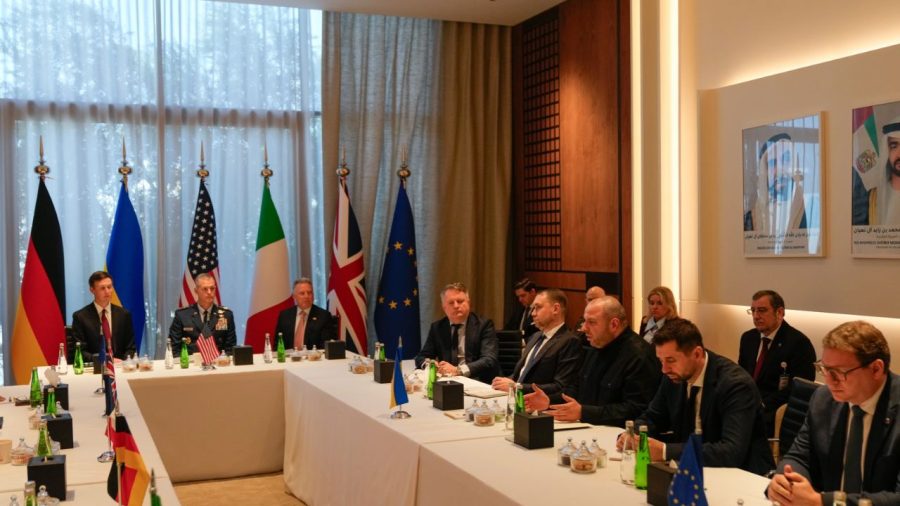



Russian, Ukrainian and US officials began a second day of US-brokered peace talks in Abu Dhabi on Wednesday, the first meeting between Moscow and Kyiv in nine months, with hopes low of a breakthrough in the war launched by Russia’s full-scale invasion nearly five years ago, reports AP.
Mediated by US President Donald Trump’s son-in-law Jared Kushner and envoy Steve Witkoff, the talks are being held in the United Arab Emirates, chosen as a neutral venue.
The delegations met for four hours on Tuesday and are due to wrap up later on Wednesday.
Rustem Umerov, head of Ukraine’s Foreign Intelligence Service and Kyiv’s lead negotiator, said on social media that the day would open with three-way talks involving Russia, Ukraine and the United States, followed by a separate meeting between the Ukrainian delegation and European partners.
Moscow does not want European countries, worried about Russia’s conduct and wider intentions on the continent, involved in direct negotiations.
Representatives of European governments, the European Union and NATO are nonetheless in Abu Dhabi, consulting the Ukrainian delegation, officials said.

The Kremlin said its delegation had had no contact with them and none was planned. Spokesman Dmitry Peskov added that President Vladimir Putin was being briefed constantly.
The negotiators gave no details after Tuesday’s session.
Ukrainian President Volodymyr Zelensky, who like Putin is not attending, called it “constructive and quite substantive”, saying it largely covered humanitarian issues, including possible prisoner exchanges and the return of Ukrainian civilians in captivity and of children taken from the country.
Security guarantees were also discussed, he said.



US Secretary of State Marco Rubio called the meeting “very productive” but cautioned that a breakthrough would take time.
There is still no sign of major compromise.
Russian forces control about a fifth of Ukraine, but territory is not the only sticking point: both sides want security guarantees, while Moscow demands that Ukraine adopt neutral status and stay out of NATO.
There is no public sign that Putin will drop his demand that Ukraine surrender the entire eastern region of Donbas before a deal can be struck, and Zelensky has repeatedly refused to hand over land that Ukrainian troops have died defending.
Trump has piled pressure on Kyiv, saying it is time for Ukraine to end the war or face “a very bad thing”.
Last week he said the war was close to being settled in a “big beautiful agreement”, though he has often predicted breakthroughs that have not materialised.
The context has shifted since the last meeting, in Geneva in February.
Russia’s wartime economy is under heavy strain and Ukraine is reeling from devastating aerial attacks on its power grid.
The Trump administration must also reckon with Democrats, who could demand more support for Kyiv, taking over Congress in January after the US midterm elections.

The renewed US push has galvanised European officials into seeking a place at the table.
Russian Foreign Minister Sergei Lavrov said Moscow prefers to negotiate a broad European security framework first, while European Commission President Ursula von der Leyen said such talks should follow a ceasefire, which Lavrov rejected as an attempt to give Ukraine breathing space.
Fighting continues, although little territory has changed hands this year.
Overnight, Russia struck the southern Zaporizhzhia region and the eastern city of Kharkiv, wounding seven civilians, and Ukraine’s prime minister, Sergii Koretskyi, said six large electricity substations were hit in four central regions.
Russia’s Defence Ministry said it downed 627 Ukrainian drones, 150 of them over the St Petersburg region.
Regional governor Alexander Drozdenko said the drones started a fire at the Ust-Luga oil export port, injuring three workers.
Drone debris killed two people in Smolensk region, TASS reported, and Moscow said it struck a cargo vessel carrying weapons southwest of Odesa. The reports could not be independently verified.