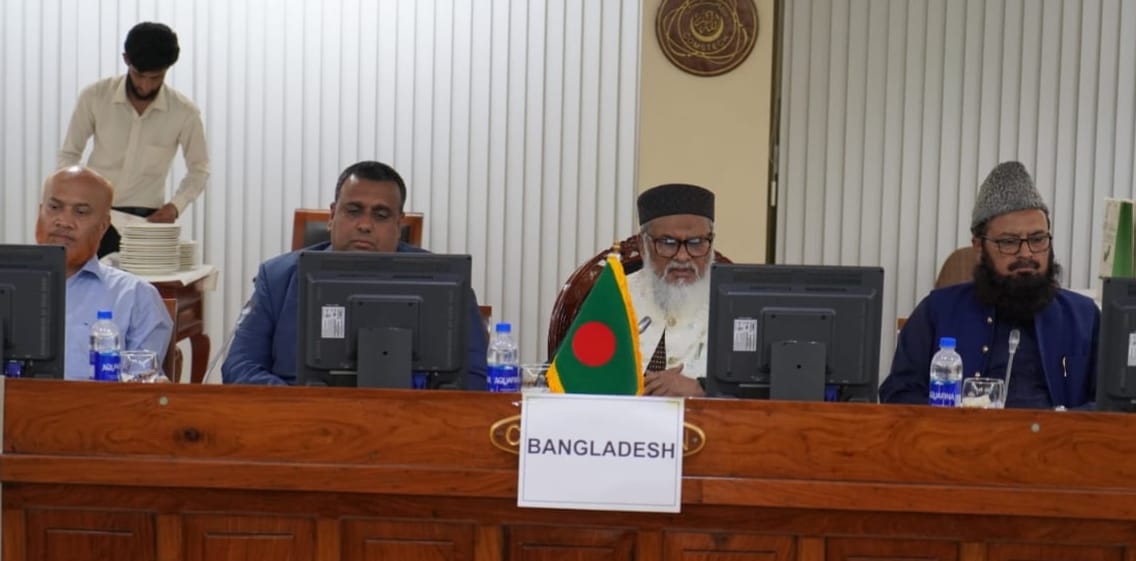

Religious Affairs Adviser Dr AFM Khalid Hossain has requested the Organisation of Islamic Cooperation (OIC) to support the halal certification process in Bangladesh.
Dr Khalid made the request following a visit to the Standing Committee on Scientific and Technological Cooperation (COMSTECH) Centre in Islamabad, Pakistan, on Thursday, September 11, 2025, where he engaged in a discussion with officials, according to a press release from the ministry.
The Islamic Foundation in Bangladesh is already working on halal certification and has sought the cooperation of relevant authorities from Turkey and Saudi Arabia in this regard.

Dr Khalid proposed that, under the OIC’s supervision and with COMSTECH’s technical assistance, Bangladesh’s halal certification staff be provided capacity-building support.
He also expressed his approval for the establishment of a halal institute in Uganda, with COMSTECH’s help.




Dr Khalid lauded COMSTECH’s role in advancing science, technology, artificial intelligence, the environment, climate change, and poverty reduction within the Muslim world, especially under the OIC’s Permanent Committee at the ministerial level.
He thanked COMSTECH for granting 100 scholarships to Bangladeshi students for studies at Lahore University, stating that this initiative will open opportunities for Bangladesh’s talented students to pursue higher education in Pakistan.
He also emphasized the need to extend similar opportunities to madrasa students, enabling them to contribute to various fields like medicine, engineering, and technology.
While discussing the importance of unity among the Muslim Ummah, Khalid said, “For the greater interest of the Muslim Ummah, we must unite under the banner of Islam, following the guidance of the Qur’an and Hadith. Without unity in diversity, we cannot progress.”
The annual global market for halal products is estimated to have surpassed $3 trillion already and is projected to reach nearly $10 trillion in a decade.
Bangladesh, with its large Muslim population, has the potential to grow as both a halal market and an exporter, according to marketers.