





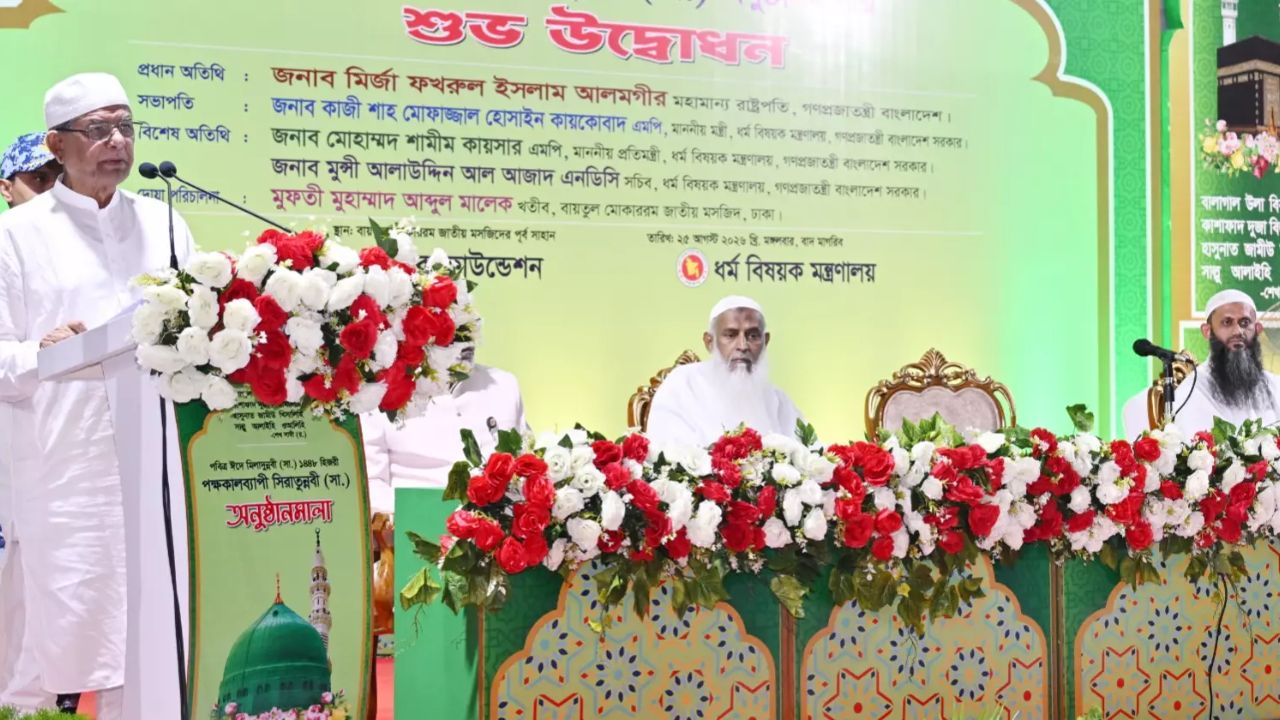
President Mirza Fakhrul Islam Alamgir has called upon the nation to follow the life and teachings of Prophet Hazrat Muhammad (PBUH) to build a peaceful, just, and prosperous Bangladesh.
Speaking on Tuesday evening at the inauguration of a fortnight-long Sirat-un-Nabi (PBUH) programme organised by the Islamic Foundation at Baitul Mukarram National Mosque, the president urged the public to spread Islam’s message of peace and humanity instead of division and discrimination in the name of religion.
The event was held on the occasion of Eid-e-Miladunnabi, marking the birth and demise anniversary of Hazrat Muhammad (PBUH).
The president conveyed his greetings to the people of Bangladesh and Muslims worldwide, describing Eid-e-Miladunnabi as a sacred and glorious occasion. He highlighted that the Prophet’s character embodied truthfulness, justice, forgiveness, patience, humanity, and profound compassion.
He further noted that the Prophet (PBUH) provided clear guidance on the rights of women, children, neighbours, and working people, teaching that no individual should be looked down upon because of their religion, race, tribe, language, region, or social status.
According to the President, establishing human dignity and building a society based on justice and fairness were among the Prophet’s foremost teachings. He emphasised that these teachings remain highly relevant today to overcome spreading global challenges such as hatred, conflict, intolerance, discrimination, extremism, falsehood, and moral degradation.
The president also highlighted the teachings of the Farewell Hajj sermon on human dignity, equality, brotherhood, justice, and mutual rights, stating they remain deeply relevant to humanity.
Pointing to Bangladesh’s long tradition of communal harmony and religious coexistence, the president remarked that the social system and peaceful coexistence established by the Prophet (PBUH) with followers of other faiths are worthy of emulation in national life.
He expressed his hope that Bangladesh would become a country where people of all faiths can practise their religions freely and live safe and dignified lives, with justice, equality, human dignity, and mutual goodwill forming the foundation of the state and society.
Addressing religious leaders, including ulema, scholars, pirs, and mashayekh, the president stressed their important responsibility in promoting truth, justice, honesty, brotherhood, and humanity. He urged them to play a stronger role in eliminating corruption, drugs, terrorism, communal hatred, rumours, violence, violence against women and children, and intolerance from society.
He expressed hope that by highlighting the true teachings of Islam, they would inspire the younger generation to embrace morality, patriotism, and human values.
The president also called for national unity to ensure that authoritarianism, fascism, and injustice never return to the country. He urged citizens to remain united in protecting democracy, justice, good governance, and fundamental rights.
Highlighting the present government’s commitment to the welfare of religious leaders, he noted that monthly honorariums have already been introduced for imams, muezzins, and khadims, with work underway to extend similar support to service providers at other places of worship.
He expressed hope that all mosques and other places of worship across the country would be brought under this monthly honorarium scheme before 2030.
Praising the Islamic Foundation for its long-standing role in religious education, Islamic culture, research, publications, and mosque-based activities, the president expressed hope that the Sirat-un-Nabi programme would successfully spread the message of peace, harmony, and human welfare.
He formally declared the programme open, wishing all its activities success, and prayed that Almighty Allah grants the ability to follow the life and ideals of the Prophet (PBUH). The inauguration was attended by Religious Affairs Minister Kazi Shah Mofazzal Houssain (Kaikobad), State Minister Mohammad Shamim Kaiser, senior ministry and Islamic Foundation officials, the Khatib of Baitul Mukarram National Mosque, distinguished ulema, and invited guests.


