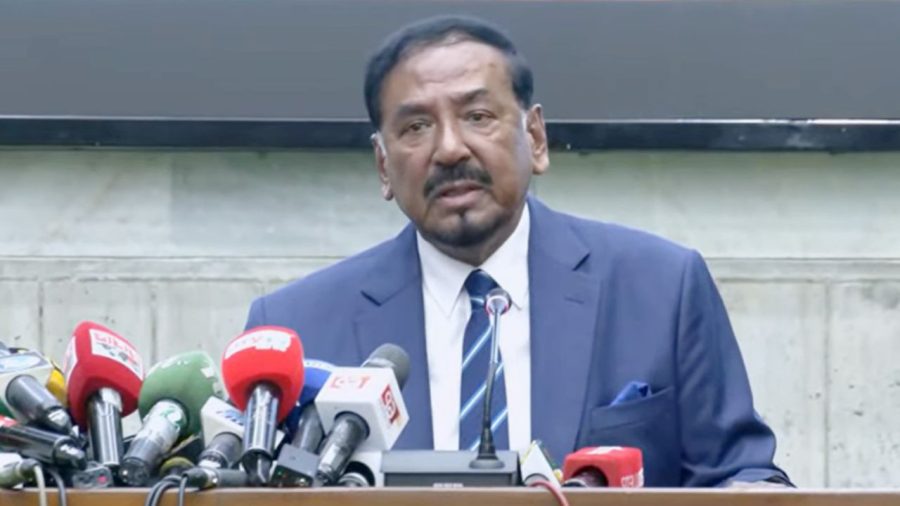



Speaker Hafiz Uddin Ahmed has expressed regret that people become important to politicians during elections, but receive far less attention at other times.
He made the remarks on Thursday at a publication ceremony in the capital for a parliamentary caucus representing underprivileged communities.
He observed that politicians do not always demonstrate interest in or responsibility towards disadvantaged citizens.
Many elected representatives become preoccupied with their own privileges after winning elections, even as millions of people across the country continue to face various forms of deprivation, he said.
Describing politicians as the most influential actors in the country, the Speaker said they could either stand beside the people or misuse their power to harm them. Positive political reform was therefore essential, he added.

Identifying corruption as one of the country’s biggest challenges, the Speaker said the caucus must speak out against it to protect the rights of underprivileged communities. He urged its members to disclose allegations of corruption regardless of political affiliation or official position.
He described the formation of the caucus as a promising initiative, saying it was the first parliamentary platform comprising MPs from different political parties to work towards protecting the rights of underprivileged people. Visible social change would be possible if its members worked sincerely, he added.
Addressing the event, Chief Whip Nurul Islam Moni said the government aimed to work for the advancement of disadvantaged communities. He said various initiatives were being implemented for farmers, working people and women, while efforts were under way to expand opportunities through support for farmers, family cards and health cards.
The event was informed that 3.5 crore people in Bangladesh currently live below the poverty line.



Debapriya Bhattacharya, convenor of Citizen’s Platform for SDGs, Bangladesh and distinguished fellow of the Centre for Policy Dialogue (CPD), said the situation was particularly severe for one crore of those people. Nearly two crore others lived in such precarious conditions that missing just two days of work could push them back below the poverty line, he added.
Despite Bangladesh’s economic progress, corresponding changes had not taken place in the social and political spheres, leaving significant economic inequality that needed to be addressed, he said.
Bhattacharya also said one in every four young people in the country, and one in every three educated young people, was unemployed.
Chairing the event, AM Mahbub Uddin Khokon, head of the caucus and BNP MP, said the goal of developing underprivileged communities could not be achieved without tackling corruption.
If everyone refrained from corruption, at least 40 per cent of national resources could be saved from wastage, he added.
MP Sabikunnahar said disadvantaged groups continued to lag behind despite the country’s overall development. She called for a slogan that would ensure no one was left behind.

MP Madhabi Marma highlighted the daily struggle for survival among people in the hill regions and their lack of access to civic services.
Responding to her remarks, Bhattacharya said the crisis in the hills was no longer merely a regional issue but a national problem requiring a national solution.
Jamaat MP Saiful Alam Khan Milon proposed setting a uniform benchmark based on fundamental rights, including healthcare, education, food and housing, to identify underprivileged people instead of relying on area-based lists.
During an open discussion, Zahid Kabir, a representative of Youth for Change, said marginalised people were often deprived of government services and faced difficulties accessing upazila executive officers and deputy commissioners.
Ramisa, representing the hijra community, said members of her community faced insecurity and remained disadvantaged in employment and healthcare.
Another rights activist raised allegations of false land cases against people in the hill regions and called for prompt government intervention.