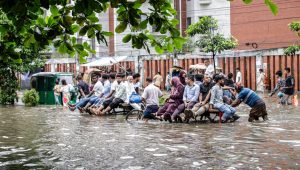
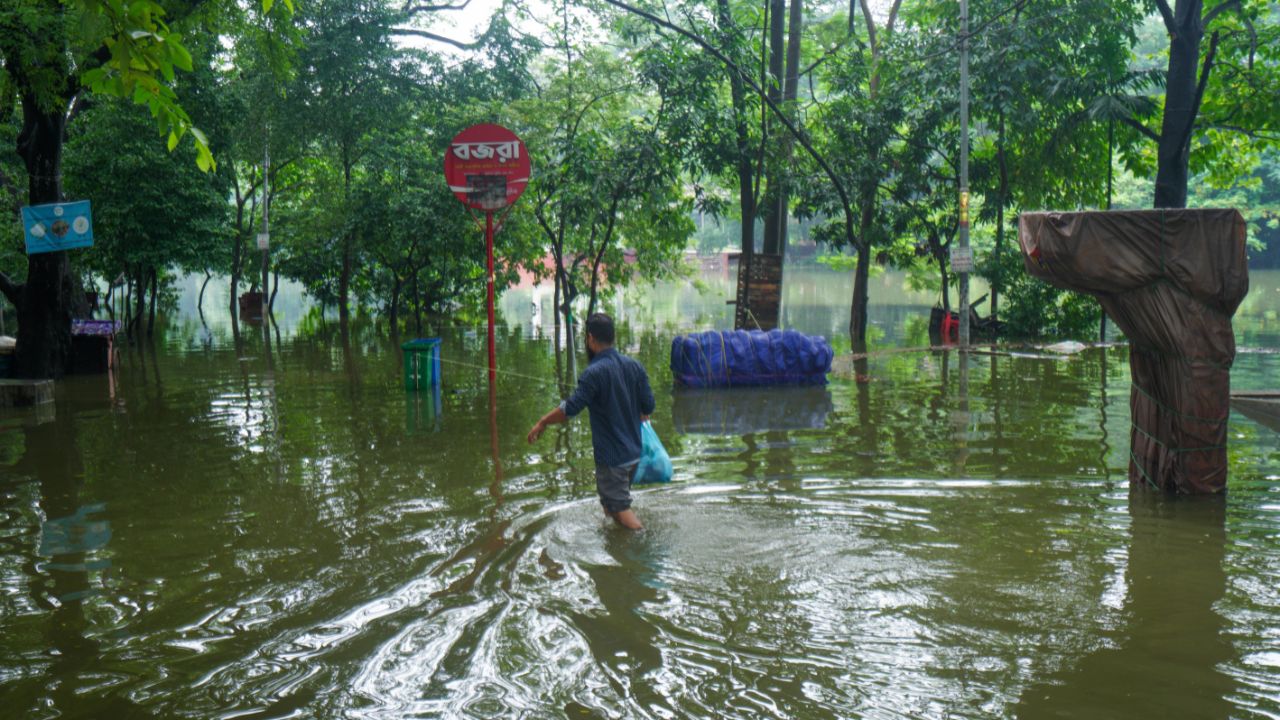

For the working-class people of Dhaka, for whom the monsoon rains bring no comfort or romantic luxury, life has been rendered utterly unbearable by a continuous week of relentless downpour.
A bleak uncertainty now grips their lives, with many homes completely submerged, going to work has become an impossibility. Some find their shops shuttered, while those who do venture out into the deluge are often forced to return home prematurely, failing to recover even their basic operating costs.
It is not merely the working class and small-scale traders who are suffering; the sales figures at big shopping complexes also reflect a dire situation. Dhaka New Market has remained closed for two consecutive days due to severe waterlogging.
Rafzan Jani Talash, the owner of a mobile phone repair shop at Bashundhara City Shopping Mall, told TIMES of Bangladesh, “The number of customers has plummeted. You could say it is now down to just a quarter of the usual volume.”
A slump in trade
Overall, the damp and persistent weather has brought a significant slump to trade and commerce. However, the situation is significantly worse for those who depend entirely on their daily earnings for survival.
When income ceases, these individuals are forced to take out loans or exhaust their meagre savings just to eat. Some footpath vendors find it impossible to open their stalls at all, and even when they manage to do so, sales remain poor.
The crisis is particularly acute for those dealing in perishable goods. Their products have rotted in the damp, resulting in heavy losses instead of income. Afenu Begum is currently waiting for the rain, which began last Sunday, to finally subside.

Her entire household relies on her selling roti, fried eggs, and vegetables on the footpath of Karwan Bazar. She typically managed her family’s needs on a daily income of Tk500 to Tk600, but the continuous rain has completely blocked that modest source of livelihood.
She has been unable to open her shop for more than seven days.
Footpath vendors’ survival at stake
The sense of despair is palpable amongst the footpath vendors. Md Manik, who has been selling singara and puri near Janata Bank in Karwan Bazar for approximately three years, normally earns between Tk1,000 and Tk1,200 daily.
However, for the past seven days, his business has been almost entirely non-existent. He told TIMES, “If it rains all day, how can I fry singara and puri? The oil, the stove – everything gets wet. I opened the shop on Monday, but I still cannot decide whether to start frying in full swing.”
This week, he has been forced to keep his stall closed for many days.




A similar situation is faced by mobile fruit seller Shamim Hossain, who maintains his family by selling dragon fruit from a van. In normal times, he sells fruit worth Tk3,000 to Tk5,000 daily, but with the lack of customers due to the rain, his sales have dropped by half.
Munna Mia, a tea seller of five years whose shop is frequented by everyone from journalists to corporate employees, noted, “Previously, daily sales were Tk9,000 to Tk10,000. Now it has fallen to half”. Another tea seller, Nure Alam, provided an identical account of the decline.
The losses extend to those like banana seller Abdur Rashid, who bought a large stock of bananas from a truck a few days ago. With no customers appearing in the rain, the majority of his stock has rotted.
He lamented, “I had to throw some bananas away, and I gave some to people for free.”
Meanwhile, Arif, who sells electrical products like multiplugs and chargers, has seen his daily profit of Tk500 to Tk2,000 vanish. Unable to open his shop, he is now forced to dip into his savings.
Mohammad Abu Taher, a resident of Kishoreganj who sells chanachur in the capital, said, “I have seen such water in Kishoreganj. But now the situation is the same in Dhaka.”
Misery in the marooned slums
In the Korail slum, located right next to the elite Gulshan area, a different world exists where life for hundreds of families has been at a standstill for a week due to waterlogging. With knee-to-waist-deep water inside their homes, stoves cannot be lit, leaving no opportunity to even cook, let alone go out for work.
Fatema Begum, living with a five-member family, is struggling as her youngest daughter, Tania, has suffered from a fever and cough for several days.
Though doctors advised keeping the child away from dampness, their entire room is submerged. Fatema said, “Yesterday (Sunday) was the hardest. The water rose to the bed… How can we sleep on a wet bed?”
For the rickshaw pullers, small grocers, and day labourers who make up the bulk of the slum’s population, the halt in income has made buying food and medicine a source of great anxiety.
Many have also seen their tools and equipment ruined by the flooding. Battery-run rickshaw driver Delowar Hossain explained that water entered his garage and ruined his battery. “Now there is no way to fix it,” he said.
“If I do not go to work, there is no income; and without income, the household cannot run.”
Most households are in no condition to cook and are surviving on dry foods like chira (flattened rice) and muri (puffed rice).
The suffering is greatest for those in low-lying areas near the canal, with many forced to seek shelter in the overcrowded homes of relatives. Jamena Begum confirmed, “In terms of food, we are spending our days eating chira and muri. There is no way to cook.”
Residents complain that canal water levels are not receding and drainage paths are blocked. Some families are spending their own limited money to rent motors to pump out water.
Sattar Hossain, who hired a motor out of desperation, said, “We have no one to turn to. Two or three days ago, some leaders came and took photos… after that, no one else came.”
These families are now demanding emergency food, potable water, and long-term initiatives to solve the city’s waterlogging.