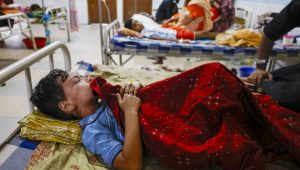
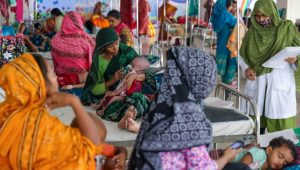
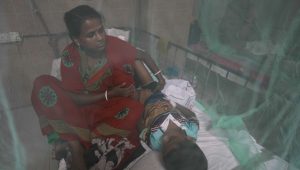
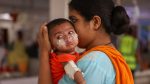
A two-year-old girl lies struggling to breathe on a thin mat spread across the floor of a crowded corridor of Infectious Diseases Hospital in Mohakhali, Dhaka, as her mother waits anxiously beside her.
Raisha Moni was brought to the capital from Bhola four days ago after contracting measles, joining a growing number of children admitted to the hospital, where patient numbers now far exceed capacity.
Raisha, weighing about 10 kilograms, has been suffering from fever, vomiting, rashes and respiratory symptoms for more than two weeks.
Her mother, Rahima Begum, says basic treatment was delayed.
“Doctors said she needed saline when we arrived, but we did not get it immediately,” she said. “After repeated requests, it was finally given.”
Hospital staff say the pressure is mounting.
A nurse working in the ICU, Mahmuda, said the 100-bed hospital is currently accommodating between 143 and 150 patients.
“With this level of overcrowding, it is becoming increasingly difficult to maintain treatment. It is a constant fight between life and death,” she said.

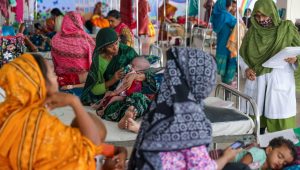
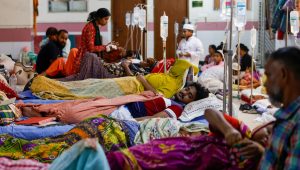
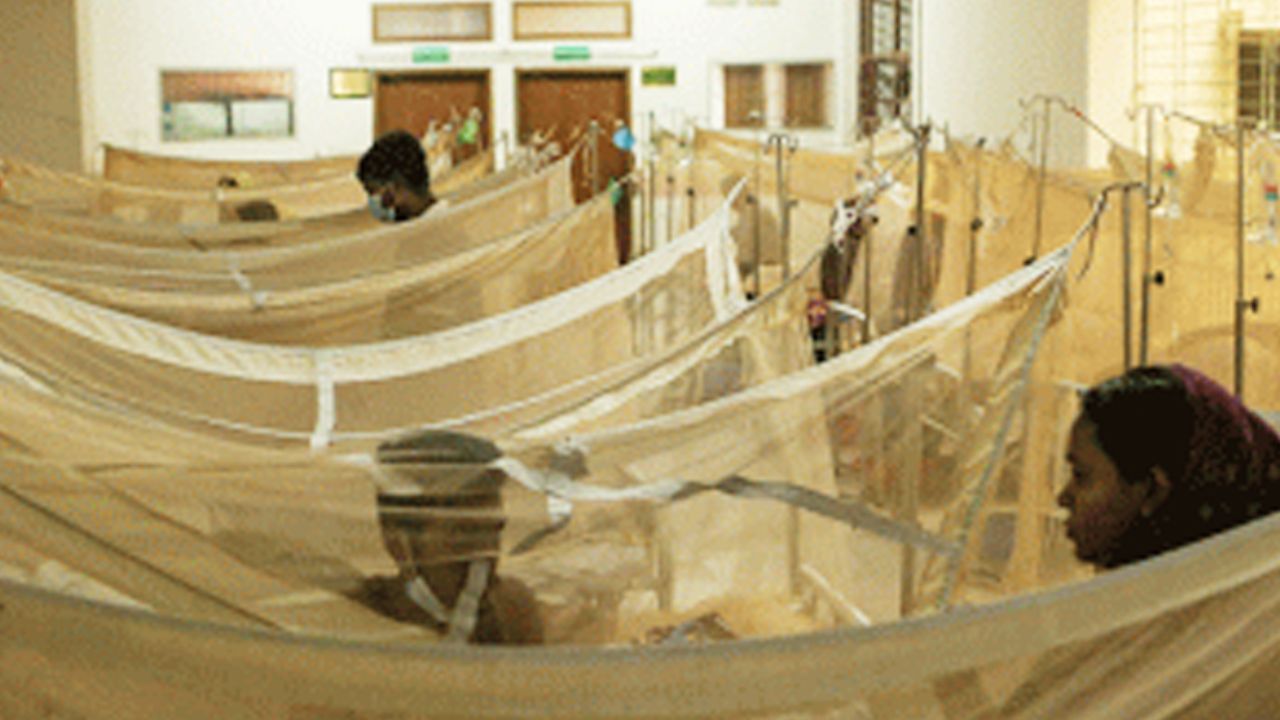
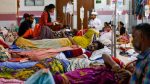
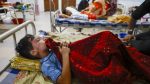
Inside the ward, patients spill into corridors, with mothers and children lying on the floor due to a shortage of beds. Health workers say the sudden spike in measles infections has overwhelmed the facility, which is struggling to cope with limited intensive care units (ICUs).
Raisha’s father, Akhtar Hossain, says he has been unable to secure an ICU bed for his daughter.
“The doctors told us to find an empty ICU first, then they would refer her,” he said, visibly shaken. “Two children died in the ICU just yesterday.”
Official data highlights the scale of the surge. The hospital admitted just 69 measles patients over the entire previous year. By mid-March this year, that number had already risen to 255.
Health authorities say the outbreak is no longer confined to the capital.
Dr Md Halimur Rashid, director of the Disease Control Division at the Directorate General of Health Services, said Dhaka remains the epicentre, but cases are also increasing in Rajshahi and Mymensingh, with infections rising steadily since January.
Experts warn that the resurgence marks a setback for Bangladesh, which had previously made significant progress in controlling the disease.
According to the World Health Organization’s 2025 fact sheet, measles is highly contagious and spreads through respiratory droplets. An infected person can transmit the virus to between 12 and 18 others, from four days before symptoms appear to four days after.
Regional immunisation data from WHO shows that Bangladesh recorded 5,098 measles cases in 2000. Children in the country are typically given the first dose of the measles-rubella vaccine at nine months and a second dose at 15 months.
Health specialists say maintaining vaccination coverage and strengthening hospital capacity will be critical to containing the current outbreak.
Hospital overwhelmed
Inside the hospital, the scale of the crisis is immediately visible, with patients lining corridors and floors as demand for care far exceeds capacity.
Monir Hossain, from Shahpur in Sirajganj, has been fighting to secure treatment for his one-year-old son Ramim, who suffers from a congenital heart condition. After days of searching, he was finally admitted to intensive care on 25 March and remains in critical condition.
A similar story unfolds for Mohammad Rabbani, who travelled from Demra with his four-month-old son Mehrab. They first sought treatment at Mugda Medical College Hospital before being referred here as the child’s condition worsened. With no beds available, they now lie on the floor.
“Neither the measles nor the breathing difficulties are improving,” the father said. “They have only told us to give oxygen. One problem follows another.”
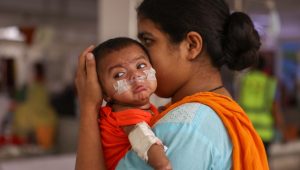
Near a staircase, 10-month-old Inaya lies on a mat in her grandmother’s lap, her skin marked by measles rashes. The child was brought from Bauphal in Patuakhali and admitted on 24 March. Relatives intermittently administer oxygen as she struggles.
“She neither sleeps nor eats and cries all night,” her grandmother, Mosammat Akhter, said.
Although she was initially placed on a bed, she was later moved to the floor due to overcrowding, before being returned to a bed when oxygen support became necessary. Family members also complain of irregular doctor visits, saying care is inconsistent.
In one ward designated for diseases including chickenpox, rabies and viral hepatitis, at least 50 patients are admitted. Three rooms contain just 15 beds in total, with the majority of patients forced to lie on mats or cloths spread across the floor.
Doctors and nurses say they are working under intense pressure to manage the surge.
The hospital currently has 21 doctors and around 60 nurses, who must also vaccinate roughly 1,500 outpatients each day.
“We are struggling to cope with the influx of measles patients,” said Dr Tanzina Jahan, a junior consultant in the ICU. “A patient arrived recently with oxygen saturation at 50 per cent. We are doing everything we can to save lives.”
Paediatric specialist Dr ARM Sakhawat Hossain Khan said staff are working from morning until late at night.
“About 20 new patients arrived this morning alone,” he said. “With limited capacity, we are prioritising severe cases for beds, while less critical patients are being managed on the floor.”
Authorities say some measures have been taken to ease the strain.
On 17 March, the health ministry announced that the hospital’s ICU, which was previously closed, had been made operational within 24 hours. The five-bed unit now has three doctors, a junior consultant and an anaesthetist.
Mahmudul Hasan, a public relations officer at the health ministry, said two dedicated wards for measles patients have also been opened at the Dhaka North City Corporation’s Covid-19 hospital, particularly for children over the age of two.
He added that efforts are under way to import vaccines from abroad, while other hospitals are being prepared to expand ICU and ward capacity.