Romana Akter heard the rain begin and ran. Her cattle were grazing in the field beside her home in Rampur of Companiganj upazila in Noakhali. She rushed out, reached the animals, and was struck by lightning on the way back. She died where she fell.
The same summer afternoon, Manik Mia left his home in Deluabari village in Gaibandha’s Fulchari upazila when he saw the sky darkening. He went to retrieve his horse from the fields. He too was struck and died on the spot.
They lived about 450 kilometres apart but died in a similar manner on 4 May.
Sixty-year-old Rabban Ali is the latest victim of lightning. A resident of Mulgram village in Chatmohar upazila of Pabna, Ali was working in his jute field when nor’westers began on Wednesday afternoon. He was rushing home but died in a lightning strike on the way.
This string of deaths across Bangladesh coincides with a marked increase in lightning strikes across the country since the beginning of the summer.
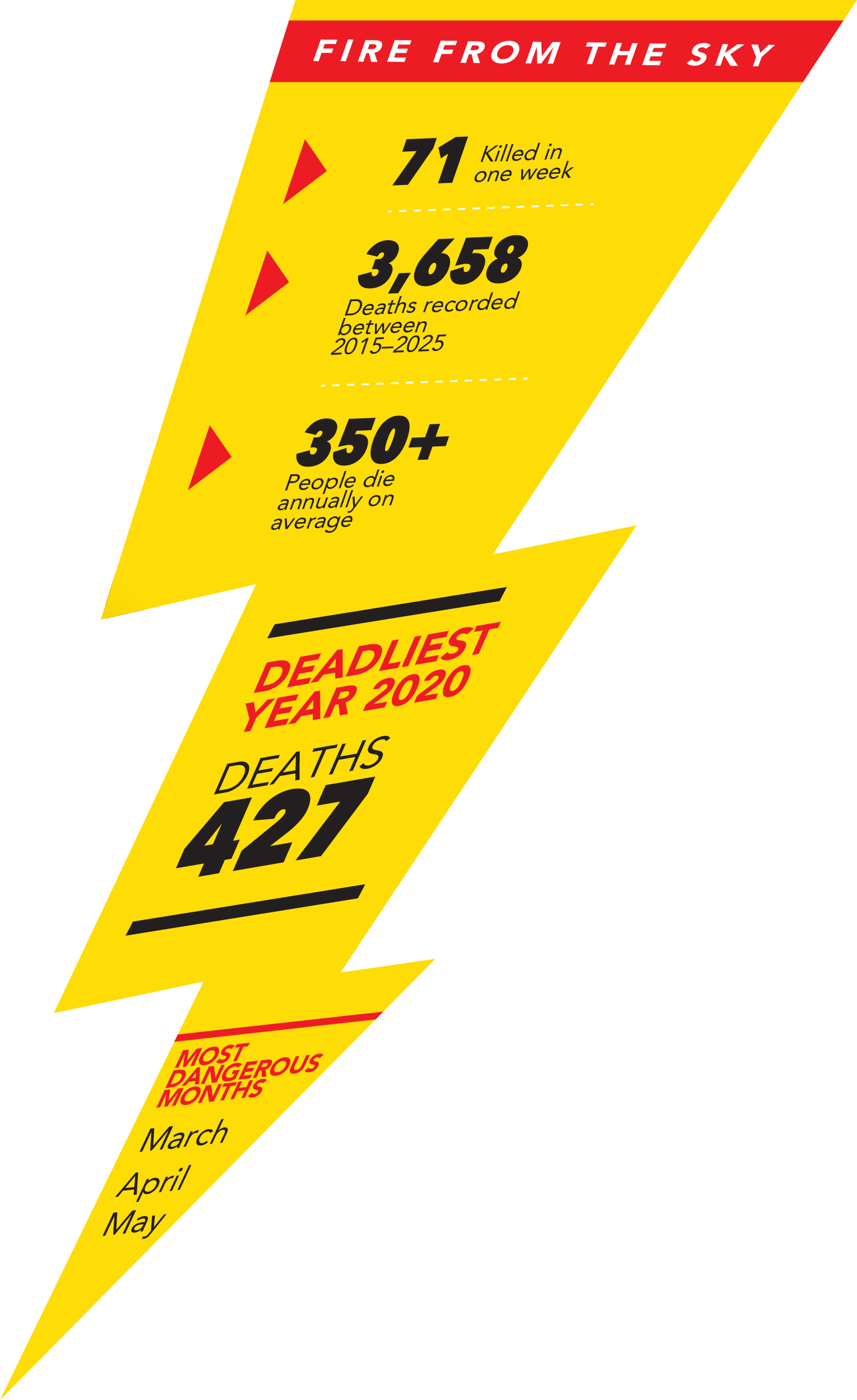
In just one week between late April and early May, at least 71 people were killed by lightning strikes across the country. The total death toll from lightning this year has already surpassed 83, according to media reports. Most victims were farmers and rural residents caught in open fields during storms.
Officials say the actual death toll is likely higher, as many fatalities in remote areas go unreported.

The Meteorological Department records more than 350 lightning fatalities every year. Between 2015 and 2025, a total of 3,658 deaths were officially logged.
In 2015, the government declared lightning a national disaster and announced a package of countermeasures. The deaths have not stopped.
The deadliest year on record was 2020, when 427 people were killed. By 2025, the annual toll had fallen to 173 – but the numbers are rising again.
As climate patterns shift, the frequency and intensity of lightning strikes are increasing, with experts pointing to a range of factors including rising temperatures and unpredictable weather events.
“A one-degree increase in temperature can significantly raise the intensity of lightning strikes. Weather phenomena like El Niño and La Niña, rising sea temperatures, and sudden heavy rainfall are all contributing to the rise in lightning incidents,” Abu Daud Md Gulam Mustafa, joint secretary of the Ministry of Disaster Management and Relief, told TIMES of Bangladesh.




March, April, and May are typically the months with the highest number of thunderstorms in the country, with the Sylhet region – particularly Sunamganj – being the most affected. Sunamganj’s Jamalganj upazila has been identified as the most vulnerable area, with the highest fatalities in the past decade. Between March and May, more than 25 lightning strikes occur per square kilometre in Sunamganj.
Gulam Mustafa explained that the intense lightning strikes in this region are primarily due to the friction of layered clouds in the Khasi Hills and Meghalaya areas of India. The interaction between hot and cold air in a moisture-laden environment causes these strikes.
In the current month alone, 12 lives have been lost to lightning strikes in Sunamganj. On a single day, five farmers and labourers died while harvesting rice and grazing ducks in various haor areas.
In response to this growing threat, 18 lightning arresters were installed in six upazilas of Sunamganj in 2022, costing over Tk1 crore. However, these measures proven ineffective in preventing lightning strikes.
In 2018, palm trees were planted in the haor areas to reduce lightning risks, but these trees no longer exist.
Disaster management expert Gauhar Naeem Wara, speaking to TIMES, said, “The areas where these devices have been installed are not frequented by farmers. They are generally placed in spots where the administration can monitor them and take photos.”
“There was no consultation with villagers about where these installations should be placed.”
He urges for more effective measures and better community involvement in efforts to reduce fatalities.
Lightning arresters, designed to reduce the impact of lightning strikes, are generally effective within a radius of around 100 meters or 300 feet. However, experts say installing these devices across the vast, open haor areas is not practical due to the sheer size of the land involved.
Joint Secretary Gulam Mustafa said, “During the monsoon season, water levels in the haors can rise up to 20 to 30 feet, making it difficult to construct and maintain permanent infrastructure.”
The cost of installing a single lightning arrester is around Tk7 lakh, while placing one with a shelter can cost anywhere between Tk15 to Tk20 lakh. Due to these high costs, current plans focus on placing these devices in more accessible locations, such as rural markets.
So far, around 400 such installations have been completed across 15 districts, said Gulam Mustafa.
The limited number of lightning arrester devices in many districts has rendered them ineffective in protecting residents from lightning strikes.
Mohammad Shariful Islam, Relief and Rehabilitation Officer in Gaibandha, said, “We have requested the relevant departments for the necessary funds to repair the non-functioning devices and install new ones as quickly as possible.”
Rafiqul Islam, an official at the Noakhali Meteorological Office, said the district currently has just two lightning arresters – one at the Noakhali Meteorological Office and another at the Hatia Upazila Office.
The growing threat of lightning strikes has sparked discussions in the parliament, with lawmakers highlighting the urgent need for effective measures to protect farmers and rural communities.
Asadul Habib Dulu, the minister of Disaster Management and Relief, recently told media, “Next year, we will build shelters, especially for farmers working in the fields during the harvest season, so they can take refuge in times of danger.”
However, disaster management expert Gauhar Naeem Wara highlighted a critical concern. “In the past, trees like babla and date palms naturally provided protection against lightning. But now, these trees are being cut down and sold, leaving farmers exposed in open fields where the risk of lightning strikes is significantly higher.”
Wara also emphasised the need for continuous research on lightning strike prevention and better response protocols for medical treatment.