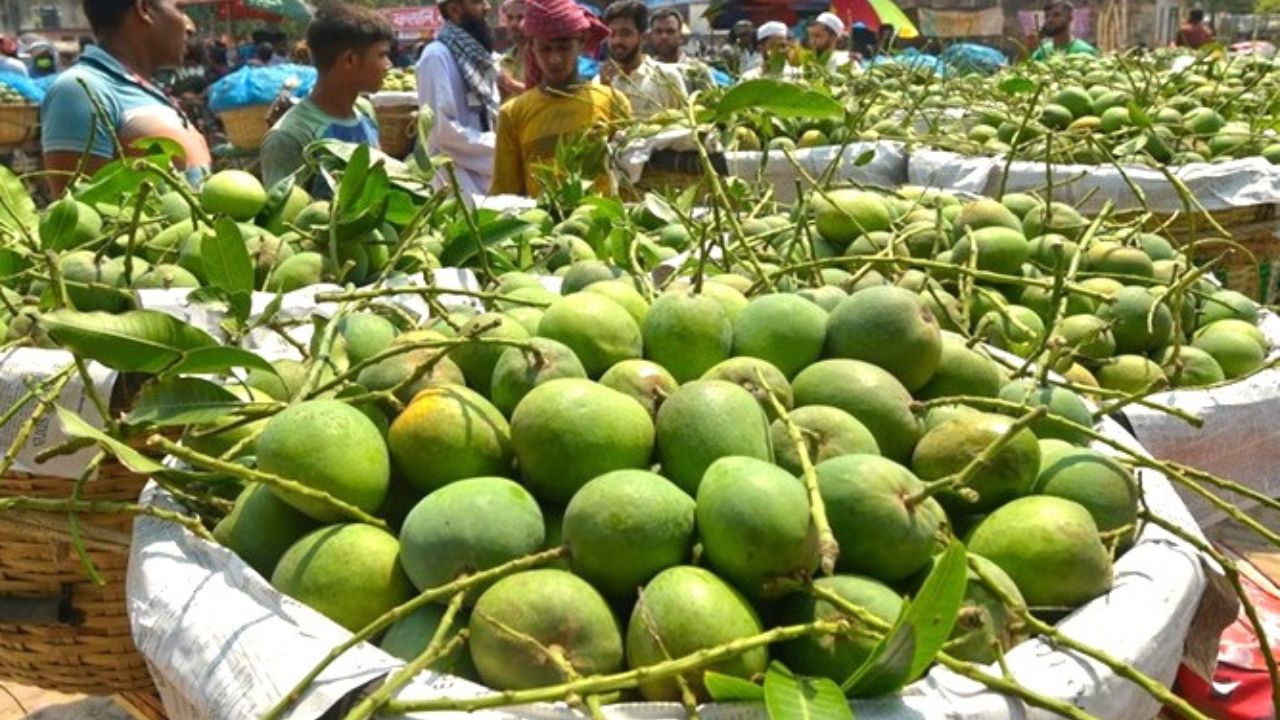



The mango season in Chapainawabganj is nearing its end, but brisk trading in late and year-round varieties has brought fresh activity to Kansat, the district’s largest mango market.
Despite the late-season revival, many growers say they failed to secure expected prices against rising production costs over much of the season, while middlemen and traders generally fared better.
Late varieties including Ashwina, BARI-4, BARI-8, Gourmati, Katimon and Banana Mango are now driving sales at Kansat, where thousands of maunds of mangoes are changing hands daily.
The market continues to draw large numbers of buyers and sellers even at the tail end of the season.
Ashraful Islam, a mango grower from Kansat in Shibganj Upazila, said Katimon mangoes were selling for Tk6,000 to Tk8,000 per maund in the closing stages of the season.
However, he said the price was still not satisfactory considering production costs.

Another grower, Abdus Salam, said Amrapali mangoes had sold for Tk20,000 per maund.
“A few years ago, the same variety fetched even higher prices. Many growers were disappointed this year because prices were below expectations early in the season,” he said.
Grower Golam Nabi brought Banana Mangoes to the market asking Tk6,000 per maund, but eventually sold them for a maximum of Tk5,500 amid pressure from buyers.




Md Wahid, who has been selling mangoes online from Kansat for around 12 years, said the market became somewhat buoyant for a few days in the middle of the season, but lacked stability overall.
He, however, said his business remained profitable this year.
Shibganj grower Ismail Hossain Khan said the upazila alone produces more mangoes than the combined output of the district’s other four upazilas.
He said Fazli once accounted for nearly 80 per cent of orchards in the area, but the share has now fallen to around half as growers increasingly switch to newer varieties because of poor returns.
Munjer Alam, general secretary of the Chapai Nawabganj Agriculture Association and an agricultural entrepreneur, said mango farming had not generated the expected returns despite rising production costs.
He said Chapainawabganj’s Khirsapat, Langra, Fazli and Ashwina mangoes have received geographical indication, or GI, recognition and more than a lakh people in the district depend on the mango economy for their livelihoods.
“To sustain the sector, the country needs mango-processing industries, stronger research activities and a full-fledged mango research institute,” he said.
At present, Ashwina mangoes are selling at Tk80 to Tk100 per kg at Kansat, BARI-4 at Tk150 to Tk180, Gourmati at Tk160 to Tk180, Katimon at Tk170 to Tk180 and Banana Mango at Tk180 to Tk200.
Prices are somewhat lower when purchased wholesale by the maund.
Morshed Khan, a mango trader from Dhaka, said he buys directly from Kansat wholesalers after checking the quality of the fruit.
He said proper handling and transport to Dhaka reduces the risk of losses, although some consignments suffered from rotting this year.
Morshed, whose family has been involved in the mango trade for generations, said he was still making a profit this season.
Atiqul Islam, deputy director of the Department of Agricultural Extension, said mangoes were cultivated on 37,487 hectares in Chapai Nawabganj this season.
The district’s production target has been set at 4,58,912 tonnes, he said, adding that supplies of late-season varieties are continuing even as the season draws to a close.