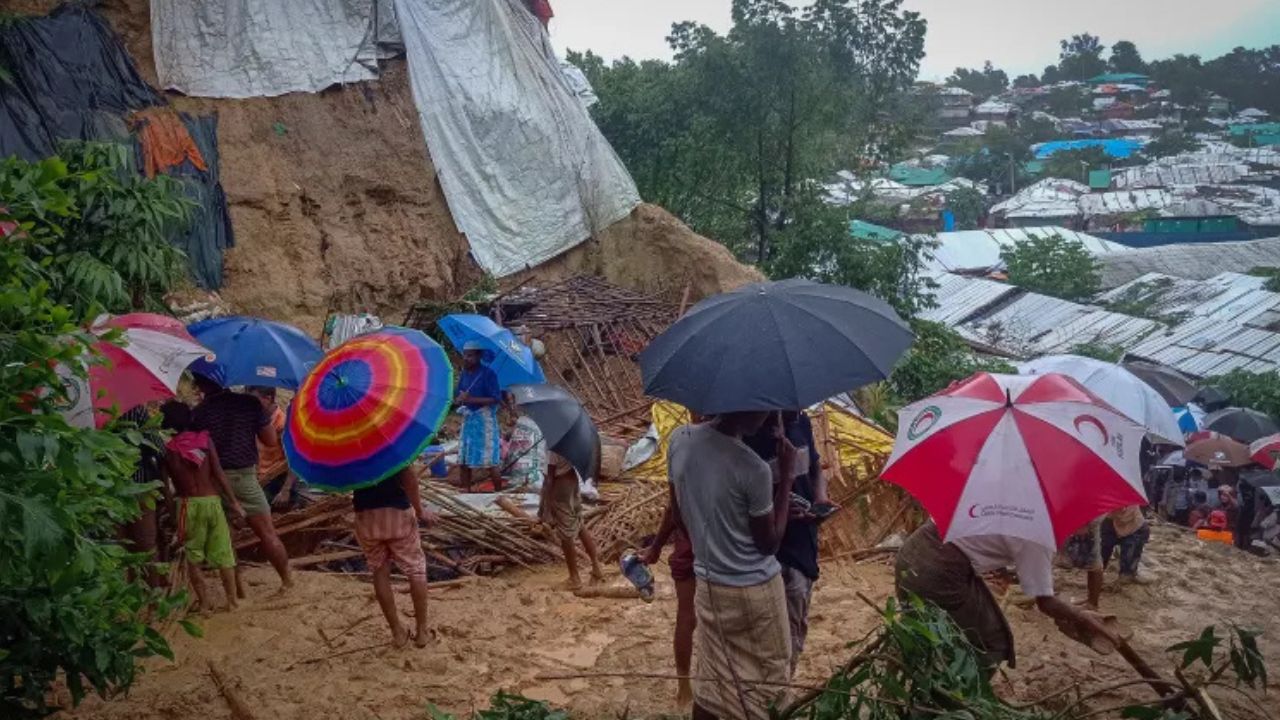

Human Rights Watch has said that landslides in July killed at least 17 Rohingya refugees and displaced more than 3,000 in Bangladesh, underscoring the deadly risks facing the community.
Bangladesh has hosted over a million Rohingya for nearly a decade, with families crowded into bamboo and tarpaulin shelters on steep, deforested hillsides highly vulnerable during the monsoon. The UN refugee agency has repeatedly warned of deaths and injuries in the congested camps from cyclones, floods, and landslides, HRW said in a statement.
HRW urged Bangladesh authorities, the UN, and donors to reduce overcrowding and restore aid for embankments, drainage, access routes, and relocation sites.
Meenakshi Ganguly, HRW’s deputy Asia director, said, “Every monsoon is becoming increasingly deadly for Rohingya refugees in Bangladesh, with denuded hills sliding away under makeshift structures, as the funding to buttress the camps has dried up.”
“These are not simply natural disasters, but a predictable outcome of policies that put refugees’ lives at risk.”

The Rohingya Coordination Platform reported 286 weather‑related incidents between 4 and 9 July across Cox’s Bazar camps, affecting 26,119 refugees. These included 95 landslides that displaced 4,307 people, partially damaged 2,809 shelters, and destroyed 13.
Learning centers, sanitation facilities, retaining walls, pathways, bridges, and roads were also damaged. Authorities relocated more than 1,000 refugees from high‑risk areas, though many resisted leaving their homes.




HRW interviewed nine people, including five refugees and four aid workers. A water and sanitation engineer said camp design was flawed from the start. He added, “The camps were made by cutting hills and without planned drainage systems. Now, because of funding cuts, sustainable landslide‑prevention work cannot be done properly, while the government refuses permanent constructions.”
New arrivals are particularly at risk, often forced to rent unsafe spaces. One man who arrived in August 2024 said his two daughters and two grandchildren died on 6 July when their makeshift shelter collapsed on a hillside.
Since November 2023, fighting between Myanmar’s military and the Arakan Army has driven at least 152,000 Rohingya into Cox’s Bazar.
Aid agencies say planning figures are inadequate, with three times more arrivals than anticipated. The UNHCR request for more land remains pending, while authorities insist refugees should not view Bangladesh as permanent settlement.
Aid workers said relocation is hampered by lack of space and privacy concerns in temporary sites. “In learning centers or other relocation places, many people stay together and there are problems with toilets and privacy,” one worker said.
In December 2024, Bangladesh approved stronger temporary shelters and semi‑permanent models, with pilot projects for two‑story units. Reconstruction of 50,000 shelters was also agreed, but funding cuts in January 2025 halted the plan. Local opposition warned against permanent settlement and forest loss.
HRW said shelter safety should be treated as a human rights issue. Donors should fund approved safer models, and Bangladesh should permit disaster‑resistant designs.
Currently, the Shelter and Camp Coordination appeal is only 42 percent funded, with $73.9 million required, and disaster risk management faces a $23.2 million gap. The Rohingya Coordination Platform has called for immediate funding for slope stabilization, drainage, watershed management, and access improvements.
Meenakshi Ganguly said, “Rohingya refugees won’t benefit from further hand‑wringing, but by an urgent and effective response.”
She also said, “Concerned governments need to act instead of waiting for the next landslide to sweep away another Rohingya family.”