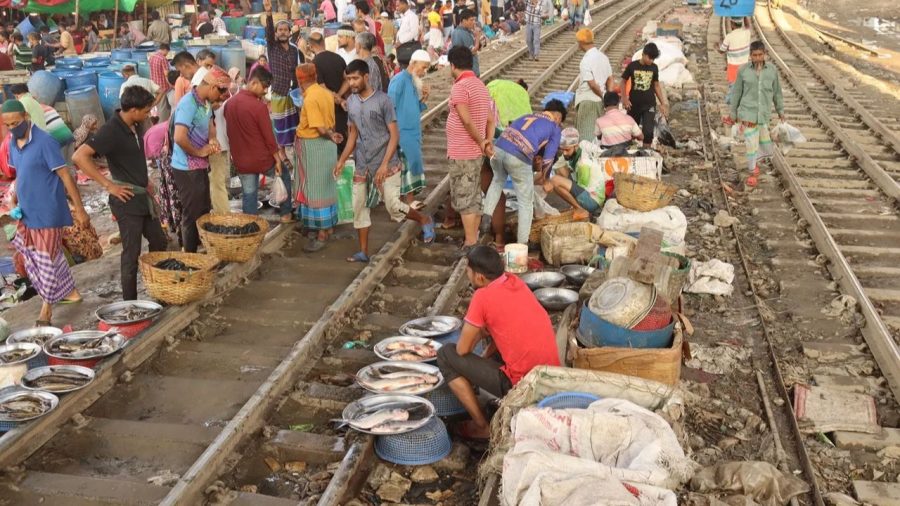



Nearly Tk2 crore is allegedly extorted every day from traders, vendors and transport operators in Karwan Bazar, one of Dhaka’s largest wholesale markets. The police have mapped the network, identified its collectors, and documented who receives the money. Yet the racket continues unabated.
A police report divides the market into 28 zones, detailing how much is collected from each area, who does the collecting and which political figures receive a share. But despite the level of detail, there has been no effective action against those named.
The collections target businesses selling agricultural produce and essential commodities, as well as trucks bringing goods to the market, vans, CNG-run auto-rickshaws, microbus stands, and roadside stalls.
Traders say they have little choice but to pay. The cost, they add, is ultimately passed on to consumers as businesses factor the extortion payments into the prices of their goods.
Some shops pay monthly, while others are charged daily. Vendors inside the market reportedly pay Tk500–650 a day, adding up to Tk15,000–20,000 a month. In all, daily collections are estimated at nearly Tk2 crore.
Ripon Kumar Mondal, a professor of agricultural economics at Sher-e-Bangla Agricultural University, told TIMES that illegal collections were contributing to higher commodity prices.
“Such illegal collections are one of the factors driving up prices. Their impact is felt not only by businesses but also directly in the cost of living for ordinary people,” he said.
Fazlul Hoque, administrator of the Federation of Bangladesh Chambers of Commerce and Industry (FBCCI), said traders had raised the issue at a meeting on commodity prices on 1 October. “Traders told us that they add the extortion payments to the prices of their goods,” he said.
Asked why the police had failed to act, Ibn-e-Mizan, deputy commissioner of the Dhaka Metropolitan Police’s Tejgaon Division, said no one had lodged a specific complaint about extortion. “We maintain strict surveillance. Whoever is involved in extortion will not be spared,” he told TIMES.
According to the police report, the people who collect the money directly are known as line men. Traders generally know only these intermediaries, who receive no more than 10 per cent of the proceeds. The rest allegedly goes to local political activists, leaders and other influential figures.

The report does not mention any possible police involvement.
An aratdar (wholesale trader) in Karwan Bazar told TIMES that businesses had been forced to pay extortion money under successive governments.
“Earlier, they came asking for party funds. Now they call it market committee or line-man expenses. We have come to accept extortion as part of doing business. Whatever happens, extortion in Karwan Bazar will not stop,” he said.
Refusing to pay is not an option, he added.
“They dump rubbish in front of our wholesale shops and prevent us from unloading goods. We are helpless.”
A tea-stall owner beneath the Karwan Bazar metro station said vendors were not allowed to operate without paying. A tea seller opposite Petrobangla said each shop along that stretch paid Tk5,000 a month.



Traders inside the wholesale market said they paid Tk500–650 a day. At night, buyers are also charged small amounts and can be prevented from taking their purchases out if they refuse to pay.
The extent of the network came into focus during the investigation into the January killing of former Jubo Dal leader Azizur Rahman Musabbir. Investigators found that disputes over control of extortion operations were among the issues behind the killing.
Tk20 lakh a month from one market
The police report identifies a man named Enayet as collecting Tk18–20 lakh a month from the kitchen market in Karwan Bazar. A portion of the proceeds allegedly goes to several BNP leaders, including one identified only as Rahman.
The stretch from the Baro Char Matha intersection to Prince Hotel generates Tk1–1.5 lakh a day, according to the report. The money is reportedly handed over to BNP leaders every 15 days.
The Prince Hotel-Kamarpatti-fish market stretch brings in Tk5 lakh a month, most of which allegedly goes to former ward commissioner Anwaruzzaman Anwar, a member of the convening committee of BNP’s Dhaka North unit.
Anwar dismissed the allegation as “completely baseless”.
“I have not visited Karwan Bazar for a long time. I challenge anyone to produce evidence of my involvement in extortion. If they can, I am ready to accept it,” he told TIMES.


Saying he was seeking to contest the city corporation elections, he suggested the allegations could be politically motivated.
The report lists several other lucrative collection points across the market.
The road beside Charulata Restaurant leading to the metro station generates Tk30,000 a day. Shops between Pragati Bhaban and Pubali Bank pay Tk30,000–35,000 each a month, while 10 shops between Pragati Bhaban and the city corporation office pay Tk40,000 each. Shops in Wasa Goli are charged Tk30,000–35,000 a month.
A man named Mithu reportedly collects Tk70,000 a month from vehicles belonging to Pran.
Fifteen shops between Abu Sayeed’s plot and Nabi Solaiman’s plot pay Tk45,000 each a month. Collections from Ittefaq Goli amount to Tk5–6 lakh a month.
A man named Taju and his elder brother collect the money there, while a man named Russell reportedly controls the lane. Around 30–35 traders bring agricultural produce to the area at night, with trading continuing until morning.

The stretch from Ershad Building to the railway line, known as Falpatti, generates Tk10 lakh a month. Twelve coconut stalls in front of Hotel La Vinci collectively pay Tk2–2.5 lakh.
The 25–30 shops in Deshi Falpatti pay Tk25,000–30,000 each a month, while shops in Kamarpatti pay Tk40,000 a month.
The report puts monthly collections at Tk1.3 lakh from the small fish market and Tk2 lakh from Second Kathpatti. Seven shops in DIT Market No 1 lane pay Tk10,000 each.
The main fish market generates Tk18–20 lakh a month. Those allegedly receiving a share include people identified as Janani Babul and Fakhrul Islam Robin, although neither is listed among the direct collectors.
The western side of Electric Market No 2 generates another Tk12–13 lakh a month.
No escape for tea sellers, transport operators
The extortion network extends well beyond the wholesale market, targeting roadside businesses and transport operators.
Between Bashundhara Shopping Complex and Karwan Bazar, 100–120 footpath shops reportedly pay Tk500–700 a day each. Another 15–20 shops between Sonargaon signal and Petrobangla are charged Tk8,000–15,000 a month, while temporary van stalls pay Tk300–400 a day.
Each tea stall on either side of the road in front of Petrobangla pays Tk5,000 a month.
CNG-run auto-rickshaw stands serving passengers through Hatirjheel are charged Tk4,500 a day, while each microbus pays Tk800–1,200.
Shops in Kathpatti, between Petrobangla and the TCB building, pay Tk8,000–10,000 a month. Temporary night-time footpath stalls in front of the BRDB building generate Tk30,000–35,000.
Collections from the footpath in front of Bapex reach Tk50,000–60,000 every night.
Temporary vegetable and fruit stalls in front of Charulata Restaurant generate more than Tk1 lakh a day, according to the report.
The stalls sell fruit and vegetables during the day but become wholesale vegetable trading points at night, when goods are loaded and unloaded. Extortion is collected twice: once during the day and again at night.