Commerce Minister Khandaker Abdul Muktadir on Tuesday said Bangladesh could increase its annual export earnings to $150 billion by developing five to seven promising sectors through targeted planning, policy support, research and skilled human resource.
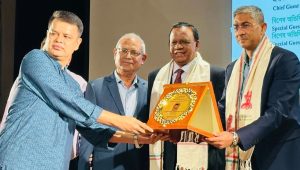
The minister made the remarks while speaking as chief guest at a consultation workshop held at the CIRDAP auditorium in the capital. He said country’s export economy could be transformed if potential sectors were nurtured with the right strategies and institutional support.
The workshop was organised to present a Development Project Proposal (DPP) based on a report titled Competitiveness Assessment of Bangladesh’s Potential Private Sectors.
Muktadir said Bangladesh had fulfilled all requirements for graduation from Least Developed Country (LDC) status, but the major challenge now was remaining competitive in global markets and building the capacity to move to the next stage of development.

He stressed the need to improve industrial efficiency, strengthen research and innovation, and accelerate technological adaptation to meet post-LDC challenges.
Referring to the Export Competitiveness for Jobs (EC4J) project, the Muktadir described its concept as timely but said delays in implementation remained a significant weakness in the country’s development activities. Future projects, he added, must be completed within stipulated deadlines and remain responsive to technological change.
The minister said initiatives were underway to transform existing infrastructure in the leather and light engineering sectors into international-standard skills development centres. Internationally recognised institutions are expected to support management and training activities to help domestic industries achieve global standards more rapidly.



Highlighting the potential of the jute sector, he said value-added jute products and jute-based fabrics could generate significantly higher earnings than raw jute exports. Bangladesh is also planning joint research and innovation initiatives with China to strengthen research, technology development and international cooperation in the sector.
Muktadir called for stronger collaboration among the government, private sector and academia to drive industrial development. Drawing on the experience of successful economies, he emphasised the importance of regularly evaluating project targets, implementation methods and outcomes.
Assuring entrepreneurs of the ministry’s support, he said the government was ready to address the challenges facing businesses and build a stronger partnership between policymakers and the private sector.
At the workshop, Research and Policy Integration for Development (RAPID) Chairman Mohammad Abdur Razzaque presented the keynote paper.
Commerce Secretary Md Ataur Rahman Khan, who chaired the event, said an integrated project worth around Tk3,000 crore was being initiated to strengthen export capacity and address post-LDC graduation challenges.
He said the second phase of the project would formulate sector-specific action plans based on the practical needs and experiences of private-sector stakeholders. Feedback from business organisations, government agencies, development partners and experts would help shape the final DPP.
The secretary said the project would focus on export sector recovery, reconstruction and capacity building in line with national budget priorities. He added that it could be implemented under the Ministry of Commerce, with the Export Promotion Bureau likely to serve as the implementing agency.
The project would prioritise ease of doing business, digitalisation, policy support and process simplification, aiming to create a sustainable model for export growth through coordinated public-private collaboration, he said.
Among others, EC4J Project Director Sheikh Mohammad Abdur Rahman and World Bank Senior Private Sector Specialist Hosna Ferdous Sumi addressed the workshop. Representatives from various industries, business leaders, policymakers and government officials also attended.