Implementation of the July National Charter is widely expected to usher in a new political beginning and lay the groundwork for rebuilding Bangladesh in the spirit of the July uprising.
The legally binding document, endorsed by political parties, could play a pivotal role in breaking free the country from divisive politics, authoritarian governance and the suppression of dissent that have shaped in decades.
Political analysts believe that whichever party forms the next government will be compelled—politically and morally—to implement the Charter and restore a more positive trajectory for national politics.
However, others warn that the July Charter carries inherent risks. They argue that if a single party secures a majority in the next parliament but lacks the sincerity to uphold the agreement, implementation of it may falter. Most crucially, the government has not made the next parliament legally obligated to adopt the Charter, leaving room for political backtracking.
Many observers draw parallels with the three-party formula of 1990. While the anti-Ershad movement mobilised around that framework, none of its commitments were implemented afterwards. In fact, the then BNP government that succeeded military autocrat HM Ershad was accused of doing the opposite. Yet that formula had no legal force, but the current context, analysts insist, is different.

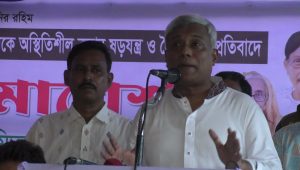
Abdul Latif Masum, retired professor of government and politics at Jahangirnagar University, hopeful. “Whoever assumes power in the new Bangladesh will implement the July Charter. They signed it through consensus. There is also a gentlemen’s agreement, as they accepted the decisions of the interim government. Whether it is the BNP, Jamaat or anyone else, they will be bound to implement it.”
He added that the dramatic scenes surrounding Sheikh Hasina’s fleeing from the country have, in his view, served as a lasting political lesson for all parties.
The movement that began in July 2024 with demands to abolish job quotas soon transformed into a nationwide anti-government revolt. The surge of protest was driven by deep frustration over the erosion of voting rights, suppression of dissent, enforced disappearances, extrajudicial killings and the illicit siphoning of billions. People from all walks of life took to the streets in response to years of accumulated anger.
Following the ouster of Hasina’s Awami League government in August amid an embolden student-public protests, the interim administration assumed office and, in February, formed the National Consensus Commission (NCC) to reform state structures. Over nine months, the NCC held 67 meetings with more than 30 political parties in two phases, generating consensus—with notes of dissent—on 84 reform proposals.




Despite fierce debate over how the Charter should be implemented, chief adviser Muhammad Yunus and representatives of 25 political parties—including BNP and Jamaat—signed the document incorporating their proposals on 17 October. The National Citizen Party (NCP) and four left-wing parties refrained from signing.
On 28 October, NCC categorised the proposed reforms into three parts, recommending immediate implementation of some elements through ordinances and executive orders. It also proposed issuing the “July Charter Implementation Order 2025” to cover 48 constitution-related matters and incorporating any referendum-approved proposals directly into the constitution.
Amid disagreements among parties over the timing of the referendum, the government on Thursday announced that a referendum be held alongside the general election, allowing “yes/no” votes on four core components of the Charter. Subsequently, the July Charter Implementation Order was issued, according to which, if a proposal receives a “yes” majority, the next parliament will pass it.
Many citizens believe that if the provisions of the referendum are implemented in good faith, no autocrat will be able to rise in Bangladesh in future. They expect greater protection of fundamental freedoms and a meaningful space for dissent.
Dilara Choudhury, another retired professor of government and politics at Jahangirnagar University, said, “Implementing the July Charter is essential if Bangladesh is to avoid the re-emergence of authoritarian rule. But the government should have taken a firmer stance on ensuring its implementation.”
If the BNP comes to power, she fears, the party will implement the Charter. “Questions remain over the transparency of the party’s current leadership, and people have not forgotten its past record in office.”
Key referendum questions are formation of a caretaker government to oversee national elections; establishment of a bicameral parliament; creation of a 100-member upper house elected proportionally based on each party’s share of votes and requiring a majority in the upper house to approve any constitutional amendment.
Additionally, provisions included increasing women’s representation in parliament, electing the deputy speaker and several parliamentary committee chairs from the opposition, limiting the prime minister’s tenure, enhancing the president’s powers, safeguarding fundamental rights and ensuring judicial independence.
“Holding a referendum and national election on the same day is unprecedented. The government’s order does not clarify what will happen if a party wins a parliamentary majority but declines to implement the Charter despite a ‘yes’ vote,” noted Abu Hena Razzaki, senior Supreme Court lawyer and political analyst.
He also questioned why referendum-approved proposals must still pass through parliament if they are intended to become part of the constitution. “There are significant legal complexities,” he said. “But if we want to build a new Bangladesh, there is no alternative to implementing the Charter.”
Despite procedural concerns, BNP has welcomed the government’s order. Jamaat and the NCP have raised questions about the implementation process, but neither has rejected the Charter. As a result, much of the anxiety surrounding the 13th parliamentary election in February 2026 subsided.
Many now hope that after the polls, political parties will move forward with a constructive approach to implementing the Charter, clearing the path towards realising the long-cherished dream of a new Bangladesh.