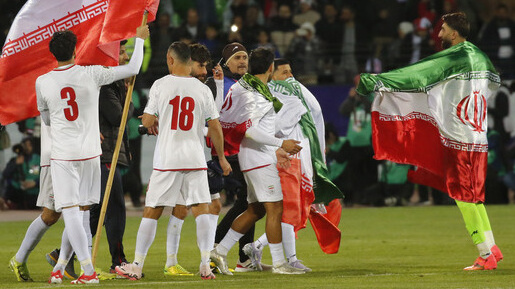

Iran’s football federation has declared that the national team will participate in the 2026 FIFA World Cup this summer, but has issued a firm set of demands to the three host nations, the United States, Canada and Mexico, insisting their conditions must be met before they travel.
The announcement, made on the federation’s official website on 9 May, comes amid months of uncertainty surrounding Iran’s presence at a tournament scheduled to run from 11 June to 19 July, with tensions heightened by the ongoing war in the Middle East following strikes by the United States and Israel in February.
“We will definitely participate in the 2026 World Cup, but the hosts must take our concerns into account,” the Iranian Football Federation said. “We will participate in the World Cup tournament, but without any retreat from our beliefs, culture, and convictions.”
Iranian Football Federation president Mehdi Taj set out 10 specific conditions in a statement on state television on 8 May, covering a range of concerns about how Iran and its delegation will be treated on arrival and throughout the tournament.

The conditions include guarantees that visas will be granted to all members of the squad and technical staff, that Iran’s flag and national anthem will be respected during the competition, and that high-level security arrangements will be put in place at airports, hotels and en route to match venues.
The most politically sensitive demand relates directly to players with military service links. Taj specifically named Mehdi Taremi and Ehsan Hajsafi as examples, calling for assurances that players who have served in the Islamic Revolutionary Guard Corps will face no obstacles in obtaining visas.


“All players and technical staff, especially those who have served their military service in the Islamic Revolutionary Guard Corps, such as Mehdi Taremi and Ehsan Hajsafi, should be granted visas without any problems,” Taj said.
The tensions between Iran and the host nations have been building for some time. Canada’s refusal last month to grant entry to the federation’s president ahead of the FIFA Congress was cited as a trigger for the current standoff, with the Canadian government having designated the IRGC as a terrorist organisation in 2024. The United States carries the same designation.
US Secretary of State Marco Rubio has attempted to strike a conciliatory tone, insisting that Iran’s footballers would be welcome at the tournament. However, he also warned that individuals within the Iranian delegation who have direct ties to the IRGC may still be barred from entering the country, a caveat that goes to the heart of Iran’s concerns.
FIFA president Gianni Infantino has sought to cut through the political noise, reiterating that Iran will play their World Cup games in the United States as scheduled and that their participation is not in question from the governing body’s perspective.
Iran are due to be based in Tucson, Arizona during the tournament and have been drawn in Group G alongside New Zealand, Belgium and Egypt. They open their campaign against New Zealand in Los Angeles on 15 June.
The federation was emphatic in its closing statement about the legitimacy of Iran’s place at the tournament. “No external power can deprive Iran of its participation in a cup to which it has qualified with merit,” it said.