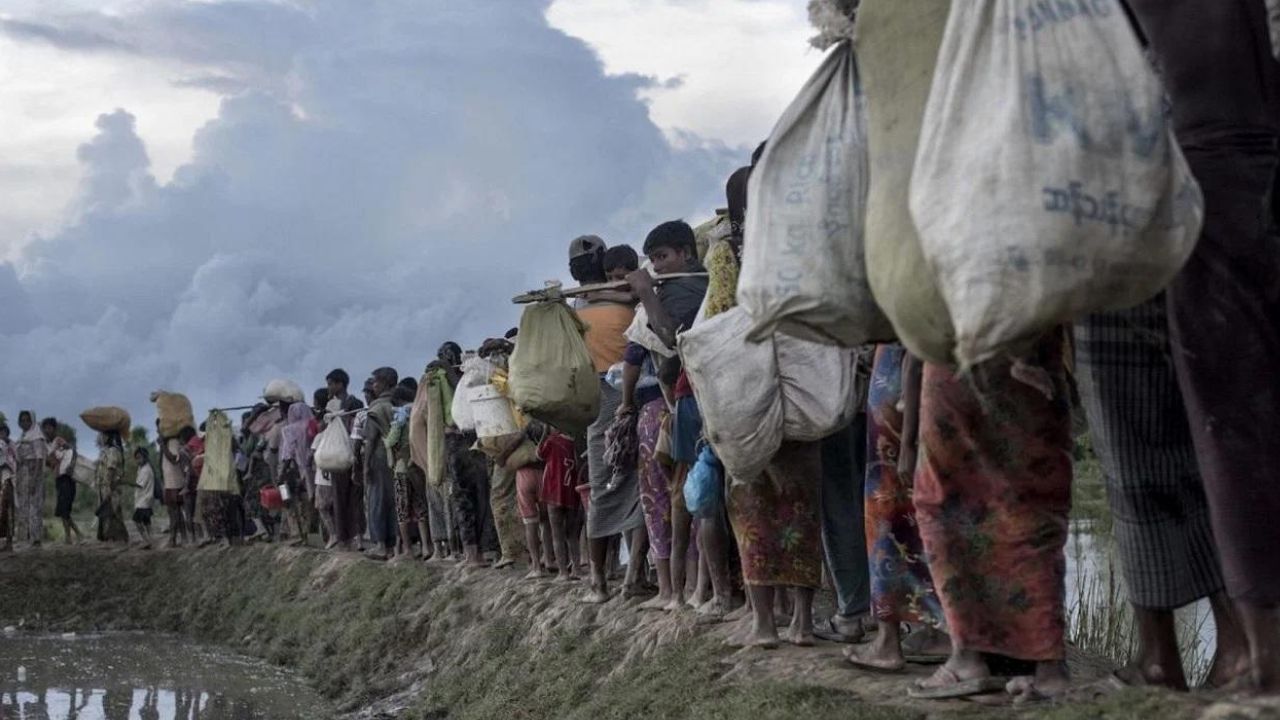



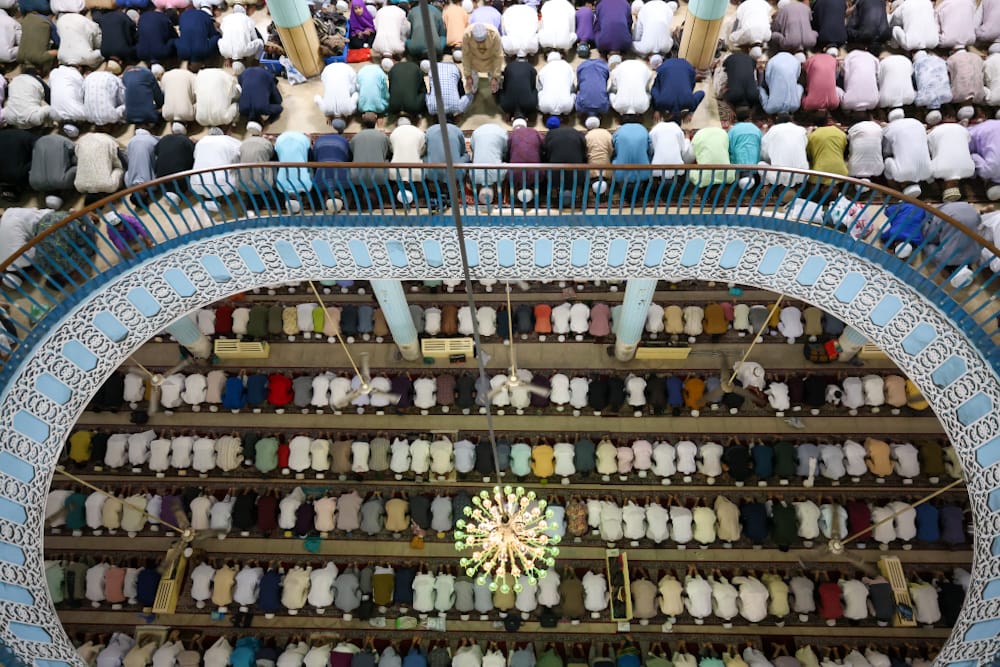
Large crowds of displaced Rohingya refugees have gathered to watch the International Court of Justice (ICJ) deliver its ruling on whether Myanmar committed genocide against the minority community.
The case was filed by The Gambia in November 2019, accusing Myanmar of violating the 1948 Genocide Convention through mass killings, sexual violence and the destruction of Rohingya villages.
The allegations relate mainly to a military crackdown in 2016 and 2017, which forced more than 700,000 Rohingya to flee to neighbouring Bangladesh.
Myanmar failed to investigate atrocities
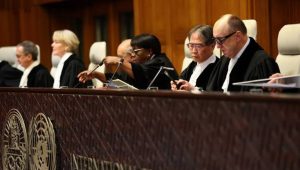
ICJ President Judge Yuji Iwasawa highlighted Myanmar’s lack of cooperation in the court’s assessment of the evidence, BBC reports.
“In assessing the evidence, the Court takes account of Myanmar’s failure genuinely to investigate the alleged atrocities and its refusal to facilitate access to evidence and witnesses to provide information requested,” he said.
Judge Iwasawa outlined the background to the case and the methodology adopted by the International Court of Justice in reaching its judgment.
He noted that, unlike previous genocide cases, the court did not have comparable judicial rulings on which to base its findings.
As a result, the ICJ could rely only on the evidence submitted by the parties to make its own determination of the facts, he said.
The court considered witness testimony and witness statements, assessing both their content and the circumstances in which they were given. Judge Iwasawa added that concerns about possible reprisals against those providing evidence were also taken into account.

During the oral proceedings, the court heard from four witnesses who experienced violence during the final week of August 2017.
“The Court found The Gambia’s witnesses credible in their account of the particular events to which they testified,” Judge Iwasawa said.
He added that many of the witnesses’ key statements were not challenged during cross-examination.
UN General Assembly adopts resolution
A resolution has been adopted by the United Nations General Assembly calling for adequate funding for humanitarian assistance for the Rohingya, the restoration of their political and voting rights, and the creation of conditions conducive to their voluntary, safe, dignified and sustainable repatriation.
In the vote held on Wednesday, 128 countries voted in favour of the resolution, which was introduced by the Organisation of Islamic Cooperation (OIC) and the European Union (EU). Six countries voted against it, while 33 abstained.
The information was disclosed in a statement received in Dhaka on Thursday.

The resolution emphasised the need to ensure adequate funding for humanitarian assistance for the Rohingya, including under the 2026 Joint Response Plan.
It also called for the restoration of their political and voting rights, as well as the creation of conditions conducive to their voluntary, safe, dignified and sustainable repatriation and reintegration.
Before the resolution was adopted, Bangladesh’s Chargé d’Affaires to the United Nations, Ambassador Sanchita Haque, addressed the General Assembly on behalf of Bangladesh. She underscored the need for urgent action to resolve the protracted Rohingya crisis.
Background of the Rohingya crisis
The Rohingya are a Muslim ethnic minority predominantly living in Myanmar’s Rakhine State. They have faced decades of discrimination and violence in the Buddhist-majority country and are denied citizenship under Myanmar law, leaving them among the world’s largest stateless populations.
Successive waves of persecution, particularly the military operation in 2017, have driven nearly two million Rohingya from Myanmar.
Thousands continue to flee the country every year, often undertaking dangerous sea journeys aboard overcrowded boats. Last year was among the deadliest in recent years for Rohingya refugees, with nearly 900 dying or going missing at sea.
More than one million displaced Rohingya are currently living in refugee camps in Bangladesh’s Cox’s Bazar. The United Nations has described them as one of the world’s most persecuted minorities.
What the charges against Myanmar
The Gambia has accused Myanmar of violating the Genocide Convention in several ways, including committing genocide, conspiring to commit genocide, failing to prevent genocide and failing to prosecute those suspected of committing such crimes.
The mass exodus of Rohingya began on 25 August 2017, after fighters from the Arakan Rohingya Salvation Army (ARSA) launched attacks on more than 30 police posts in Rakhine State.
Myanmar troops, backed by local Buddhist mobs, subsequently launched what the authorities described as “clearance operations”.
Refugees reported widespread killings of civilians and the burning of entire villages. According to medical charity Médecins Sans Frontières (MSF), at least 6,700 Rohingya, including at least 730 children under the age of five, were killed in the month following the outbreak of violence.

Amnesty International has also accused Myanmar’s military of raping and abusing Rohingya women and girls.
Myanmar has consistently rejected the genocide allegations, maintaining that its military operations targeted militant and insurgent threats.
During hearings at the ICJ in January 2026, Myanmar’s government representative Ko Ko Hlaing argued that the country was not obliged to remain idle in the face of terrorist attacks in northern Rakhine State.
He described the military actions as counter-insurgency or counter-terrorism operations carried out in response to attacks by Rohingya fighters.
How the ICJ case unfolded
The Gambia filed the case in November 2019 on behalf of 57 member states of the Organisation of Islamic Cooperation (OIC), accusing Myanmar of breaching the Genocide Convention.
In January 2020, the ICJ ordered Myanmar to take all measures within its power to prevent genocidal acts against the Rohingya.
Between 2023 and 2024, several countries, including Canada, Germany, the United Kingdom and Ireland, submitted declarations of intervention seeking to participate in the proceedings and present their interpretations of the Genocide Convention. The court accepted their applications.
The ICJ held public hearings on the case in January 2026 before beginning its deliberations.
On November 3, the court announced that it would deliver its judgment on November 19.
Wider implications
The judgment is being closely watched internationally, particularly for its potential implications for other genocide proceedings before the ICJ, including South Africa’s case against Israel over its military campaign in Gaza.
The case is the first genocide dispute to be heard by the UN’s highest court in more than a decade.
No state has so far been found guilty of committing genocide by an international court.