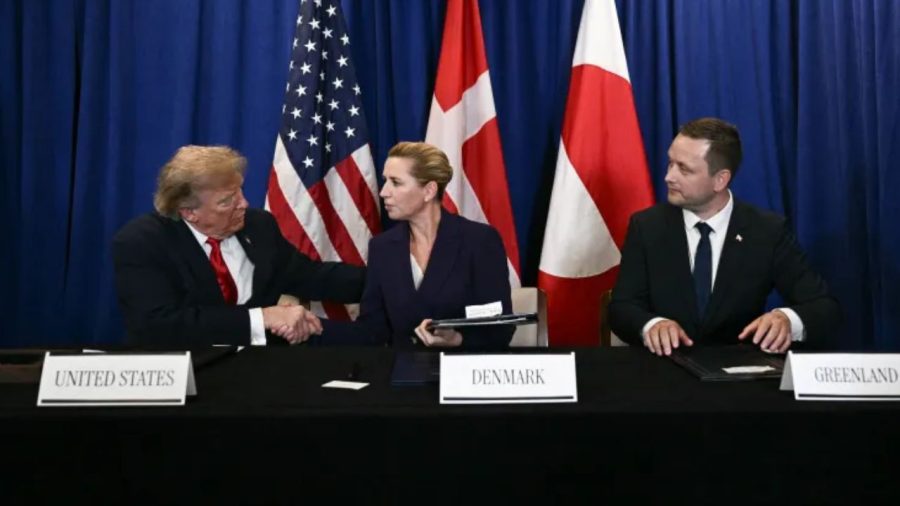



Denmark’s parliament on Thursday unanimously ratified a security agreement with the United States over Greenland, hoping to defuse a standoff triggered by President Donald Trump’s repeated demands for control of the autonomous Danish territory, says Reuters.
All 109 members present in the 179-seat chamber voted in favour, with none against, according to the parliamentary tally. The trilateral security and military access agreement between Washington, Nuuk and Copenhagen widens the US military footprint on the mineral-rich island in the northern Atlantic and permits a “Golden Dome” missile defence system, while reaffirming Danish sovereignty and Greenlanders’ right to self-determination.
Greenland’s parliament ratified the text in early November, before the Danish vote. Last week, the deal cleared a first reading in the Danish parliament with the backing of every party, and lawmakers voiced relief and hope that it would normalise the situation in Greenland.
The agreement was signed in September by Trump, Danish Prime Minister Mette Frederiksen and Greenlandic Prime Minister Jens-Frederik Nielsen, but still needed ratification from lawmakers in Greenland and Denmark before it could proceed.

The executive agreement is not subject to a vote by the US Senate. It will enter into force once the Danish foreign ministry informs Washington in a diplomatic note that procedures are complete. In practice, that notification is the final step before the deal takes effect.
Kenneth Howery, the US ambassador to Denmark, welcomed the ratification in a post on X. “The agreement is a tremendous accomplishment, one that modernizes our partnership for the security challenges of the future and bolsters the security of the United States, the Kingdom of Denmark, including Greenland, and all of NATO,” he said.




The standoff over the Arctic island’s future has rattled transatlantic relations. In January 2026, Trump renewed calls for Greenland to become part of the United States, threatening military action and tariffs against European allies if they opposed him. He argued that Denmark could not protect the Arctic territory from threats posed by China and Russia. His demands strained US relations with Denmark and alarmed European NATO allies.
His refusal to rule out military or economic force to acquire the island sparked a diplomatic crisis within NATO in January and forced Denmark and Greenland into months of intensive negotiations.
Tensions eased somewhat in late January, when Trump and NATO Secretary-General Mark Rutte announced a “concept of a deal” that would expand US military access to Greenland. That then led to the agreement being signed in September.
The new text adds to the broad military access the US already has in Greenland under a 1951 agreement. Denmark had repeatedly said it was open to expanding the US military presence on the island, but rejected Trump’s demand for full US control.
Not everyone believes the ratification will close the chapter on the Greenland question. “However, there are many indications that this is not an end, but rather a beginning,” said Mikkel Vedby Rasmussen, a political science professor at the University of Copenhagen.

“With the treaty in hand, the US will be able to demand greater influence on decisions that have security policy implications and on part of the extraction of strategic resources,” he said.
Other experts, however, say the new agreement does not add much to the US military access already in place on Greenland.
Greenland is a self-governing Danish territory home to about 57,000 people. It lies on the shortest route from Europe to North America and already hosts the northernmost US military base.