
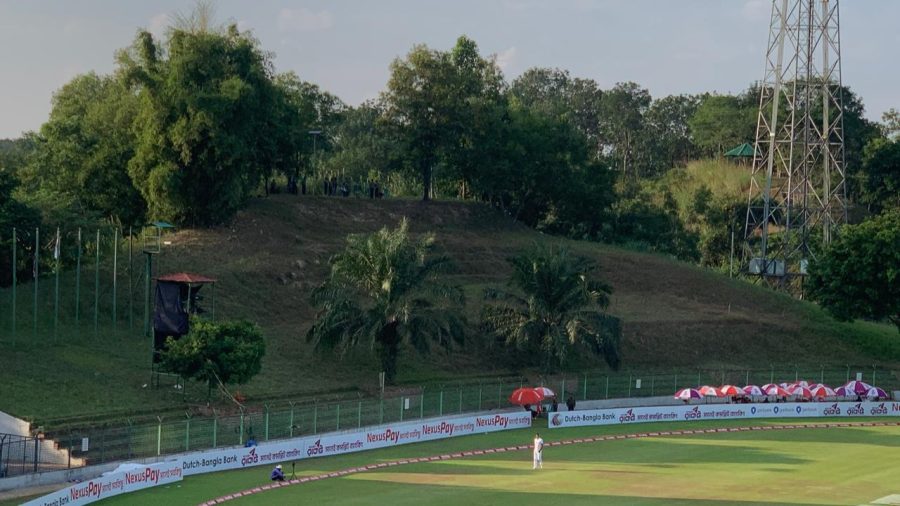



If you are a cricket enthusiast visiting the Sylhet International Cricket Stadium, the lush greenery of the Lakkatura Tea Estate is an attraction in itself. But watching a Test match from the Green Gallery takes the experience to another level.
As the sun sets over Sylhet, golden rays filter through the trees on the western side of the ground, casting a warm glow over the field. From the grassy slopes, spectators get an uninterrupted view of the action, from close-in fielders crowding the bat to players in mud-stained white jerseys battling through the final session. Nestled amid the tea gardens, the Green Gallery offers a match-day experience unlike any other cricket venue in Bangladesh.
Yet, the Green Gallery, now one of the defining features of the Sylhet venue, almost never came into existence in its present form. During the ground’s redevelopment, there was a proposal to replace the open green space with a conventional seated gallery, which would have meant cutting down the hill on the western side.
Ali Wasiquzzaman Chowdhury Oni, an official of Sylhet’s local club Anirban Krira Chakra, witnessed the rise of cricket in Sylhet and was involved in the development and renovation of the venue, recalled to TIMES how former Bangladesh Cricket Board (BCB) director Ahmed Sajjadul Bobby played a key role in shaping the ground’s identity.

Oni recalled the ground’s formative days in 2007.
“There is actually a story behind the development of this ground. It started around 2007, when there was only this media building, which housed the cricket pavilion, and the Green Gallery, essentially a hillock. Nothing else was here. The rest of the area was enclosed by barbed-wire fencing,” he said.
A BCB delegation visited the venue with an eye on eventually bringing international cricket to Sylhet.




“At the time, a BCB delegation visited the ground. Bobby Bhai was part of that delegation, and he insisted that we could bring this venue into international cricket or at least include it in the BCB’s programmes,” he said.
Following discussions at the board level, the proposal to develop the venue was eventually taken into consideration. However, plans to prepare the ground for the 2011 World Cup ran into trouble around 2010, when a trade fair was organised at the venue.
“Our target at the time was to prepare the venue so that it could host some matches during the 2011 World Cup. But stalls for the trade fair had already been set up across the ground. Those of us involved in sports in Sylhet had to put up quite a fight with the government at the time. After nearly three to four months of struggle, we managed to stop the fair,” Oni said.
By then the opportunity to prepare the venue for the 2011 World Cup had passed. The renovation work eventually began in 2013, ahead of the 2014 ICC T20 World World Cup.
The redevelopment brought another challenge, preserving the hill that now gives the Green Gallery its distinctive character.

“There was a group that strongly wanted to turn the entire area into a gallery, which would have meant removing the hill. Everyone wanted more seating capacity,” Oni said.
He recalled how Bobby argued against the proposal, making the case that the hill and its natural surroundings were precisely what would set the Sylhet venue apart.
“Then Bobby Bhai made an important point. ‘Why would people come to Sylhet if it looked like every other stadium? They would come here to see the hill. Since we had the opportunity to preserve it, there was no need to cut it down’.”, the veteran organiser said.
“That is how the hill was ultimately saved,” He concluded