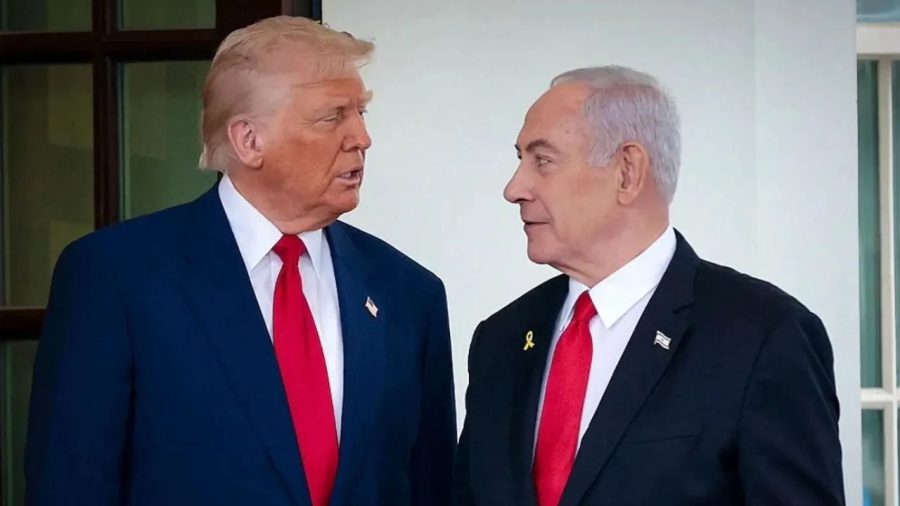



Following a decisive performance in the United States midterm elections, Democratic lawmakers hold significant leverage to strip a controversial military collaboration provision from the Pentagon’s annual funding bill.
The measure is embedded within the Fiscal Year 2027 National Defense Authorization Act (NDAA), a $1.15 trillion package that, alongside supplemental legislation, includes funding for key military priorities of US President Donald Trump, such as the “Golden Dome” missile shield, a planned “Trump-class” battleship fleet, and war operations in Iran.
Section 219 of the current Senate bill seeks to establish the “United States-Israel Defense Technology Cooperation Initiative” to accelerate joint research, development, testing, evaluation, coordination, and industrial co-operation between the two nations.
Top Democratic figures, including Senate Minority Leader Chuck Schumer previously registered opposition to the overall funding package over Iran war expenditure and domestic financial pressures.
Leverage over defence spending
Although a version of the defence package passed the Republican-controlled House of Representatives in May, Democrats delayed the Senate version through a procedural vote in July.
Lawmakers now face an 11 December deadline when existing stopgap funding expires, requiring another temporary measure or the full NDAA to maintain military operations.

Because the NDAA requires a 60-vote threshold to pass the Senate, Democrats retain substantial leverage in the remaining weeks of the congressional session before taking control of both chambers in January.
Cavan Kharrazian, senior policy adviser at Demand Progress, noted that Democrats must explicitly condition their votes for the NDAA on removing the US-Israel military integration clause and prohibiting involvement in the Iran war.
Kharrazian explained that Democrats possess the leverage to filibuster the bill until the provisions are stripped out, adding that a simple amendment vote would be insufficient if the final legislation is allowed to pass intact.
While defence analysts anticipate a tightening of Pentagon spending – including a stalled $360 billion supplemental package – it remains uncertain whether party leadership will target Section 219 directly.




Adam Smith, representative and ranking Democrat on the house armed services committee, called for a sustainable national security strategy that avoids a trillion-dollar defence budget funded through severe cuts to domestic programmes.
Smith, who initially supported the integration measure before later opposing it, echoed concerns raised by Schumer regarding excessive spending on defence contractors while community investments wait.
However, Schumer and Hakeem Jeffries, house minority leader, have yet to clarify their positions publicly as both seek to retain leadership positions.
Bypassing congressional oversight
Policy experts and critics warn that Section 219 would create an opaque mechanism allowing the Pentagon to funnel US tax funds to Israeli military firms through joint development ventures while bypassing congressional oversight.
Embedding Israeli-developed technology into American programmes would also entrench long-term dependencies, making future diplomatic pivots far more difficult to execute.
Matthew Duss, executive vice president at the Center for International Policy, explained that the provision aims to move US-Israel military aid further outside the purview of Congress to shield it from democratic accountability.
Duss observed that while lawmakers opposing the measure stand on firm ground, confronting party leadership could prove challenging given their traditional pro-Israel stance, though both Schumer and Jeffries have shown signs of recognising that their caucuses hold different ideological views.

Deepening caucus opposition
Opposition within Congress has broadened significantly in recent months. While Chris Van Hollen, senator, joined six colleagues in opposing the measure in July, a total of 12 senators have now signed a joint letter to party leadership.
The signatory coalition includes progressive figures such as Bernie Sanders, senator, alongside centrists such as Ron Wyden, senator, and Tammy Duckworth, senator.
Hamid Bendaas, communications director for the IMEU Policy Project, pointed out that the letter reflects alignment across a wider section of the Democratic caucus, driven in part by public opinion polls showing widespread voter opposition to military aid for Israel amidst the Gaza conflict.
Both Trump and JD Vance, vice president, have acknowledged that the US-Israel relationship has become politically sensitive.
In their joint letter, the 12 senators warned that Section 219 would expand bilateral co-operation into sensitive technological domains – including artificial intelligence, quantum computing, biotechnology, autonomous systems, and cyberwarfare – surpassing integration levels with some NATO allies.
The lawmakers stressed that embedding Israeli technology into the US defence industrial base risks creating long-term dependencies and granting Israel leverage over American weapons systems.
They concluded that deepening such ties is particularly unwise while the Israeli government pursues policies in Gaza, the West Bank, and the wider region that conflict with American interests and values.