


Ever since the release of Gajab Raat, comparisons with Mosharraf Karim’s popular Bangladeshi crime thriller Mohanagar have surfaced among viewers. Some have questioned whether the Manoj Bajpayee-starrer borrows from the Hoichoi series, while others see it as an inspiration drawn from a similar crime-thriller formula.
A corrupt cop, an injured woman, powerful people desperate to silence her and a race against time form the heart of Gajab Raat. The Manoj Bajpayee-starrer sets up an intriguing crime thriller, but its familiar storyline, unnecessary comic moments and predictable developments leave several questions about how effectively it uses its premise. Bajpayee’s performance, however, gives viewers a reason to stay invested.
Directed by Ritesh Shah and backed by Neeraj Pandey’s banner, the film follows Sub-inspector Ajay Nirvit (Bajpayee), a corrupt police officer accustomed to taking bribes and bending rules. During a hotel raid near Delhi’s Connaught Place, an injured young woman is thrown from a moving car. Ajay takes charge of the case, initially treating it as another routine assignment.
However, the investigation soon attracts unwanted attention. A CBI officer, Navin Madhok (Akshay Oberoi), attempts to take control of the case, while representatives of a women’s organisation question the police investigation. As more powerful figures become involved, Ajay finds himself caught in a complicated web of crime, political influence and deception. An offer of Rs 5 crore further tests his loyalties and his already fragile conscience.

The first 30 minutes establish an intriguing atmosphere. The screenplay gradually introduces the characters and their competing interests, keeping the mystery surrounding the injured woman alive. The single-night setting also gives the investigation a sense of urgency. However, as the story progresses, the familiar territory of corrupt cops, influential politicians and criminal networks becomes increasingly apparent.
The film occasionally loses its grip on suspense. Some revelations feel predictable, while several subplots, including the interaction between Ajay and Rosie (Nushrratt Bharuccha), fail to develop meaningfully. Saqib Saleem’s character also receives limited scope. The unnecessary comic elements sometimes interrupt the tension, making the narrative feel closer to another familiar police drama than the gripping thriller it initially promises to be.




Ritesh Shah’s direction keeps the large ensemble and multiple character threads reasonably accessible. However, the screenplay by Neeraj Pandey, Ritesh Shah and Deepak Venkateshan struggles to maintain the initial momentum. Ajay’s transformation from a self-serving officer to someone willing to pursue justice provides the story with its emotional centre, although the shift could have received more convincing development.
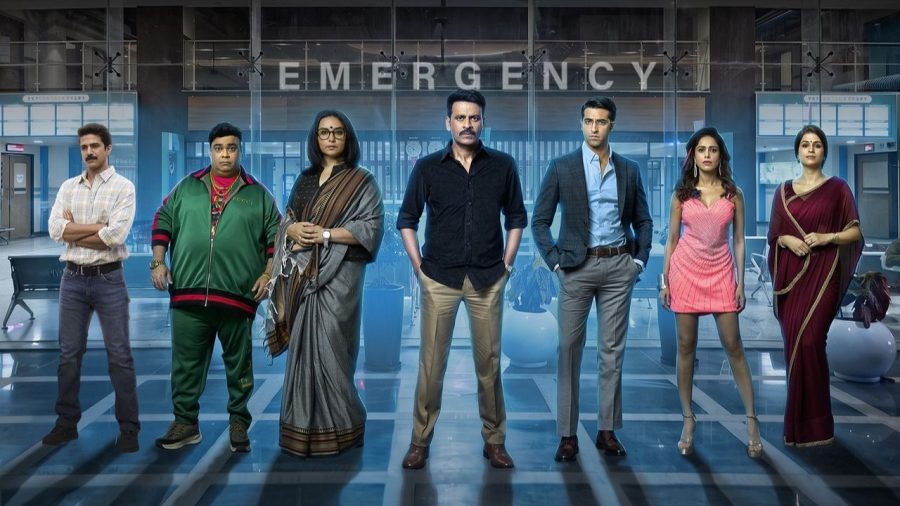
Bajpayee remains the film’s biggest attraction. He brings remarkable control to Ajay’s shifting personality, particularly in conversations with his superiors. His dialogue delivery and comic timing add personality to an otherwise familiar character. Divya Dutta makes an impression as a powerful politician, while Akshay Oberoi keeps his performance restrained. Shraddha Das, Rajiv Gupta and Kiku Sharda also contribute to the ensemble. Nushrratt Bharuccha adds lighter moments as Rosie, although her track remains underdeveloped. Saqib Saleem, meanwhile, has relatively little to work with.
Visually, the film maintains an immersive atmosphere through Arvind Singh’s cinematography. Sanjoy Chowdhury’s background score supports the tension, while the realistic action sequences and sharp editing help the investigation move forward. The production design and costumes also complement the film’s urban crime setting. There are no songs to interrupt the narrative.
Ultimately, Gajab Raat offers a familiar crime-thriller experience with an engaging central performance. Its predictable turns, uneven pacing and unnecessary humour may leave viewers wanting more from the story. Yet Bajpayee’s screen presence, sharp comic timing and ability to command a scene make the film an entertaining one-time watch.

For viewers looking for a straightforward crime thriller with a strong lead performance, Gajab Raat is worth considering on Netflix. Those expecting an unpredictable investigation packed with consistently gripping twists may find the night less eventful than its premise suggests.
So, is Gajab Raat really inspired from Mohanagar?
Not quite. The similarities are understandable: both feature corrupt, street-smart cops navigating a chaotic night through humour, manipulation and personal connections, amid police corruption and powerful interests. However, their stories take different routes. Mohanagar centres on OC Harun and a hit-and-run involving an influential businessman’s son, while Gajab Raat follows Ajay’s investigation into an injured woman, drawing him into a conflict involving the CBI, political influence and a criminal conspiracy. The resemblance lies more in their crime-thriller framework than their plots. Calling Gajab Raat a copy or inspired, therefore, would be an unfair conclusion.