






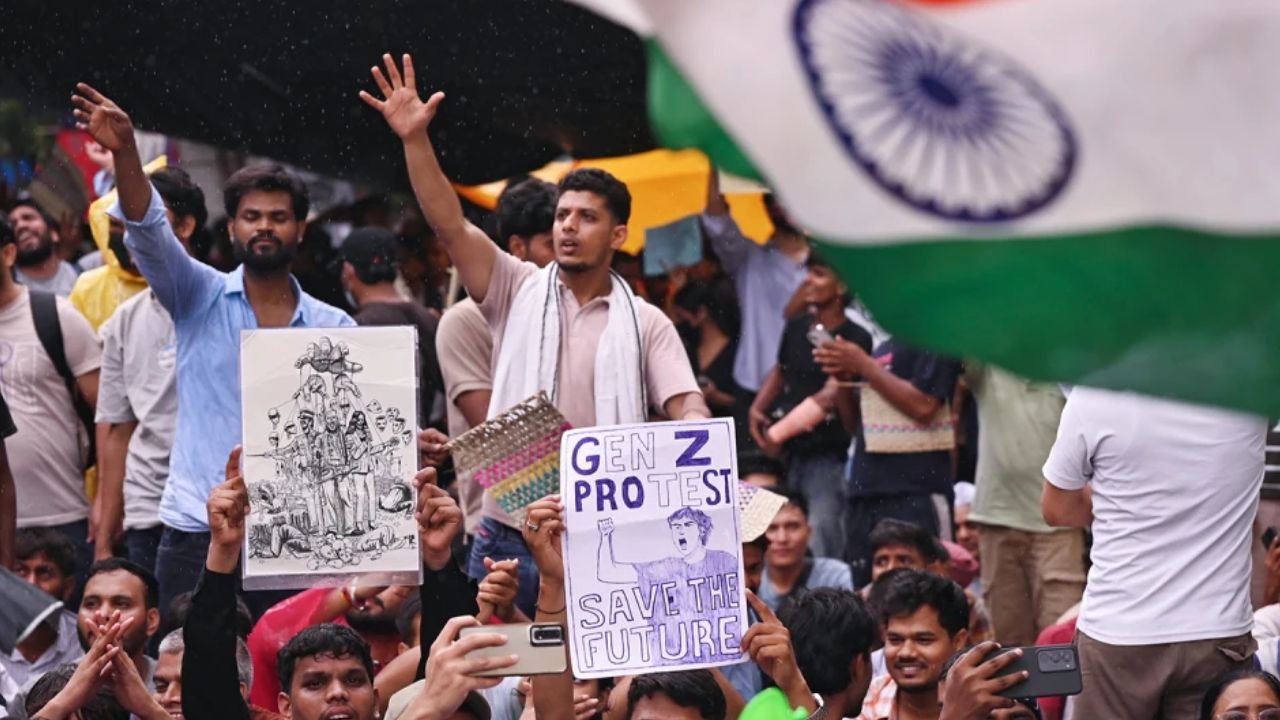
Protests usually come with fiery speeches, slogan-shouting and endless placards. But at Delhi’s Jantar Mantar, India’s latest youth-led movement has added something else to the mix: Instagram reels, viral memes, trending audios and a healthy dose of internet humour.
As thousands of young people gathered under the banner of the Cockroach Janta Party (CJP), demanding accountability over alleged examination paper leaks and the resignation of Indian Education Minister Dharmendra Pradhan, the protest also evolved into a social media phenomenon. Smartphones became nearly as common as placards, and every dramatic, emotional or humorous moment had the potential to become the next viral reel.

The movement itself began online before spilling onto the streets, making social media an integral part of the protests from the outset. For Generation Z, the protest existed in two places at once — on the streets and on their screens.

Protest, but make it Instagram
Instead of waiting for television cameras to document events, many protesters became storytellers themselves.
Some posted “Get Ready With Me” (GRWM) videos before leaving home, showing viewers how they prepared for the demonstration.
Others uploaded dance clips filmed amid tense situations, while several documented the day like a personal vlog.
What is normally associated with fashion influencers or lifestyle creators found an unlikely backdrop in protest sites filled with slogans, police barricades and demonstrators.
Even a casual game of Uno played by protesters at Jantar Mantar became social media content, highlighting how Gen Z naturally blends everyday internet culture into public spaces.
The result was a new style of documentation that was simultaneously activism, personal storytelling and content creation.
When protest meets meme culture
If there was one thing that defined the demonstrations beyond the slogans, it was humour. Rather than relying solely on traditional slogans, protesters embraced sarcasm, irony and pop culture references to make political statements.
One placard read, “My ex and this government are both heartless.” Another responded to allegations that protesters were being paid by declaring, “Nobody funds me, I hate this government for free.” Others joked, “Ikea has better cabinets.”
Bollywood also became fair game. Protesters recreated posters from the film “Tu Jhoothi Main Makkaar,” replacing its stars with Indian Prime Minister Narendra Modi and Dharmendra Pradhan.
Protester and self-described “memer” P Hossain Khan explained the thinking behind the humour.
“Since the government doesn’t seem to take students seriously, perhaps using a non-serious method will get their attention. And it is also entertaining to see how the andhbhakts (die-hard supporters) are incapable of understanding the nuance of fighting force with laughter,” reports The Indian Express.
Subway Surfers, but in real life
Perhaps nothing captured the internet’s imagination more than the “Subway Surfers” trend.
Videos of protesters running as police chased them with batons were edited to resemble the popular mobile game, complete with its instantly recognisable soundtrack.
One Instagram reel by a Delhi-based fitness influencer, captioned “Bro thought he can outrun me,” reportedly received 2.3 million likes.
The trend quickly spread online, with many users joking that the scenes looked like a real-life version of the endless running game.
Some who were not present at Jantar Mantar even joked about experiencing “peak FOMO” over missing the chance to “play Subway Surfers” there.
Other viral clips included protesters dressed as Mahatma Gandhi, humorous takes on tear gas, and memes referencing Chief Justice of India Surya Kant’s “cockroach” remark, which inspired the formation of the Cockroach Janta Party platform.
Every reel became a record
Beyond the jokes, social media also reshaped how the movement spread.
Videos showing confrontations with police, emotional moments and on-the-ground updates circulated rapidly across Instagram and X, allowing the protest to reach audiences far beyond Delhi. Some creators with previously modest followings saw their audiences grow after regularly posting protest-related content.
One widely shared clip showed a woman from Mumbai standing before a police vehicle and demanding the release of detained protesters. The dramatic visuals quickly became one of the defining moments circulating online.
A digital protest generation
The protests have been widely described as reflecting how Gen Z approaches political participation differently from earlier generations, blending activism with the digital spaces they already inhabit. Every slogan, confrontation, joke and conversation had the potential to become a reel, meme or story within minutes.
For Gen Z, protest is no longer confined to the streets. It lives simultaneously on Instagram feeds, meme pages and reels, where a witty placard can travel faster than a speech, a joke can spark national debate, and dissent is measured not only in crowds but also in clicks.


