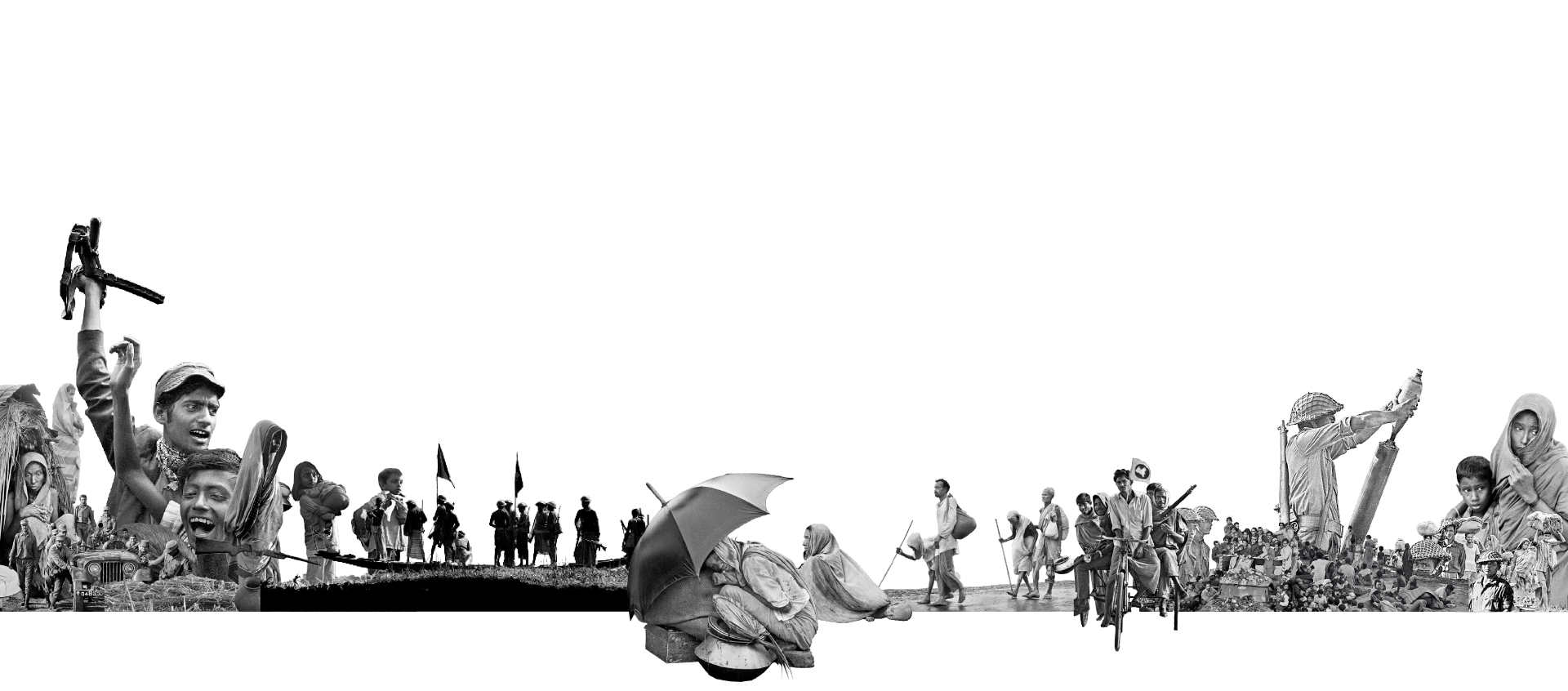
1971 was not fought only on battlefields. It was fought in voices, verses, frames and sketches. Before Bangladesh was born on the map, it was born in imagination. Artists helped create that imagination.
Music became the emotional backbone of the Liberation War. When fear travelled faster than news, songs travelled faster than fear. Abdul Jabbar stood at the centre of this musical resistance and his voice carried both grief and courage.
“Salam Salam Hajar Salam” honoured those who had already fallen. It taught people how to mourn without surrender. “Joy Bangla, Banglar Joy” transformed a political slogan into a collective chant. It entered streets, refugee camps and radio waves. “Ekti Phulke Bachabo Bole Juddho Kori” reduced the meaning of war to something fragile and human, a single flower worth saving.
Apel Mahmud carried the same spirit through Swadhin Bangla Betar Kendra. Broadcast from exile, his rendition of “Mora Ekti Phulke Bachabo Bole Juddho Kori” reached occupied Bangladesh through secret radios. The sound was often unclear, but the message was not. These songs reminded listeners that they were not alone. That the war was being fought for them.
“Purbo Digonte Shurjo Utheche” by Jagoroner Gaan carried a simple promise. Darkness was temporary. The sun would rise.

Film turned suffering into undeniable proof. Zahir Raihan understood that the world needed to see, not just hear. In 1971, he made “Stop Genocide”, a 20-minute documentary that exposed the atrocities of the Pakistan Army. Burnt villages, mass graves and endless lines of refugees. The film travelled internationally to influence public opinion and diplomatic response. It was cinema as evidence.
Zahir also made “A State Is Born”, imagining Bangladesh as a political reality before independence arrived. At the same time, his feature film “Jibon Theke Neya”, already a powerful allegory of oppression, was screened in Calcutta for freedom fighters. The film reminded them what authoritarianism looked like and why it had to end.



Theatre refused to stay silent or still. With no permanent stages, performance moved where people were. Padatik Natya Sangsad performed street plays in refugee camps and border areas. Their stories spoke of loss, occupation and resistance. Audiences gathered in circles. There were no tickets. Only urgency.
Theatre activist Fazlul Haque used performance as mobilisation. His work educated displaced communities and inspired those preparing to fight. Drama became instruction. Drama became solidarity. In the absence of formal institutions, the theatre built collective awareness.
Poetry shaped the emotional language of freedom. Shamsur Rahman’s “Shadhinota Tumi” did something rare. It gave independence a human form. Freedom became something one could see, touch and miss. His wartime poems circulated quietly, often handwritten, often memorised. They travelled faster than newspapers.
Al Mahmud wrote from the land itself. His poems carried rivers, fields and village life scarred by war. He ensured that rural Bangladesh was not erased from the story of independence. Loss, longing and return lived in his lines.
Literature bore witness and paid a brutal price. Munier Choudhury was an educationist, playwright and cultural critic. He believed ideas were acts of resistance. On December 14, 1971, he was abducted and murdered by collaborators. His death symbolised the attempt to erase Bangladesh’s intellectual future.
Shahidullah Kaiser worked quietly and dangerously. As a journalist and novelist, he documented atrocities under cover. He also helped coordinate logistics for freedom fighters. He disappeared days before victory. His absence remains a scar on Bangladesh’s literary conscience.
Art recorded what words could not. Zainul Abedin sketched refugees, hunger, and displacement during the war. His lines were direct. There was no embellishment. Pain was drawn as it was. These works remain among the most honest visual records of 1971.
Alongside cultural resistance stood armed courage. The Crack Platoon operated inside occupied Dhaka. Composed largely of students and civilians, they carried out daring guerrilla attacks. Their operations disrupted enemy control and lifted public morale. They proved resistance lived within the city itself.
Together, these contributors changed the horizon of a nation. They preserved dignity when survival was uncertain. They shaped memory before history could be written. 1971 was imagined before it was won, and artists made that imagination impossible to destroy.