




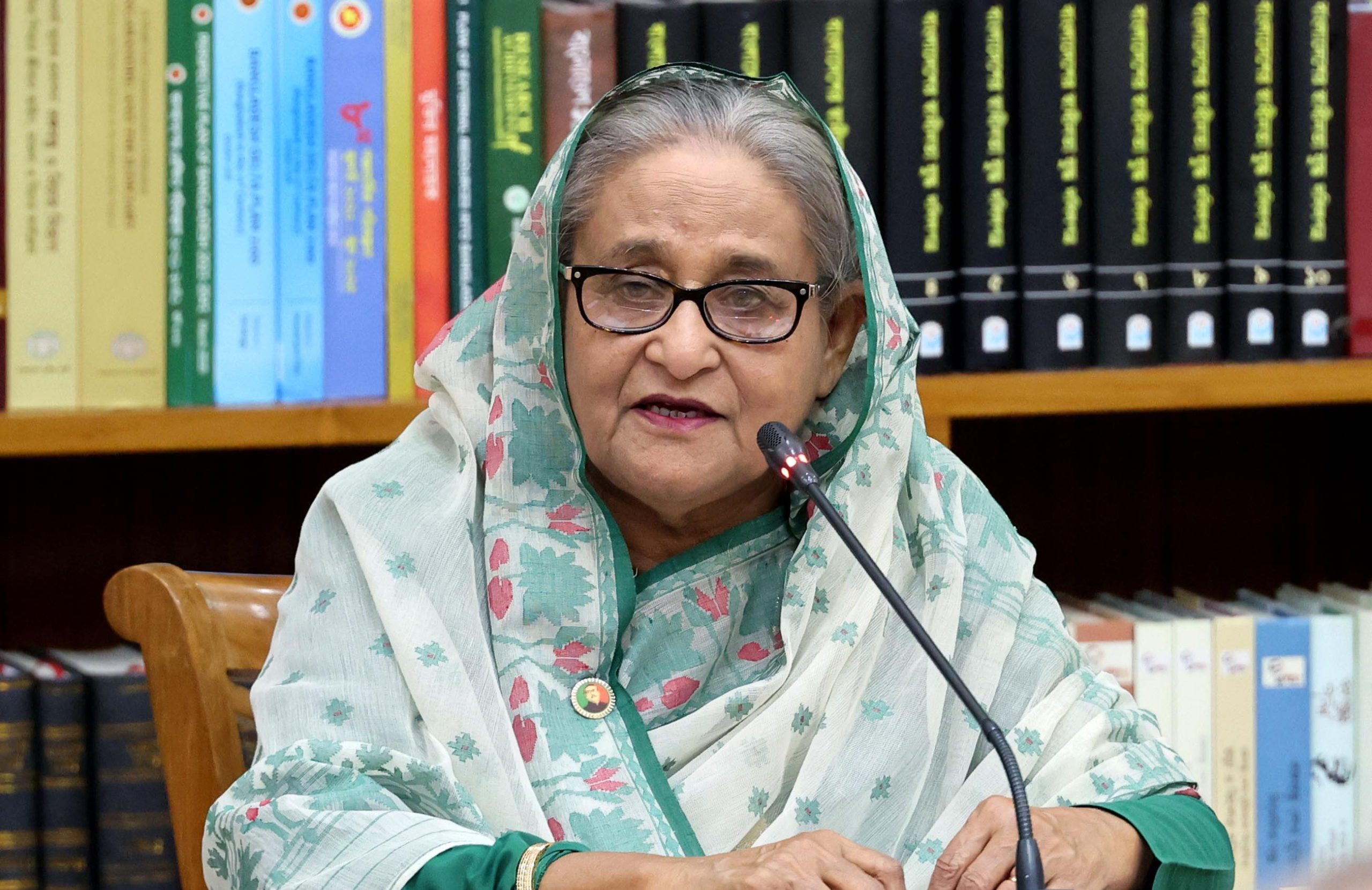
Following the massive uprising that toppled her government, ousted prime minister Sheikh Hasina fled to India on 5 August last year. New Delhi agreed to host her “for the moment,” but 15 months later she remains in the country. Early speculation suggested she might travel onward to London or seek asylum elsewhere, but that never materialised.
Experts now say that the narrative of short stay in India soon after she fled was merely a facade and that her stay was endorsed in an all-party meeting in New Delhi. To India, Hasina is a valuable bargaining chip that can be used to shape political developments in Bangladesh.
“India understands very clearly that Sheikh Hasina is the symbol of the Awami League and remains a relevant player in Bangladesh politics,” former ambassador Md Abdul Hye told TIMES of Bangladesh. At first, he said, India was cautious about how her prolonged stay might be perceived domestically.
Former ambassador Md Sufiur Rahman echoed the view. “After 5 August, India was buying time to observe the situation. It was difficult to believe she would leave for a destination less comfortable than India and where from she could enthuse her supporters and give them directions,” he said.
Beyond this proximity factor to keep her party united, if Hasina were in London or elsewhere, he added, it would have been harder for Delhi to manoeuvre within Bangladesh’s political landscape and regain lost influence.
According to multiple sources familiar with the political developments leading up to 5 August last year, Sheikh Hasina had been preparing to leave Bangladesh well before the uprising that toppled her government. These sources say the former prime minister always intended to take refuge in India and had no plans to move to any country that is a party to the International Criminal Court (ICC).
One source, speaking on condition of anonymity, confirmed that a senior Indian official visited Dhaka before 5 August and briefed Hasina on the rapidly evolving situation. The official reportedly assured her that India would make the necessary arrangements for her stay in New Delhi. Since her arrival, Hasina has been enjoying the full protocol and security typically extended to a foreign dignitary residing on Indian soil.
Another source with direct knowledge of the matter said early speculation that Hasina might seek political asylum in London or elsewhere served largely as a camouflage. “She would never consider settling in a country that is a member of the ICC,” the source said. “It would be far too risky for her. If any case were filed at the ICC and a summons issued, that country would be obligated to arrest her and hand her over to the international court.”
These accounts suggest that Hasina’s relocation was strategically planned long in advance and that India was her preferred—and likely only—viable destination given the legal and political risks associated with ICC-member states.
A calculated asset
Despite losing office, Hasina retains influence over Awami League networks and parts of the state machinery — and India recognises that.
“It is a tacit pressure tactic with its own political dynamics,” Ambassador Humayun Kabir told TIMES.
Ambassador Sufiur Rahman described Hasina as “a bargaining chip for India to influence both the present and future political discourse in Bangladesh and leverage that to retain influence and leverage as much as possible.”
According to him, the Awami League may not return to power for soon, but its return may happen sooner than initially thought due to lack of purpose and unity by the forces opposing AL and their inability to work together rising above divergences. That, he said, brings hope to India to regain some of the lost space and gives her every reason to strive to preserve leverage.
A long and strategic friendship
India has long considered Hasina an ally — a relationship that stretches back more than four decades. She and her sister Sheikh Rehana took refuge in India after 1975, and Hasina lived there for six years with her family. Today, analysts say her strategic value to India is even higher, as Indian foreign policy strategy towards her neighbours have not been without flaws and as Chinese shadow becoming longer.
“After the fall of the Hasina government, the power dynamics of Bangladesh were extremely fluid — students, the military, BNP, Jamaat and many others,” Ambassador Abdul Hye said.
India initially remained cautious, but as the situation evolved, “It not only understood the new power structure but also gained some ability to influence it,” he added.
He also noted that India has regained political space it felt it lost after the fall of the Awami League government.
Ambassador Sufiur Rahman pointed out that hosting political allies is not unusual for India. It is rather an inevitable thing, a compulsion. “Look at the Dalai Lama, who has been in India for decades,” he said, adding that India has also sheltered hundreds of Awami League leaders who fled after the government’s collapse. India must demonstrate that she cares about her political allies in the region, regardless of costs.


