






Despite enjoying duty-free access and strong trade relations, Bangladesh’s garment sector has struggled to increase its exports to Australia, with shipments stagnating at around $800 million annually for the past three fiscal years.
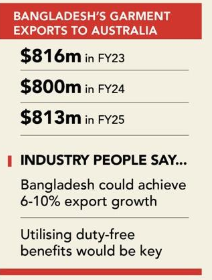
According to data from the Export Promotion Bureau (EPB), Bangladesh exported apparel worth $816 million in FY23, $800 million in FY24, and $813 million in FY25.

 Former BGMEA President Anwar-ul-Alam Chowdhury told TIMES that the stagnation is largely due to China’s market dominance, while local exporters often overlook emerging opportunities.

“Buyers in Australia typically place small orders, which doesn’t suit our volume-based apparel industry,” Chowdhury said.
He noted that while Bangladesh’s current export share of the Australian market is around 12 percent, it could reach 20 percent with better market alignment.
Bangladesh has enjoyed duty-free and quota-free (DFQF) access to the Australian market under its Generalized System of Preferences (GSP) for least developed countries (LDCs) since July 1, 2003.
This arrangement allows almost all Bangladeshi products, including garments, to enter the Australian market without paying duty, provided they meet the rules of origin and compliance requirements.
This facility is expected to continue for five more years after Bangladesh graduates from LDC status in 2026.
However, industry people believe there are untapped opportunities in the Australian market. Australia is currently diversifying its apparel sourcing due to growing risks associated with overreliance on China.
Shovon Islam, managing director of Sparrow Group, highlighted how Bangladeshi apparels are gaining traction in Australia thanks to their duty-free market access, strong sustainability commitment, internationally recognized labour safety standards, and diverse product range.
“Australia imported apparel worth $7 billion last fiscal year, with nearly 85 percent coming from China,” Islam said.
But ongoing global uncertainties, including tariff adjustments and supply chain disruptions, have prompted Australian retailers to explore alternative sources.
“So, Bangladesh, with its competitive advantages and policy support, could be the alternative,” he added.
One of Bangladesh’s key advantages lies in its duty-free access to the Australian market, which enables
Bangladeshi exporters to offer highly competitive landed costs. This is particularly attractive to Australian buyers operating in cost-sensitive retail segments.
“The elimination of duties significantly enhances price competitiveness for volume orders, improves margins, and allows faster inventory turnover for Australian brands,” said Mohammad Hatem, president of the Bangladesh Knitwear Manufacturers and Exporters Association.
Hatem added that with strong backward linkages, skilled labour, and growing investment in innovation and fabric development, Bangladesh is well-positioned to meet the dynamic product requirements of the Australian market.
Sparrow Group’s Islam also noted that many Bangladeshi factories now offer small minimum order quantity capabilities, catering to mid-sized and boutique Australian retailers. This is a crucial factor in a market defined by short fashion cycles and niche customer segments.
He projected that Bangladesh could achieve 6-10 percent annual export growth to Australia if proper steps are taken.
As Australia is in the Southern hemisphere, specialised factories for certain segments could use their capacity year-round, Islam added while urging for more efforts to capitalise on off-peak seasons and better serve Australian retailers.


