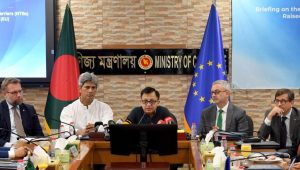
Bangladesh Bank Governor Ahsan H Mansur has instructed the Bangladesh Financial Intelligence Unit (BFIU) to submit reports of its activities, undermining the unit’s legal authority and independent functioning.
The intervention of the governor in BFIU activities has raised serious concerns about the intention behind such a move, since the unit deals with sensitive information.
A couple of former BFIU chiefs said the governor has no legal authority to demand reports from BFIU, while several central bank officials termed the move as “unprecedented.”
The governor’s office has issued a letter ordering BFIU to submit its reports covering the period from January 2024 to March 2025, and also monthly thereafter.
The letter, a copy of which was obtained by TIMES of Bangladesh, was issued on 6 April, raising serious questions about the independence of the intelligence unit.
According to the letter, BFIU will submit monthly reports of its activities directly to the governor’s office. The reports, containing sensitive intelligence, are being stored with the office of the governor’s personal secretary (PS), raising fears of them being leaked and misused.

The reports must list received complaints, CTRs (Cash Transaction Reports) and STRs (Suspicious Transaction Reports), actions taken, intelligence reports prepared during the period, those approved for action, and details of which agencies received them and their progress, reads the letter.
Signed by then-acting director Md Monir Uzzaman, the governor’s PS, and additional director Md Kamrul Islam, and joint director Mohammad Masum, the letter also instructed that information such as accounts frozen and unfrozen should be included in the reports.
“We sent the letter under orders from the authorities,” Monir Uzzaman said, but declined to give further details.
Since April this year, the unit has been submitting monthly reports, sources at the BFIU confirmed, adding that the reports covering activities from January 2024 to March 2025 have also been submitted.




Speaking to TIMES, BFIU deputy head Md Mofizur Rahman Khan Chowdhury said the unit is legally independent, though it depends on the central bank for human resources and operational costs.
He, however, claimed that both the governor and BFIU share the same goal, which is restoring order in the financial sector.
But Transparency International Bangladesh’s Iftekharuzzaman said no matter how noble the intention, responsible officials cannot break any rules that may vitiate the independent operations of such a crucial unit.
Former Bangladesh Bank chief economist Professor Birupaksha Paul told TIMES, “If the governor’s letter has violated the law and undermined the autonomy of the BFIU, then he was not right to issue it. Even if his intentions were good, the concern is that future governors could misuse this precedent for dishonest purposes.”
Expressing concern over sensitive information being stored with the governor’s personal secretary, he added, “If there is any link between him and predatory groups, it could cause serious harm.”
The governor did not respond to repeated calls, texts, and interview requests over the past three days. His PS, Kamrul Islam, also declined to make any comments.
Former BFIU chiefs said the governor has no legal authority to demand reports. Under FATF rules, the BFIU chief alone decides and is accountable only to the National Coordination Committee (NCC) chaired by the finance minister or adviser.
Several senior central bank officials, speaking anonymously, called the letter “unprecedented” and warned that those who signed it had “risked their jobs without realising it.”
Crisis-hit watchdog
Thirteen months after the government’s fall on 5 August, the BFIU remains largely inactive. Nearly three years after the High Court ordered it to sign treaties with the top ten destinations of illicit funds, only two deals have been secured.
The agency is crippled by scandals. One ex-chief is jailed, another was removed, and even shortlisted successors were tied to controversial business groups, Governor Ahsan H Mansur admitted in a recent interview with TIMES.
In the past 13 months, the BFIU has not been able to recover any funds or produce credible laundering estimates. Investigations into billions of siphoned money have yielded 66 prosecutions and six charge-sheets.
Ten industrial groups tied to the former Awami League leadership, including ex-prime minister Sheikh Hasina’s family, remain top recovery targets—but progress is negligible.
The High Court has twice rebuked the agency for “half-baked” reports.
Since 2012, an estimated Tk 2 lakh crore has been laundered. Hopes of recovery are fading fast, as the governor’s intervention fuels further questions about the independent functioning of the BFIU.