At the United Nations’ high-level climate summit on Wednesday, China, the world’s largest emitter of carbon dioxide, took a significant step in addressing climate change by announcing its target of reducing emissions by 7% to 10% by 2035.
Chinese President Xi Jinping’s statement marked a key moment as over 100 global leaders gathered to discuss urgent measures to combat climate change and its devastating effects, including extreme weather events.
With China responsible for more than 31% of global carbon dioxide emissions, this move is a critical development. Xi’s commitment also includes expanding China’s wind and solar energy capacity by six times its 2020 levels and making pollution-free vehicles a common feature. His vision is to build a “climate-adaptive society” in China, signalling a decisive shift toward cleaner energy and environmental responsibility.
The announcement came ahead of major international climate negotiations set to take place in Brazil, which are expected to play a crucial role in shaping the future of global climate action.
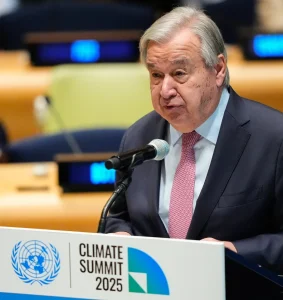
United Nations Secretary-General António Guterres led the summit, pushing for more aggressive actions to limit carbon emissions from fossil fuels, including coal, oil, and natural gas.
In a video address, Xi pledged that China would increase its wind and solar power sixfold from 2020 levels, make pollution-free vehicles mainstream and “basically establish a climate adaptive society.”

Xi and his Brazilian counterpart President Luiz Inácio Lula da Silva, also made statements on Wednesday afternoon that may have referred to US President Donald Trump’s attacks a day earlier on renewable energy and the concept of climate change. “While some countries are acting against it, the international community should stay focused on the right direction,” Xi said.
Guterres said, “The science demands action. The law commands it. The economics compel it. And people are calling for it.”
European leaders outlined their own ambitious targets. Ursula von der Leyen, President of the European Commission stated last week that EU member states had agreed to cut emissions by 66% to 72%. The European Union will submit its formal plan before the November climate talks.
Despite these positive developments, Jake Schmidt of the Natural Resources Defense Council cautioned that the targets set so far may not be sufficient to avoid catastrophic climate outcomes, warning, “these targets will not be enough to keep us safe from climate destruction.”




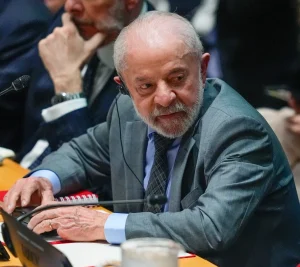
The summit also highlighted global concerns about climate change’s impacts, with leaders from vulnerable nations sharing their experiences. Brazilian President Lula, the host of the upcoming climate conference, stressed that no country is immune to climate disasters. “Nature does not bow down to bombs or warships. No country stands above another,” he declared.
Marshall Islands President Hilda Heine used the summit to call for urgent action, emphasising the devastating effects rising tides have on her nation’s hospitals and schools.
Pakistani Prime Minister Muhammad Shehbaz Sharif also addressed the summit, detailing the ongoing effects of devastating floods in his country, which claimed over 1,000 lives and displaced millions. The floods in 2022 also resulted in more than $30 billion in damages, mentioned Sharif.
Australia’s Prime Minister Anthony Albanese echoed the growing sense of urgency, describing the next decade as decisive for global climate action. “Australia knows we are not alone,” he said, referring to the increasing frequency of extreme weather events such as cyclones, floods, and bushfires.
Climate scientist Johan Rockström warned that the world is dangerously close to triggering irreversible environmental changes. “Warming appears to be accelerating,” he said, acknowledging the failure to protect vulnerable populations from the severe effects of human-induced climate change.
“We’re dangerously close to triggering fundamental and irreversible change,” Rockstrom said.
In a news conference, Lula said he invited both Trump and Xi to the November climate negotiations, saying it is crucial that leaders listen to scientists.
Under the 2015 Paris Climate Agreement, 195 nations are required to submit updated five-year plans for reducing emissions.
Before 2015, the world was on path for 4 degrees Celsius of warming since pre-industrial times, but now has trimmed that to 2.6 degrees Celsius Guterres said.
However, the Paris accord set a goal of limiting warming to 1.5 degrees Celsius since the mid-19th century and the world has already warmed about 1.3 degrees Celsius since.
UN officials said countries really need to get their plans in by the end of the month so the UN can calculate how much more warming Earth is on track for if nations do what they promise. Former US President Joe Biden submitted America’s plan late last year before leaving office and the Trump administration has distanced itself from the plan.
Simon Stiell, the UN’s climate chief, remarked that China’s new plan sends a clear message that the global economy is transitioning toward clean energy. He noted that stronger climate action would drive economic growth, job creation, and improved public health worldwide.
Despite some scepticism, particularly from former Colombian President Juan Manuel Santos, who called China’s target “too timid,” the commitment was largely seen as a positive development.
Santos, who is the chair of the group The Elders, urged China to adopt a more aggressive approach, stating, “China must go further and faster” in its efforts to combat climate change.