





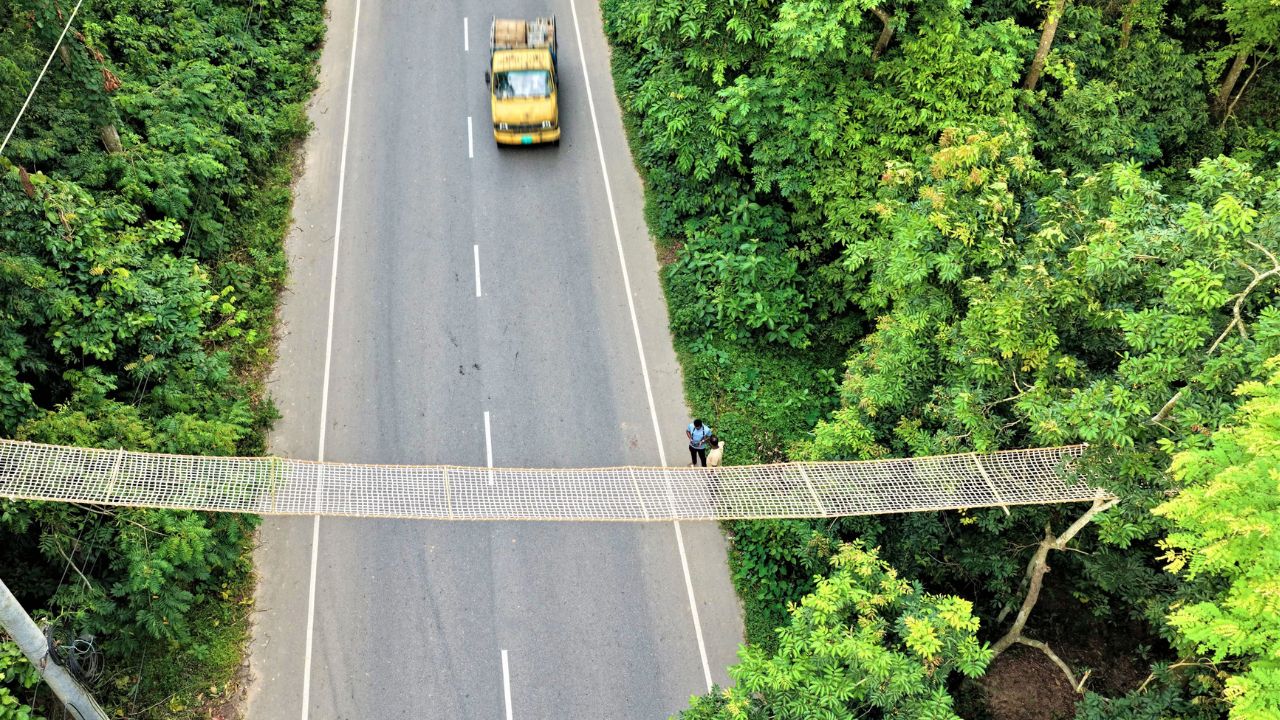
The Forest Department has built five ropeways in Tangail’s Madhupur Sal Forest to help wildlife safely cross roads and prevent deaths caused by speeding vehicles.
The innovative project is helping various species of wildlife living in the forest avoid accidents on highways by allowing them to move from one side of the forest to the other without coming down to the ground.

Forest officials said the effectiveness of the five pilot ropeways would be assessed, and if the results remain positive, more such ropeways would be built at vulnerable locations across the forest.

The ropeways are being used by monkeys and other tree-dwelling animals to cross the road safely while remaining on the trees.
According to the Tangail Forest Department, the construction of regional highways through Madhupur Sal Forest has fragmented wildlife habitats. Many animals, including the endangered-looking capped langur, often cross roads in search of food and breeding opportunities, only to be killed by speeding vehicles.
The Tangail-Mymensingh regional highway runs through Madhupur National Park, surrounded by dense forest on both sides. Animals living inside the forest frequently attempt to cross the road, putting their lives at risk.
To reduce wildlife deaths, the Tangail Forest Department has installed ropeways at five points along the highway passing through the national park.
The department said the total forest land under Tangail Forest Division covers 122,876.90 acres. Of this, 64,670.62 acres are reserved forests under Section 20 of the Forest Act, 1927, while the remaining 58,206.28 acres are acquired or assigned forest land notified under Sections 4 and 6.
However, around 39,000 acres of forest land have been illegally occupied. In addition, roads and highways running through forest areas have contributed to habitat loss. Deforestation, shrinking habitats and food shortages have pushed many wildlife species towards a survival crisis.
Experts believe that alongside building ropeways, ensuring forest conservation and a safe environment will bring positive changes in protecting Madhupur’s biodiversity.
Local residents said monkeys and langurs often come onto the highway in groups in search of food due to shortages inside the forest. Many pedestrians stop vehicles to feed them bananas, biscuits and snacks.
As hundreds of monkeys and langurs gather on the highway every day, many are killed after being hit by vehicles. Locals believe the Forest Department’s ropeways will significantly reduce wildlife deaths.
Gautam Chandra Chandra, divisional coordinator of the Bangladesh Environmental Lawyers Association (BELA), said food shortages force monkeys and other wildlife to come near highways in search of food, where they often become victims of road accidents.
“Building ropeways for monkeys and other wildlife is a commendable initiative by the Tangail Forest Department. It will reduce wildlife deaths and bring positive changes in protecting the biodiversity of the forest,” he said.
Professor Dr ASM Saifullah, chairman of the Department of Environmental Science and Resource Management at Mawlana Bhashani Science and Technology University, said the rare capped langur found in Madhupur forest prefers living on high tree branches and moves from one tree to another in search of food.
He said these animals are often injured after becoming entangled with electric wires along roads inside the forest, while many langurs also die after being hit by vehicles while crossing highways.
“Installing ropeways along highways near forest areas will reduce wildlife casualties. Such initiatives deserve appreciation for protecting nature and wildlife,” he said.
Mohammad Mosharraf Hossain, deputy ranger of Madhupur National Park Sadar Range, said the ropeways were constructed at vulnerable locations by connecting strong ropes between tall trees on both sides of the road using special techniques.
“As a result, monkeys, langurs, squirrels and other tree-dwelling animals can safely move from one side of the forest to the other without coming down to the ground,” he said.
Tangail Divisional Forest Officer Dr Abu Naser Mohsin Hossain said monkeys, langurs and nocturnal animals frequently die while crossing the paved road in this area.
“Although warning signs have been installed asking drivers to reduce speed, many drivers do not follow them. The ropeways have been built to ensure safe movement of tree-dwelling animals,” he said.
He said the ropeways were constructed under the Madhupur Sal Forest Restoration Project, through which monkeys, langurs, civets and other wildlife are now able to move safely.
The project began in April 2025 and is scheduled to be fully implemented by March 2028. With participation from local communities, five pilot ropeways have been constructed between Pochish Mile and Rasulpur Bazar under the project.


