


“With the previous salary, we were just managing to survive somehow. Now, players can hopefully live a little more comfortably and with less struggle.”
That was the initial reaction of Bangladesh’s first-class cricketer Shakhir Hossain Shuvro when asked how it feels to receive an increment in salary and match fees.
Tamim Iqbal is now at the helm of Bangladesh Cricket Board as the head of an ad hoc committee formed by the National Sports Council. Last Tuesday, the NSC dissolved the previous board due to irregularities in the election held on October 6, 2025, following a report from an independent probe committee.
In its second meeting, the ad hoc committee, with Tamim present, announced an increase in the centrally contracted first-class cricketers’ salaries and match fees. Earlier, Grade A players received BDT 35,000 monthly, while Grade B and C players received BDT 30,000 and BDT 25,000 respectively. Under the revised structure, Grade A players will now receive BDT 65,000, Grade B will receive BDT 50,000 and Grade C will receive BDT 40,000.
The match fee, previously BDT 75,000 across all grades, has also been increased. From the next four-day BCL tournament, players will receive BDT 100,000 per match.

The move has brought a sense of relief among local cricketers. With domestic competitions such as the NCL, BCL and DPL spread across the season, players often rely heavily on the Dhaka Premier League for a significant portion of their income.
When out of action, players still have to maintain fitness, stay match ready and cover their own preparation costs, which comes at a price. A pair of bowling spikes can cost at least BDT 25,000, while a quality match bat can cost around BDT 100,000 on average. Alongside that, expenses for protein supplements and fitness maintenance add further financial pressure. Altogether, managing these costs could consume nearly two months of a Grade A player’s salary.
Cricketers expect a stable and fair financial system that reflects the demands of modern domestic cricket. Beyond salary and match fee increases, they want consistent payments, better support for training, and a structure that doesn’t force them to depend on a single league for survival.
Simply put, if performance expectations are high, financial security and professional conditions should match them, allowing players to focus fully on cricket without constant pressure.




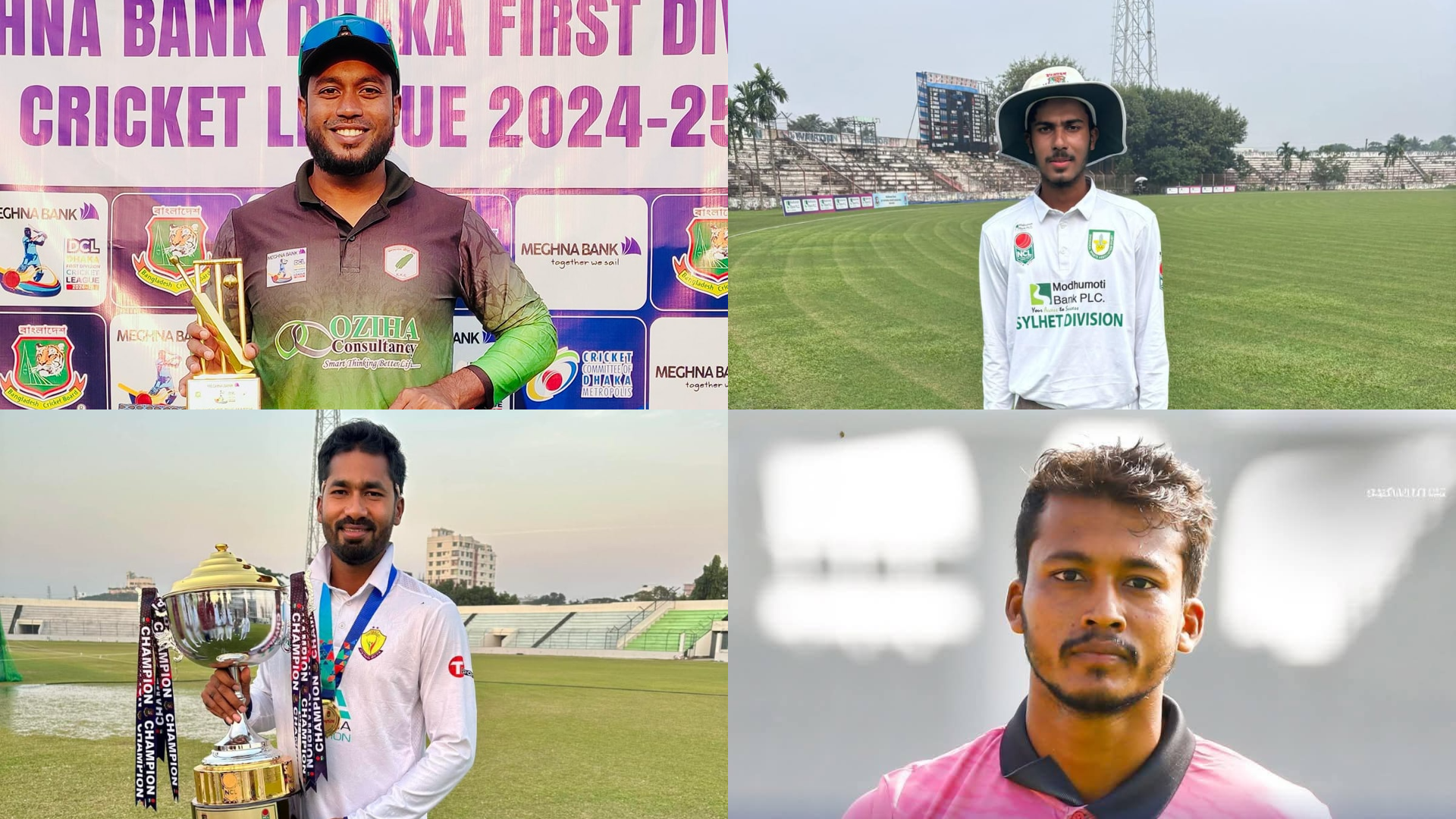
Fahad Hossain, a left-arm medium pacer from Chattogram Division, told Times of Bangladesh, “To be honest, managing things before was really tough. We couldn’t do anything comfortably. A good quality pair of spikes costs at least Tk 25,000. If you factor in protein supplements, spikes, kits, two to three months’ salary would be gone just like that.”
Fahad, who made his first-class debut in 2023, also welcomed the decision taken by the Tamim-led ad hoc committee. Reflecting on the recent increment, he said, “This has definitely been good for us as first-class players. There was always a gap when it came to covering our yearly expenses, and the previous pay was quite low. Now that it has increased, we can hopefully take better care of ourselves and manage those costs more comfortably. It already feels a bit better.”
A tone of quiet frustration was also evident in the words of Rajshahi Division wicketkeeper-batter Shakhir Hossain Shuvro, as he said, “This is something we deserved but didn’t receive for a long time. We raised this issue many times through the Cricketers’ Welfare Association of Bangladesh, which has been our main platform to voice concerns. We spoke about it repeatedly, and they also pushed for it. But at one point, I think you even reported that there was a proposal to increase it by Tk 5,000. We were not really willing to accept that, because such a small increase would not make any real difference.”
Cricketers like Shuvro have long looked to the board to address their financial struggles, as they had to manage themselves and bear their own expenses on limited income. However, he appreciated the newly formed ad hoc committee for focusing on the financial structure of red-ball cricket.
Shuvro added, “That’s why we were hoping for something more substantial, like what Tamim bhai has implemented now. For this, the ad hoc committee and Tamim bhai certainly deserve appreciation. At least now there is recognition that a first-class player needs proper financial support for preparation.”
He also expressed hope that the process will continue in the future development of red-ball cricket. “The thing is, they’ve increased it by 50 percent. You can’t expect a 100 percent increase all at once. This 50 percent rise is a start, and over time, as cricket progresses and the board becomes stronger financially, our cricket will also develop. Then, naturally, salaries will increase further. That’s how it works,” he added.
Robiul Haque, the right-arm medium pacer from Rangpur Division, echoed similar sentiments. He believes the increment should have come earlier. He said, “This should have been done much earlier. Because how can a first-class player survive on such a low salary?”
“Among all formats, if there is one that is the toughest and demands the most hard work, it is four-day cricket,” Robiul added, highlighting the demands of red-ball cricket. “If you think about it, even a normal person cannot lead a decent life on such a low income, yet we somehow try to maintain ourselves with these salaries. On the other hand, you expect 100 out of 100 in performance but pay us less money. So how is that possible?”
However, Robiul also acknowledged the initiative as a positive step. He believes salaries should increase gradually over time. “It may not happen all at once. Even now, if you look at the current salaries, Premier League contracts, and match fees, they are not enough in today’s market.”
He further pointed out the rising cost of equipment. “Equipment costs are very high. A pair of bowling shoes costs around Tk 25,000. A decent bat can cost about $1,000, which is roughly Tk 100,000. And you cannot manage your entire career with just one bat, you need two or three. So overall, the money we earn from the NCL is often spent just on equipment. Then there is family life and other expenses as well.”
Mubin Ahmed Dishan, the 19-year-old batter from Sylhet Division, who has a Shubman Gill-esque batting style and presence, also reflected on the changes. Coming off his maiden red-ball century last season, he said the announcement has been motivating for younger players.
He said, “The match fee was around Tk 75,000 to 80,000, I think. As both the match fee and the salary have been increased, this is very good for us. It will increase players’ interest and motivation to play. Overall, it’s a big positive. It will definitely motivate us much more than before.”