The government’s decision to keep procurement prices for Boro paddy and rice unchanged this season has sparked concern among farmers and agricultural experts, who warn it could lead to widespread losses and undermine food security.
Under the new policy announced after a meeting of the Food Planning and Monitoring Committee at the Secretariat on Wednesday, the government will procure 500,000 tonnes of paddy, 1.2 million tonnes boiled rice, and 100,000 tonnes of parboiled rice from the domestic market.
The procurement prices have been set at Tk36 per kilogram for paddy, Tk49 for boiled rice, and Tk48 for parboiled rice—identical to last year’s rates.
This marks a departure from previous years, when procurement prices were regularly increased. In 2025, the government raised prices by Tk4 per kilogram compared to the previous year, while increases of Tk2 were recorded in both 2023 and 2024.
Rising costs, static prices
The decision has drawn criticism even from within the government’s own agricultural machinery.
Salma Laizu, director of the Crops Wing at the Department of Agricultural Extension, described the pricing as “detached from reality”.
Speaking to TIMES of Bangladesh, she said the government had failed to account for rising production costs when setting procurement prices.

“Due to the fuel crisis, rising fertiliser prices, and supply disruptions, farmers’ costs have increased this season. At these rates, there is no possibility of profit; instead, farmers will face severe financial pressure,” she said.
The decision also appears to contradict the ruling BNP government’s election pledge, which promised to reduce production costs and ensure fair prices for farmers.
Farmers struggle under mounting pressure
On the ground, farmers say the situation is becoming increasingly unsustainable.
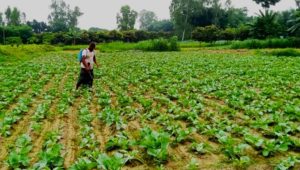
Mohammad Sujan Mahmud, a farmer from Jashore who has cultivated nearly two acres of Boro paddy, described a season marked by hardship.



He said there was a severe shortage of TSP fertiliser at the start of the season, forcing him to buy at higher prices from informal markets. Now, fuel shortages are affecting irrigation, with electricity supply unreliable and diesel difficult to obtain.
“If the selling price does not increase, I will incur losses of Tk2,000 to Tk5,000 per bigha,” he said.
According to his calculations, the cost of cultivating one bigha stands at Tk22,600. Including Tk9,000 in land rental, total costs rise to Tk31,600. With an output of 20 maunds, selling at Tk36 per kilogram would generate Tk28,800—resulting in a guaranteed loss on rented land.
Similar concerns were raised by Bapparaj Bappi, a farmer from Kishoreganj’s Itna upazila.
He said the price of a sack of urea fertiliser has risen from Tk1,300 last year to Tk1,600 this year. Potash prices have also increased, while ploughing costs have gone up from Tk2,500 to Tk3,000 per bigha.
Labour costs have seen the sharpest rise. Harvesting expenses have nearly doubled, from Tk7,000 per acre last year to Tk12,000 this season.
“If prices do not increase, we will be wiped out in the fields,” he said.
Experts warn of wider impact
Agricultural economist Jahangir Alam Khan has described the procurement price of Tk36 per kilogram as “completely unreasonable”.
“At least a Tk2 increase was necessary,” he told TIMES, warning that current pricing would inevitably lead to farmer losses.
The professor at Bangladesh Agricultural University also raised concerns about declining production.
According to international agency USAID, Boro output could fall by around 7.5% this season. However, he warned that under current conditions, the decline could reach as high as 10%.
“As Boro is the backbone of the country’s rice production, any drop will increase per-unit costs and push the agricultural economy towards a dangerous edge,” he said.
He further cautioned that continued losses could discourage farmers from cultivating in future seasons, posing a direct threat to national food security.
A policy without explanation
The Food Planning and Monitoring Committee—chaired by the home minister and comprising senior ministers from agriculture, food, finance, commerce and other key sectors—has not provided any detailed explanation for maintaining last year’s prices.
Repeated attempts by TIMES to obtain comments from multiple committee members were unsuccessful.
The absence of justification has added to concerns that the decision does not reflect current economic realities.
As production costs rise and returns stagnate, farmers warn that the consequences will extend beyond individual losses—potentially affecting the country’s overall food supply in the months ahead.