


Bangladesh’s treasury-bill yields have fallen below 9 per cent for the first time in nearly three years, but the easing in borrowing costs has done little to revive the stock market as investors focus instead on energy shortages, weak corporate prospects and the sustainability of the economic recovery.
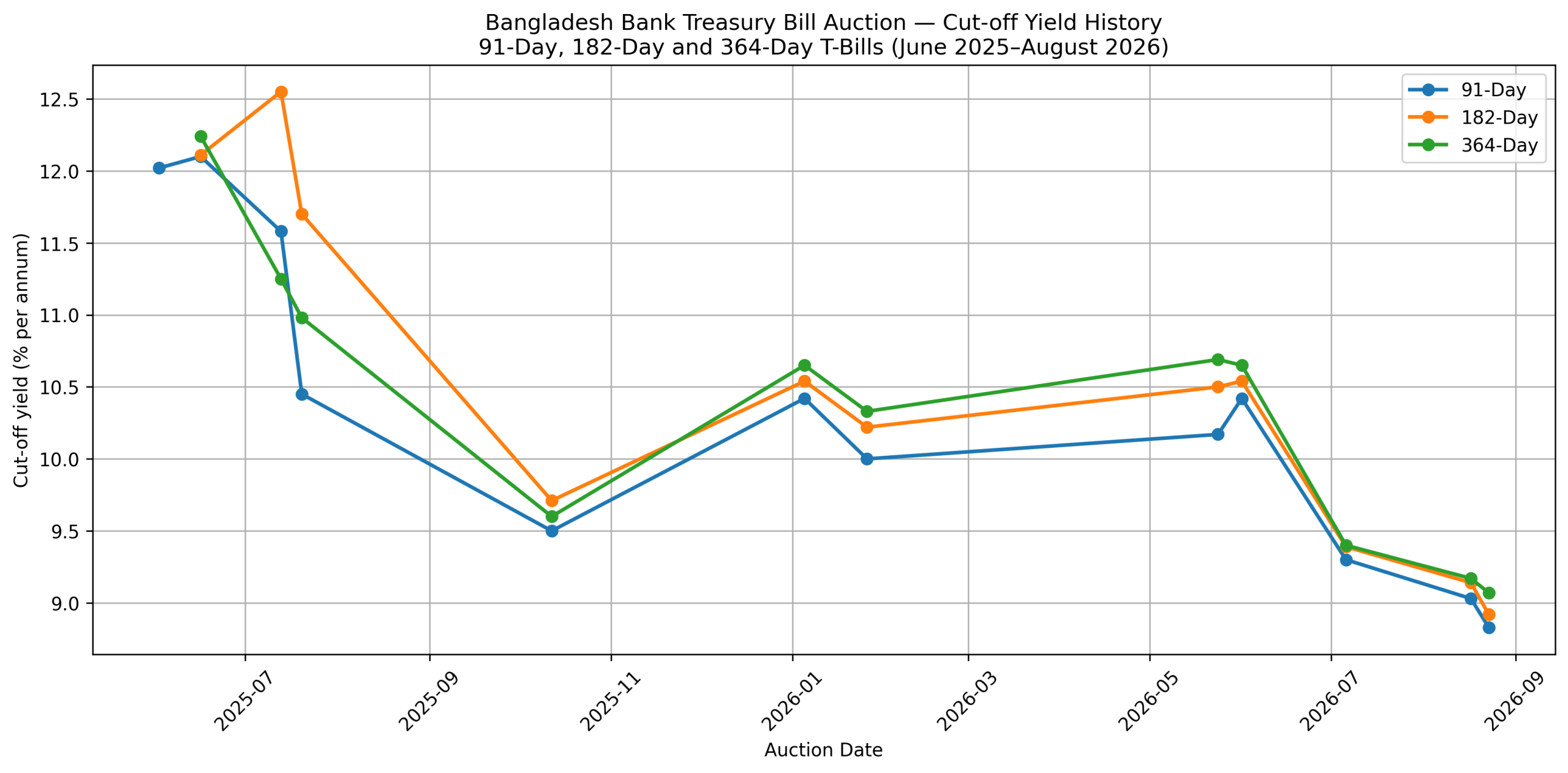
The 91-day treasury-bill yield fell to 8.8290 per cent at Sunday’s auction, while 182-day and 364-day yields dropped to 8.92 per cent and 9.07 per cent respectively, which were above 10 per cent at the beginning of June even.
That marks a sharp reversal from the rate shock of the past three years. The 91-day yield had climbed to 12.10 per cent in June 2025, with 182-day and 364-day yields reaching 12.11 per cent and 12.24 per cent respectively.
Yet low-yielding government securities have not triggered a rush into equities. The Dhaka Stock Exchange benchmark DSEX fell 63.9 points, or 1.1 per cent, to 5,722 on Sunday, its lowest level since July. Of 395 traded securities, 322 declined and just 32 advanced.
The divergence reflects a market where liquidity is improving but investors remain reluctant to take on corporate risk.
“Banks are preferring to buy treasury securities, causing yields to drop much below the policy rate,” said Asif Khan, chairman of Edge Asset Management.

Banks are finding fewer attractive lending opportunities as private-sector credit demand remains weak, leaving surplus liquidity to flow into government securities. That stronger demand has pushed T-bill yields lower.
The decline accelerated after Bangladesh Bank cut its policy rate by 50 basis points last month. The fall marks a dramatic change from October 2023, when 91-day bills yielded 7.32-7.45 per cent, 182-day bills 7.48-7.60 per cent and 364-day bills 8.05-8.25 per cent.
Tight monetary policy, high inflation, liquidity pressures and heavy government borrowing subsequently drove yields to record highs in less than two years.




Market participants now expect further easing if inflation continues to moderate.
“The market has liquidity and there are limited investment opportunities, so this reaction is natural,” said Sheikh Mohammad Rashedul Hasan, managing director and CEO of UCB Asset Management.
But lower rates have not translated into stronger equity demand. The DSEX had risen strongly earlier this year and tried three times since mid-July to break above 5,938.
The subsequent retreat has been driven partly by profit-taking and corrections in shares that had risen sharply, analysts said.
“A sharp decline in treasury yields would normally support the stock market,” said Shahidul Islam, managing director and CEO of VIPB Asset Management.
“But the stock market is going down because the recent rally was driven by price increases of some junk shares. Those shares are now going through a correction,” he said.
Mohammad Emran Hasan, managing director and CEO of Investit Asset Management, said investors were locking in gains after the broader market rose about 20 per cent this year.
Energy shortages and higher oil prices have added another layer of uncertainty, particularly for companies facing higher production costs.
Asif Khan said the energy crisis and geopolitical uncertainty were weighing on investment sentiment.
Some analysts also questioned whether the recent rate cut came before inflation had eased sufficiently. Headline inflation remained above 8.3 per cent in July.
The key issue for equities, therefore, is no longer simply the price of money.
Banks can benefit from gains on their treasury portfolios as falling yields lift bond prices, but stock investors need evidence that cheaper financing will translate into stronger corporate earnings and investment.
For now, that evidence remains limited for the majority of listed firms.
Each of the analysts, however, remained optimistic about the future of the fundamentally sound blue-chip stocks, which they still consider cheaper.