A wave of targeted shootings across Dhaka and beyond has fuelled fresh public anxiety, with grieving families raising concerns over hired gunmen, while police insist the violence is part of a routine crime cycle.
Several people have been killed and others wounded in contract-style attacks as the proliferation of firearms heightens tensions within the underworld, prompting rival gangs to assert dominance through violence.
A lethal combination of illicit arms, political rivalry and intelligence failures is driving the rise in targeted killings. Scores of firearms looted from police stations also remain unaccounted for, leaving dangerous weapons in circulation.
Relatives claim that professional hitmen and contract killers are carrying out attacks fuelled by territorial feuds, commercial rivalries and mounting political friction.
Police authorities, however, maintain that the spike is part of a natural cycle.
“Crime is like a wave; it ebbs and flows,” Khondker Rafiqul Islam, additional inspector general of police (Crime and Operations), told TIMES of Bangladesh. “Tensions exist in various areas, and illegal weapons remain in circulation, but arrests are being made daily.”
He added that law enforcement agencies remained fully active in curbing crime and apprehending offenders.
Criminologists point to deeper structural flaws, blaming easy access to illicit arms, operational lapses and intelligence failures for the bloodshed.
Professor Muhammad Omar Faruk of the Department of Criminology and Police Science at Mawlana Bhashani Science and Technology University warned that public order was on fragile ground.
“The government lacks a firm grip on weapons control. Targeted killings are escalating due to power struggles, business disputes and political friction. This trend is deeply alarming. Police must urgently step up intelligence and operational activities to stem the tide.”
Former inspector general of police Baharul Alam said political instability invariably unleashed violent crime.

“Killings surge when political activity resumes amid volatility,” Alam said, noting that criminals themselves were frequently targeted. “On average, around 10 people are killed nationwide every day, with Dhaka, Chattogram and Khulna bearing the brunt of the violence.”
Targeted killings trigger alarm
A string of targeted attacks has laid bare a deepening law-and-order crisis.
In Khulna, assailants shot dead two people in separate incidents within three days at Boro Khalpar in South Tutpara and near the railway line under Aranghata Police Station.
7In Bheramara, Kushtia, the bodyguard of businessman Monirul Islam Moni was shot when gunmen opened fire on his speedboat on the River Padma.
In the capital’s Dainik Bangla area, gunmen missed their intended target. In Kafrul, shots fired at a Jubo Dal leader went astray, killing one person and injuring another. After local people detained a suspect carrying a firearm, police learned that a professional killer had allegedly been hired from Jhenaidah.
In Hathazari, Chattogram, assailants opened fire on the moving off-roader of brickfield owner and property businessman SM Shahidullah.
On 3 January, BNP leader Alamgir Hossain was gunned down in Jashore’s Shankarpur area. Barely 48 hours later, Jubo Dal leader Jane Alam Sikder was killed in Raozan, Chattogram, by three masked gunmen on a motorcycle.




In Chattogram, Union Shramik Dal leader Abdul Mannan was shot dead on his way home last November, days after Chattogram-8 BNP candidate Ershad Ullah survived a campaign shooting that killed a bystander.
In Dhaka, the violence has claimed Jubo Dal’s Golam Kibria in Pallabi, Tarik Saif Mamun near the court premises and Swechchhasebak Dal leader Azizur Rahman Mosabbir in Tejaturi Bazar. Underworld figure Khondker Naim Ahmed Titon was killed in broad daylight in New Market on 28 April.
Omar Faruk warned that illicit arms were now being openly traded online.
“This easy access is driving up the body count and fostering a dangerous contempt for the law,” he said.
Trail of wounded victims
A series of targeted shootings has also left numerous people seriously injured.
In Gazipur on 9 January, an NCP activist was shot and robbed of his motorcycle by fleeing assailants.
On 3 April, 31-year-old Jubo Dal activist Russell was critically wounded in an attack at Dhaka’s Nayabazar Park. Another targeted shooting took place in Pallabi on 9 June following an internal dispute.
On 14 July, gunmen opened fire on a betel shop near UN Shishu Park, targeting a group that included Khulna Sadar BNP office secretary Lelin and four local journalists: Awal Sheikh, Syed Humayun Kabir Rana, Rakibul Islam Mati and Rafiul Islam Tutul.
Three days later, businessman Ramiz Uddin, 32, was critically wounded in Chakaria, Cox’s Bazar. Further attacks have been reported in Satkania, Chattogram, Khulna, Mirpur and Benapole.
Growing underworld arsenals
Behind the violence lies a large stockpile of illicit weapons. Intelligence sources say more than 2,000 illegal firearms and substantial quantities of ammunition are held by over 400 identified suspects in the capital alone.
Police records point to armed syndicates operating across Dhaka, including in Mirpur, Pallabi, Mohammadpur and Motijheel. In Pallabi, gangs are reportedly using dedicated armed cadres to carry out contract killings.
Baharul Alam acknowledged the scale of the crisis, warning that illegal weapons had long blighted the country and remained in the hands of dangerous criminal networks.
Police struggle against influx
According to Police Headquarters, law enforcers recovered 325 firearms and 638 locally made weapons during special operations nationwide between May and July. A total of 1,42,000 people were arrested on various charges during the period.
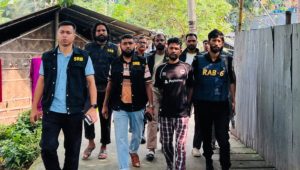
A crackdown launched on 1 May recovered 243 firearms and led to the arrest of more than 500 suspects.
However, 1,328 weapons looted from police stations and prisons remain unaccounted for.
Dhaka Metropolitan Police recorded 90 arms cases and seized 86 weapons between January and May.
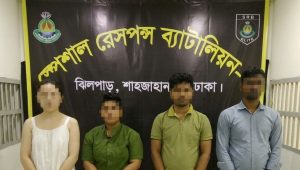
On 17 July, officers in Motijheel dismantled an extortion ring, arresting alleged gunman Tanim Reza, alias Bappi, and four accomplices, and seizing three imported handguns and live ammunition. In another incident, police recovered a firearm after stopping a sports car in Gabtoli.
Coastal and border regions remain major entry points for illegal weapons.
In Chattogram, Arms Act cases rose from 548 in 2024 to 624 in 2025, with another 302 cases filed in the first half of this year. Senior officers acknowledge that porous land borders and smuggling routes along the Bay of Bengal continue to supply firearms.
Looted weapons remain missing
Official police records show that 3,619 service weapons were looted from police stations across the country on 5 August 2024.
Law enforcement agencies have recovered 2,259, or roughly 62 per cent, leaving about 1,340 weapons missing.
Baharul Alam said the missing weapons included Chinese rifles, tactical shotguns and about 400 semi-automatic pistols.
However, he noted that criminals were largely choosing black-market weapons over looted police arms because stolen service weapons were easier for investigators to trace.
Murder cases rise
Political violence and targeted attacks are contributing to an alarming rise in homicides.
According to the Human Rights Support Society, political clashes in the first half of this year left 56 people dead and 5,246 injured. The casualties included 37 BNP and six Jamaat-e-Islami activists.
In 2025, political violence claimed 79 lives and injured more than 4,100 people.
Police records show that murder cases rose to 3,785 in 2025, up by 353 from 3,432 in 2024. July was the deadliest month, with 362 cases, followed by June with 344 and May with 341.
Monthly totals in 2024 generally ranged between 200 and 300, apart from an August spike caused by the delayed registration of cases from previous years.
The influx of illegal firearms, contract killings and gang warfare points to a deepening public safety crisis as criminal networks expand their reach across Bangladesh.