


Abu Taher
Students’ politics has always been a decisive force in shaping the future leadership of Bangladesh. This tradition is not built on academic merit alone but on a deep understanding of political dynamics. After its establishment in 1921, Dhaka University became the central ground of politics and the nerve centre of the country, opposing the repression, deprivation, and misrule imposed on the people during the Pakistan government, and even after independence of the country.
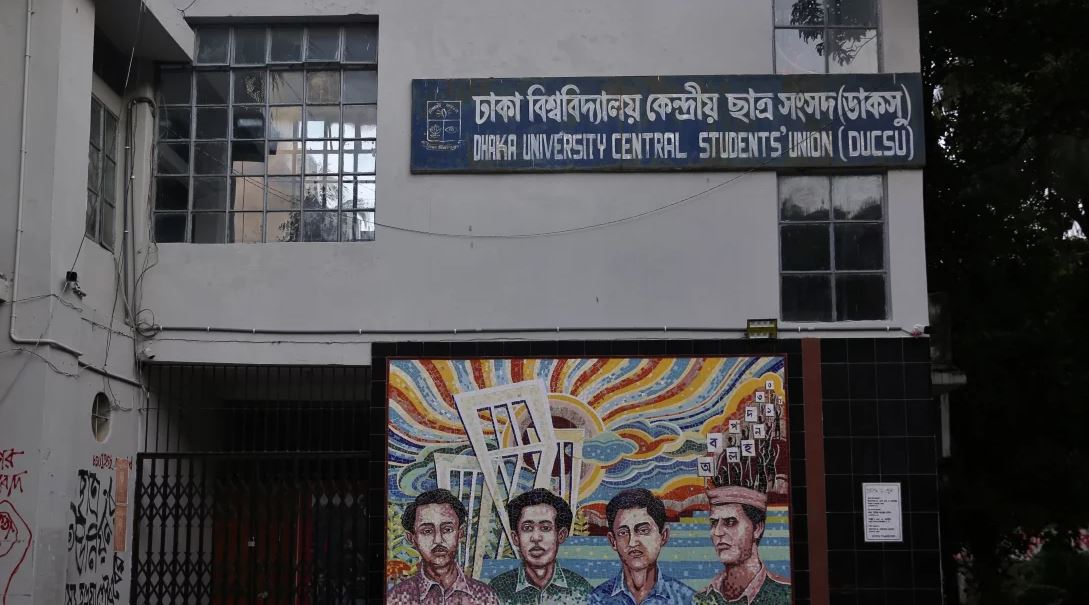
The evolving glory of Dhaka University are derived from the extracurricular activities through DUCSU that calibrates the students to that level of serving the nation. We witnessed that over time DU produced a number of political alongside other professionals who played pivotal roles in nation-building through their knowledge, leadership, and acumen. Their clarion calls inspired the masses to fight for the Language Movement in 1952, the Six-Point Demand in 1966, the mass uprising in 1969, the Liberation War in 1971, the anti-dictatorship movement in the 1990s, and the recent July mass upsurge against fascism in 2024.
Students’ politics are deeply intertwined with the history of Bangladesh. After the establishment of Pakistan, one of the first major threats came to the Bengali language. Students and teachers at Dhaka University were among the first to realize the adverse effects on education and employment if Urdu were imposed as state language. They protested and sacrificed their lives to establish Bangla as a state language. The university has since remained a focal point for Bengalis in joy and sorrow, courage, determination, and commitment to justice for nearly seven decades.

During the infamous Agartala Conspiracy Case, which centred on the Six-Point Demands for autonomy of East Pakistan (Bangladesh), the entire student community led by the Dhaka University Central Students’ Union (DUCSU), came forward and protested vigorously and contributed to raising millions of hands support in favour of our independence. The spirit of resistance nurtured by these students ultimately fuelled the independence movement of Bangladesh.
The rhetoric is not over, in the 1990s student-led mass uprisings ousted an autocratic government, paved the way for multi-party democracy. In 2007, students’ unrest at Dhaka University challenged the legitimacy of the then army-backed government, which later spread nationwide, led withdrawal of military influence and holding free and fair elections in 2009. Again, students came as avant-garde it began with a midnight rally on the Dhaka University campus on July 15, 2024, initially calling for rational reforms in the government job quota system, later on evolved into a mass upsurge and ultimately culminated in the ouster of the decade-old authoritarian regime on August 5, 2024.




Drawing the above lines, we understand that student politics at Dhaka University has historically emerged as the antidote to misrule. The university—long regarded as the “Oxford of the East”—has been the breeding ground of movements that reshaped the nation: Again and again, Dhaka University students have broken the shield of authoritarianism and toppled those who sought to cling to power indefinitely.
Following the July 2024 movement, the long-standing demands for student parliament elections in universities have gained unprecedented strength. It is not only students but the nation as a whole that awaits these contests. Leadership cannot grow in a vacuum; student union elections are crucial to developing the next generation of honest, and competent leaders. The first step lies in holding free and fair Dhaka University Central Students’ Union (DUCSU) elections in 2025.
This year though no grave manipulation in DUCSU election has been reported, the results startled the observers. The Chhatra Shibir panel swept over the 19 posts, reflecting a deeper shift in student sentiment. Many wonder why students rejected both left- and right-wing parties tied to the Awami League, BNP and others. The answer lies in the mindset of Gen Z. To them, the Awami League and BNP are two faces of the same coin: dynastic, self-serving, and corrupt. Having grown up under the Awami League’s long rule, they are weary of repression and disillusioned by the BNP’s failure to provide an alternative. To this generation, Islamic-oriented parties appear as fresh players who might resist the entrenched culture of amassing wealth and prioritize national over partisan interest.
History supports the claim that DUCSU elections can foreshadow national election outcomes. In 1990, even under dictatorship, fair DUCSU polls gave the Bangladesh Nationalist Chhatra Dal an overwhelming majority. Within a year, the BNP swept to power in the 1991 national election. Nearly three decades later, in 2019, another DUCSU election sent a similar signal: Nurul Haque Nur, the face of the anti-quota movement, defeated the ruling party’s candidate for vice president by a landslide. The result, bitterly contested by the Bangladesh Chhatra League, proved a portent of the Awami League’s eventual collapse in 2024.
The lesson is clear: DUCSU is not a trivial exercise—it is a mirror of national politics. If current patterns hold, the BNP may find little traction with Gen Z. Their preference for smaller or Islamic-oriented forces could signal a new trend in Bangladeshi politics: the fragmentation of power and the rise of fresh players in government formation.
In the end, the DUCSU election is more than a campus affair. It is a rehearsal for national change, a barometer of the people’s discontent, and perhaps the opening act of Bangladesh’s next political transformation.
The writer is a journalist and a communication professional