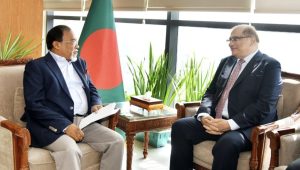
Bangladesh and China have agreed to jointly implement the Teesta mega plan, a key component of the BNP’s election manifesto. Dhaka has also joined China’s Global Development Initiative (GDI) and agreed to introduce Mandarin language education into the school curriculum.
The issues were discussed during bilateral talks between Prime Minister Tarique Rahman and Chinese Premier Li Qiang in Beijing. Tarique is scheduled to meet Chinese President Xi Jinping today, prime minister’s Adviser Mahdi Amin told a press conference following the talks on Thursday.
Regarding the Teesta project, Mahdi said China had expressed interest in being involved throughout the entire process—from project definition and planning to execution—by providing technical support and expertise.
He described the Teesta initiative as a mega plan that would utilise Chinese expertise in comprehensive water management, particularly in drainage systems.
“Both countries agree that a joint feasibility study is essential for a project of this scale, and China has offered to work with Bangladesh on the assessment,” he said.
Political relations
The two leaders discussed the future of Bangladesh-China relations, focusing on elevating the partnership to a strategic level based on mutual respect, regional stability and historical continuity.
“The relationship is moving from a comprehensive partnership to a strategic partnership, which will take bilateral ties to a new height,” Mahdi Amin said.

According to him, China expressed full support for Tarique’s leadership and governance, saying it was optimistic about Bangladesh’s progress under the current administration.
He added that China views the present government as a democratically elected one that reflects the will of the people, providing a foundation for national stability and economic development.
13 MoUs signed
Following the bilateral meeting, the two countries signed 13 memorandums of understanding (MoUs) covering a wide range of sectors aimed at strengthening strategic and economic cooperation.
The agreements include cooperation on the Global Development Initiative, trade and investment, transport and connectivity, port development, logistics, education, concessional loans, human resource development and media cooperation.
Mahdi Amin said the concessional loan agreement seeks to reduce interest rates and extend grace periods, while the GDI framework focuses on health, education and human resource capacity building.


Two separate MoUs were signed on technical and vocational education. Another agreement aims to boost Chinese investment in economic zones in Anwara and Mongla through the establishment of new factories and production facilities, creating employment opportunities.
An MoU was also signed to facilitate the export of jackfruit, Bangladesh’s national fruit, to China. Four additional agreements focus on media cooperation, think-tank collaboration and cultural exchanges.
Regional and global diplomacy
Both countries emphasised the importance of regional cooperation and stability in South and Southeast Asia, Mahdi said.
He noted that China recognised Bangladesh’s growing international stature and its constructive diplomatic role in addressing strategic issues.
“China expressed support for Bangladesh’s potential integration into BRICS,” he said.
On the Regional Comprehensive Economic Partnership (RCEP), he added, “China welcomes Bangladesh’s intention to join the bloc.”
Infrastructure and investment
Several infrastructure projects and industrial investments were discussed to further strengthen bilateral ties.
Mahdi highlighted China’s contribution to Bangladesh’s physical development, particularly in transport and connectivity.
The two leaders discussed Chinese assistance for the construction of roads, bridges and tunnels, as well as cooperation in the electric vehicle sector and infrastructure development. Specific development projects for Mongla Port also featured in the talks.
China has also shown interest in investing in Bangladesh’s logistics sector to support production and trade.
“Strategic plans are in place to increase Chinese investment in Bangladesh’s industrial landscape, with new economic zones and industrial parks expected to create jobs,” he said.
Investment plans are focused on economic zones in Anwara and Mongla. Bangladesh is also being considered as a hub for relocated Chinese production facilities as industries in China move up the value chain.
The sectors identified for future investment include garments and textiles, high technology and the digital economy, pharmaceuticals, ceramics, agriculture, fisheries and green development.
Mahdi Amin said several Chinese banks are interested in operating in Bangladesh, citing opportunities in the country’s evolving financial sector.
Rohingya crisis
China intends to play a facilitating role in resolving the Rohingya crisis, which Bangladesh considers one of its major national security concerns, Mahdi said.
“China has expressed its willingness to facilitate dialogue between Bangladesh and Myanmar to move towards a solution,” he said.
He added that Beijing aims to support a voluntary, safe and dignified repatriation process for the Rohingya people.
China’s involvement in the Myanmar crisis is also linked to its broader objective of maintaining stability in South and Southeast Asia.
“The Chinese premier indicated that China will always stand for positive cooperation in assisting Bangladesh on this issue,” Mahdi said.