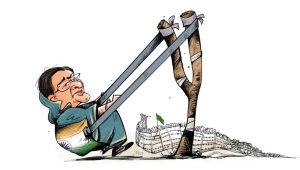
Should the Awami League, which already faces a ban on its political activities, be erased from the constitution or confronted in the political arena? That question has fractured the ruling BNP, when a volatile backdrop of escalating street violence ignites urgent cross-party talks.
Grassroots violence allegedly carried out by Awami League activists has drawn sharp scrutiny across the political spectrum, bringing rival parties back to the negotiating table. The push for dialogue coincides with remarks by senior ministers over the weekend floating a constitutional ban on the party amid a surge in sabotage linked to its cadres.
Yet even as Prime Minister Tarique Rahman moves to forge a united front among the anti-fascist forces of the July mass uprising, deep divisions remain over the endgame: whether to dismantle the former ruling party through constitutional engineering, or defeat it at the ballot box and in the courts.
A divided ruling party and escalating unrest
The push for a permanent ban gained momentum on Saturday when State Minister for Local Government Mir Shahe Alam told journalists in Rangpur that the interim government’s earlier prohibition of the Awami League had been “proven correct and justified.” He suggested that the time had come to permanently ban the party via a constitutional amendment, adding that the government and opposition would seek consensus to do so if necessary.
Later that evening, Minister for Law, Justice and Parliamentary Affairs Md Asaduzzaman confirmed that the administration was actively examining the legal avenues for such a move, insisting the government would strictly follow lawful channels rather than arbitrary measures, though “only time would tell” how a final decision would be reached.

Yet behind closed doors, the ruling BNP is sharply divided. Party insiders reveal two competing factions: one advocating an outright legal ban in light of the Awami League’s past record, and another arguing that individuals guilty of crimes should face justice while the party itself is confronted politically.
Speaking on condition of anonymity, a member of the BNP Standing Committee warned that formally banning the Awami League would only drive its “subversive activities” further underground, arguing it would be far wiser to counter the party in the political arena.
These deliberations unfold against a backdrop of severe nationwide violence. Amid speculation over deposed prime minister Sheikh Hasina’s possible return to Bangladesh in December, party activists have been accused of orchestrating crude bomb blasts and arson attacks across multiple districts.



Police have reported widespread vandalism targeting law enforcement vehicles and facilities, alongside arson and petrol bomb assaults on 72 branches of Grameen Bank. At least five people, including three BNP leaders, have been killed in the unrest so far.
PM initiates high-stakes dialogue
Seeking to contain the crisis, Prime Minister Tarique Rahman has launched a series of bilateral talks with the political forces that spearheaded the July uprising, aiming to revive the collective unity seen during that movement.
The dialogue begins at noon on Monday with a four-member delegation from the National Citizen Party (NCP), led by its Convener and Opposition Chief Whip in the Jatiya Sangsad, Nahid Islam, alongside Senior Joint Conveners Nasiruddin Patwary and Hasnat Abdullah, and Senior Joint Member Secretary Sarjis Alam.
Speaking to TIMES, NCP Joint Convener Sarwar Tushar clarified that the party would attend Monday’s talks independently rather than as representatives of the broader 11-party alliance, noting that the government was recognising the NCP’s distinct role as a primary stakeholder in the July uprising.


Tushar outlined an ambitious agenda for the meeting, saying the NCP would press the prime minister on the implementation of the referendum verdict, the trial of the Awami League as a “fascist organisation,” justice for the July killings, enforcement of the verdict against Sheikh Hasina, and the renewal of the Ganges water-sharing treaty.
Crucially, the NCP plans to confront the BNP over why post-July unity fractured, alleging that elements within the ruling party and the government have attempted to rehabilitate the Awami League’s political space since 2024, with Tushar warning the delegation might even name specific individuals responsible.
On the question of a constitutional ban, Tushar maintained that while judicial proceedings must not be predetermined, political consensus was vital, “If all political parties believe that the Awami League no longer has a place in politics and can no longer operate as the Awami League, that should be considered the sovereign decision of the people,” he said, adding that a public referendum could follow initial party consensus.
Opposition demands clarity, analysts warn of ‘pandora’s box’
Meanwhile, Jamaat-e-Islami, which is expected to receive its formal invitation for talks with the prime minister by Monday, pending the return of the opposition leader, has remained cautious. Jamaat Assistant Secretary General Ahsanul Mahboob Zubair told TIMES that individual ministerial remarks do not constitute a clear government policy. “If such a proposal comes, the responsible leaders of our party will discuss the matter together and make a decision,” Zubair said. He stressed that Jamaat’s priority in meeting Tarique Rahman would be the implementation of the July National Charter and holding the BNP accountable for rebuilding the national unity he said the ruling party had allowed to collapse after July.
Political analysts, however, are sounding the alarm over the long-term perils of constitutional prohibition.
Asif Bin Ali, a Doctoral Fellow at Georgia State University, described the calls for a ban as “primarily political statements rather than arguments for a practical solution,” noting that Bangladeshi politicians frequently shift positions without accountability.
He warned that outlawing the Awami League would open a “Pandora’s box,” as the exact same legal and political rationale could be weaponised against other parties, such as Jamaat-e-Islami, whenever power changes hands. “It seems that politics is being given greater importance than justice here,” Ali told TIMES, arguing that administrative bans cannot resolve deep-seated political crises.
Bangladesh, he concluded, stands at a crossroads: it can either strengthen its democratic transition through transparent, credible trials of individual offenders, or risk deeper instability by pursuing a path of political prohibition whose consequences remain dangerously unpredictable.