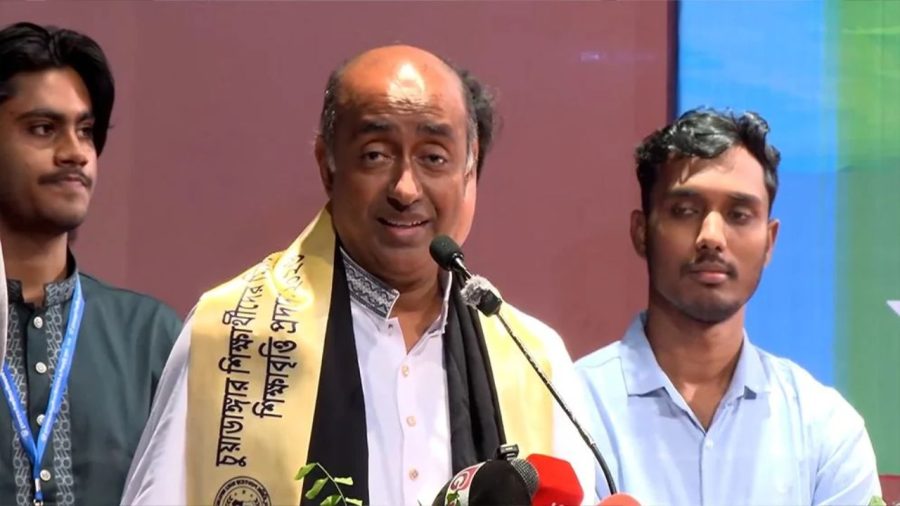



The government is examining the legal options regarding a possible ban on the Awami League, while also reviewing whether the party’s alleged violence in Gopalganj should be brought before a tribunal, Law Minister Md Asaduzzaman has said.
He made the remarks in response to questions from journalists on Saturday evening after attending a reunion and scholarship distribution programme for students from Chuadanga living in Dhaka at the National Museum.
Referring to the recent violence in Gopalganj, the minister said the Awami League had apparently expected the government to respond with gunfire.
“But this government will not follow their path. We will deal with the situation in accordance with the law,” he said.

He accused the Awami League of creating a shameful chapter in the country’s history through mass killings, adding that the party had shown no remorse for its actions.
Earlier, addressing the programme, Asaduzzaman said they had never imagined that Bangladesh would witness one of the world’s worst forms of fascist rule between 2009 and 5 August 2024.




He claimed that around 4,500 of their fellow activists were killed by gunfire over the 16-year period while participating in movements demanding democracy, voting rights and the “Save the Country, Save the People” campaign.
Many of these killings were subsequently portrayed as incidents of “crossfire”, he alleged.
The minister also claimed that more than 700 activists had been picked up and forcibly disappeared, with many still missing.
He said families of the missing continued to wait for their loved ones, with relatives regularly praying for their safe return and shedding tears during prayers.
Asaduzzaman further claimed that hundreds of thousands of opposition leaders and activists had suffered permanent disabilities while fighting for democracy.
He alleged that around 60 lakh BNP leaders and activists faced political persecution for speaking in favour of democracy, the rule of law and human rights.
The law minister expressed gratitude to the Gen-Z generation for its role in helping the country emerge from what he described as a difficult period.
He said the younger generation had not forgotten its own suffering, the pain of losing family members, the anguish of bereaved relatives or the cries of friends and fellow activists.
He added that they would continue working alongside the younger generation to build the Bangladesh of the future.