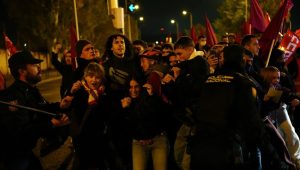
Clashes broke out between masked groups and police in Barcelona after tens of thousands of people joined Spain’s first general strike in 14 years, organised by the country’s major trade unions over housing affordability and the rising cost of living.
Around 120,000 people attended a demonstration in Madrid, while more than 50,000 took to the streets of Barcelona. Footage showed masked individuals setting fire to rubbish bins and smashing shop windows as police fired tear gas to disperse them, reports BBC.
The strike caused significant disruption to transport and other public services across Spain.
Spaniards are scheduled to vote in parliamentary elections on 29 November.
The head of the UGT trade union, Pepe Álvarez, described the strike as a success, citing “massive” participation. Unai Sordo of the CC OO union also said turnout was “very significant”.
Police maintained a heavy presence in central Barcelona on Wednesday evening, with officers wearing helmets and carrying riot shields.
Some of the clashes occurred along Passeig de Gràcia, near the city’s iconic Plaça de Catalunya. Rubbish bins were set ablaze, with fires burning in the middle of streets.
Local media reported that a group of people fired fireworks at police and looted several shops, including a Lego store. Some protesters also attempted to enter the Apple Store.
A woman who attended the Barcelona demonstration told the BBC that the protest had been largely peaceful and “joyful”. She said she joined the rally to protest against high housing costs, adding that “there were a lot of children and old people there”.

However, she witnessed fires across the streets while in the Las Ramblas area in the evening. “The fires were everywhere, it was very intense,” she said.
Earlier in the day, traffic came to a standstill on several major roads in and around Madrid and Barcelona, causing widespread disruption.
The interior ministry said police had arrested dozens of people over various incidents. Spanish media also reported attacks on the offices of estate agencies.
“We’ve completely brought the city to a standstill,” a protester in Madrid told Reuters, describing widespread public support for the strike. “Everyone’s out there, despite the rainy weather; everyone’s out on the streets.”
Another demonstrator, 37-year-old teacher Olga Domingo, said she joined the protest because “the housing situation is outrageous. The current cost of living compared to wages is completely unsustainable”.
The nationwide strike followed growing public protests over the lack of affordable housing and rising living costs. The eviction of 87-year-old Maricarmen Abascal from her Madrid flat, where she had lived for seven decades, further fuelled public anger. She died in hospital several weeks after the eviction.




Rental costs in Madrid have surged in recent years. According to property portal Idealista, the average monthly rent for a 50-square-metre apartment in the capital reached €1,170 ($1,300; £1,000) in October, while Spain’s average gross monthly salary stands at around €2,460.
Renting such an apartment therefore costs nearly half the average gross monthly salary, significantly exceeding the 30% affordability threshold commonly recommended by housing experts and public institutions.
Socialist Prime Minister Pedro Sánchez called a snap election last month after parliament rejected his proposed housing reform plan.
Spain last witnessed a general strike in 2012, during the conservative government of Mariano Rajoy.
Unlike previous strikes that put pressure on the government of the day, the latest action has received encouragement from Sánchez and his ministers, who have urged workers to stop working and demand affordable housing.
“Your eight-hour day. Your pension. Your public healthcare… These were collective conquests,” Sánchez wrote on social media, praising those who participated in earlier strikes.
The conservative People’s Party (PP), however, accused the government of exploiting the industrial action for electoral purposes.
PP leader Alberto Núñez Feijóo dismissed the strike as “nonsense” and described the unions as “mafia” and “trash”. His party is leading in opinion polls ahead of the 29 November election.
PP spokesman Miguel Tellado accused the government of using the strike to warn voters against allowing a right-wing administration to take power, an outcome that currently appears the most likely after the election.
Responding to the criticism, Sánchez told Spanish television this week: “What is nonsense is to question the rights of workers to strike.”
Among the demonstrators was 27-year-old Gonzalo Álvarez, who visited several picket lines in central Madrid.
Although he works in sales, Álvarez volunteers for a housing union that works to protect tenants and inform them about their rights.
He told the BBC that the eviction of Maricarmen Abascal in late September “was the little fire” that ignited the protests.

Álvarez knew the 87-year-old woman, whose rent had tripled under new landlords, and said he was deeply upset by the way she had been treated.
He shares a small one-bedroom flat with his girlfriend, a dental hygienist, in Madrid’s southern Arganzuela district. The couple pay €1,000 in monthly rent, meaning each spends around half their salary on housing before covering other expenses.
“It’s absolutely crazy… with the food, with the electricity, with the water, with gas,” he said.
Álvarez also believes that buying a property remains beyond his reach.
“You have to collect an insane amount of money to be able to buy a house. So with these salaries, it’s impossible,” he said.
Given current rental and property prices, he considers purchasing a home “completely impossible”.
Meanwhile, Miguel Garrido, vice-president of the CEOE, Spain’s largest business association, criticised the strike, arguing that businesses had little responsibility for the country’s housing costs.
“This is not a strike for labour-related reasons, but rather for political ones, and it is closely linked to the early calling of elections,” he said.
Demonstrations were scheduled to take place in several major Spanish cities later in the day. The level of participation is expected to serve as an indicator of public dissatisfaction ahead of the parliamentary election.
Electricity demand in the country’s industrial sector also provides an indication of support for general strikes.
Data from electricity grid operator Red Eléctrica showed that power consumption in Spain dropped by 7.5 per cent during the early hours of Wednesday.
During the previous general strike 14 years ago, electricity consumption fell by more than 15% over the corresponding period.