




City Group, one of Bangladesh’s largest industrial conglomerates, is preparing to raise up to Tk1,500 crore from the capital market as part of its financing strategy, at a time when the group is undergoing a major debt restructuring process involving more than Tk26,600 crore in loans.
The move marks the group’s first attempt to tap Bangladesh’s capital market after more than five decades of operations spanning essential commodities, consumer goods and industrial products.
The company is exploring multiple financing options, including an initial public offering (IPO), private equity, preference shares, corporate bonds, Sukuk and other permissible capital market instruments, according to people familiar with the development.
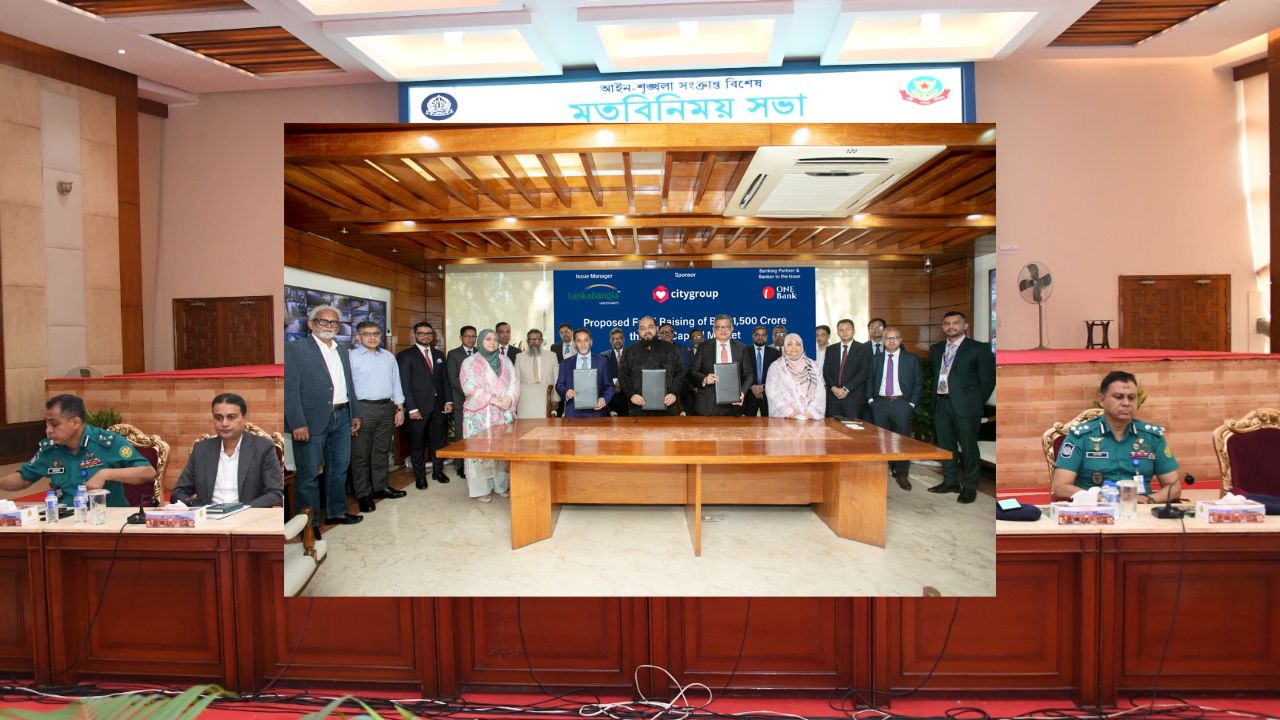
City Group has appointed LankaBangla Investments PLC as issue manager for the proposed fundraising, while ONE Bank PLC will act as banking partner and banker to the issue. The transaction will be subject to applicable regulations, necessary regulatory approvals and prevailing market conditions.
An agreement related to the proposed fundraising was signed at City Group’s corporate head office in Gulshan, Dhaka.
The signing ceremony was attended by City Group Managing Director Md Hasan, Sponsor Shareholders and Directors Farzana Rahman and Shampa Rahman, LankaBangla Investments Director and LankaBangla Securities Managing Director Mohammed Nasir Uddin Chowdhury, ONE Bank Managing Director Muhit Rahman, and senior executives from the respective organisations.
The fundraising initiative comes as City Group faces financial pressure after years of aggressive expansion, heavy borrowing and a challenging operating environment marked by currency depreciation, rising interest costs and shortages of gas and electricity.
The conglomerate, which generates annual revenue of around Tk32,000 crore and employs about 25,000 people, has expanded into multiple sectors, including edible oil, flour, sugar, pulses, rice, feed and other consumer and industrial products.
However, several large-scale investments outside its core operations have struggled to generate expected returns, while higher import costs and a weaker taka have increased pressure on its balance sheet.
The group’s financial difficulties intensified after the death of founding chairman Fazlur Rahman in late 2023, creating a leadership transition challenge as the company faced mounting liquidity pressures.
To manage the situation, a consortium of 36 lenders — including 34 local and two foreign banks — has moved towards a coordinated debt restructuring framework aimed at keeping the company operational while protecting lenders’ interests.
Under the proposed arrangement, City Group’s sales proceeds will be routed through a jointly managed escrow account. Under the mechanism, 80% of sales revenue will return to City Group as operational working capital, while 20% will be allocated for debt servicing.
Lenders are also adding two to three representatives to City Group’s board of directors. An independent monitoring committee and external consultants will oversee expenditures and sales, while an international audit firm will assess the group’s long-term commercial viability.
The company is also selling non-performing and non-core assets, including high-tech parks and economic zones, to generate immediate liquidity. At the same time, lenders have requested that Bangladesh Bank defer loan classification as non-performing until 30 September 2026 while the restructuring process continues.
City Group’s financial situation has drawn attention because of its role in Bangladesh’s essential commodity supply chain. A disorderly collapse of the group could disrupt supplies of products such as edible oil, sugar and flour, while affecting thousands of employees and suppliers.
The restructuring effort is also being viewed as a test case for Bangladesh’s banking sector, where large corporate borrowers have traditionally relied heavily on bank loans rather than capital market financing.
The proposed capital market entry could provide City Group with a new source of long-term funding while reducing dependence on bank borrowing. The fundraising is expected to be undertaken on a best-efforts basis over the next 12 to 18 months, subject to applicable laws and regulations, requisite regulatory approvals and prevailing market conditions.


