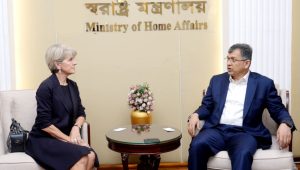
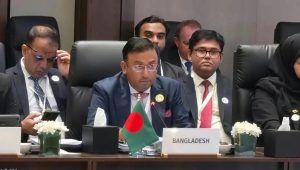
Bangladesh supports the vision of building a community with a shared future for humanity, a core tenet of Chinese President Xi Jinping’s foreign policy that was first articulated in a speech at the Moscow State Institute of International Relations in March 2013.
Chinese Ambassador Yao Wen said bilateral relations had reached a new height, with China ready to work with Bangladesh to fully implement the consensus reached by the political leadership of the two countries.
He made the remarks at a press conference at the Chinese Embassy on Thursday on Prime Minister Tarique Rahman’s recent visit to China.
“The most significant outcome of the visit was the decision by both sides to elevate the China-Bangladesh Comprehensive Strategic Cooperative Partnership to jointly build a China-Bangladesh Community with a Shared Future in the New Era. This represents the highest level of China’s relations with its friendly neighbours in Asia,” the ambassador said.
He discussed a range of issues, including strategic relations, new dialogue mechanisms, the Teesta project, direct connectivity, defence cooperation, trade and investment.
About Teesta project, he said if Bangladesh wants, China will help executing the project.

Political relations
China’s support for Bangladesh will remain unchanged despite shifts in the global landscape, and Beijing will not waver in its commitment to bilateral ties, Yao Wen said.
Quoting President Xi Jinping, the ambassador said: “No matter how the world changes, China will not waver in its commitment to the overall direction of China-Bangladesh friendly relations and will always be a trustworthy good friend, good neighbour and good partner of Bangladesh.”
He noted that at a time when unilateralism and power politics are on the rise and regional and international uncertainties are increasing, China-Bangladesh relations have stood the test of time over the past five decades and continue to demonstrate resilience and strong momentum.
According to Yao Wen, the recent visit injected fresh momentum into bilateral relations, with the leaders of the two countries holding candid and productive discussions and reaching important consensus.




“The meetings sent a clear message of stronger communication, deeper mutual trust and closer cooperation between the two countries,” he said.
Teesta project
The ambassador reaffirmed China’s commitment to the Teesta project, describing it as a livelihood initiative that would benefit around 10 million people.
He stressed the importance of conducting a scientific feasibility study involving leading experts from both countries before implementation.
Responding to a question about India’s concerns over Chinese involvement, Yao Wen said: “The Teesta project is Bangladesh’s project.”
“Other elements are not China’s concern. China will proceed as long as Bangladesh wants,” he added.
Opposition to external interference
Yao Wen said China’s foreign policy firmly opposes external interference in the internal affairs of any country.
Responding to a question, he said China itself faces similar challenges.
“A lot of foreign elements want to intervene in China’s internal affairs. Even now we face the same attempts by some forces,” he said.
He added that China fully understands the situation Bangladesh is facing and supports the country’s efforts to resist foreign interference.
“The message conveyed to Bangladesh is very clear: China supports Bangladesh in opposing any foreign intervention,” he said.
Proposed 2+2 mechanism
The proposed 2+2 dialogue mechanism is intended to strengthen strategic communication and defence cooperation between Bangladesh and China, the ambassador said.
He explained that two new platforms have been proposed to support high-level bilateral engagement. The first is a strategic dialogue between the foreign ministers of the two countries, while the second is a 2+2 framework involving political and defence officials.
“It does not mean the mechanism has already been established. We are still exploring how such a framework could be formed and need further discussions on the matter,” he said.
He noted that China already maintains similar arrangements with several Southeast Asian countries.
Economic corridor
The Bangladesh-China-Myanmar Economic Corridor aims to improve regional connectivity and deepen economic cooperation, Yao Wen said.
He described connectivity as a prerequisite for meaningful economic integration among the participating countries.
Although the broader Bangladesh-China-India-Myanmar (BCIM) Economic Corridor was proposed about 15 years ago, China is now focusing on advancing cooperation with Bangladesh and Myanmar, while remaining open to the participation of other countries in the future, he added.