


China and Malaysia were the only commercial missions to exceed their assigned export targets in FY2025–26, while 51 of Bangladesh’s 61 overseas missions fell short, according to an Export Promotion Bureau report.
The performance came as Bangladesh’s merchandise exports stood at $48.00 billion during July–June FY2025–26, down 0.58 per cent from $48.28 billion in the previous fiscal year and 12.72 per cent below the government’s annual merchandise export target of $55 billion.
The country’s major export sectors continued to dominate overall earnings, accounting for more than 90 per cent of merchandise exports. However, several traditional products, including knitwear and woven garments, recorded year-on-year declines, while pharmaceuticals, home textiles, leather goods, plastic products and some jute items posted growth.
China, Malaysia stand out among commercial missions
The EPB report, titled Analysis of Export Performance (Goods) of the Bangladesh Missions Abroad, showed that exports associated with Bangladesh’s 61 overseas missions accounted for more than 95 per cent of total merchandise exports.
Only 10 missions achieved their assigned targets, while 51 fell short.
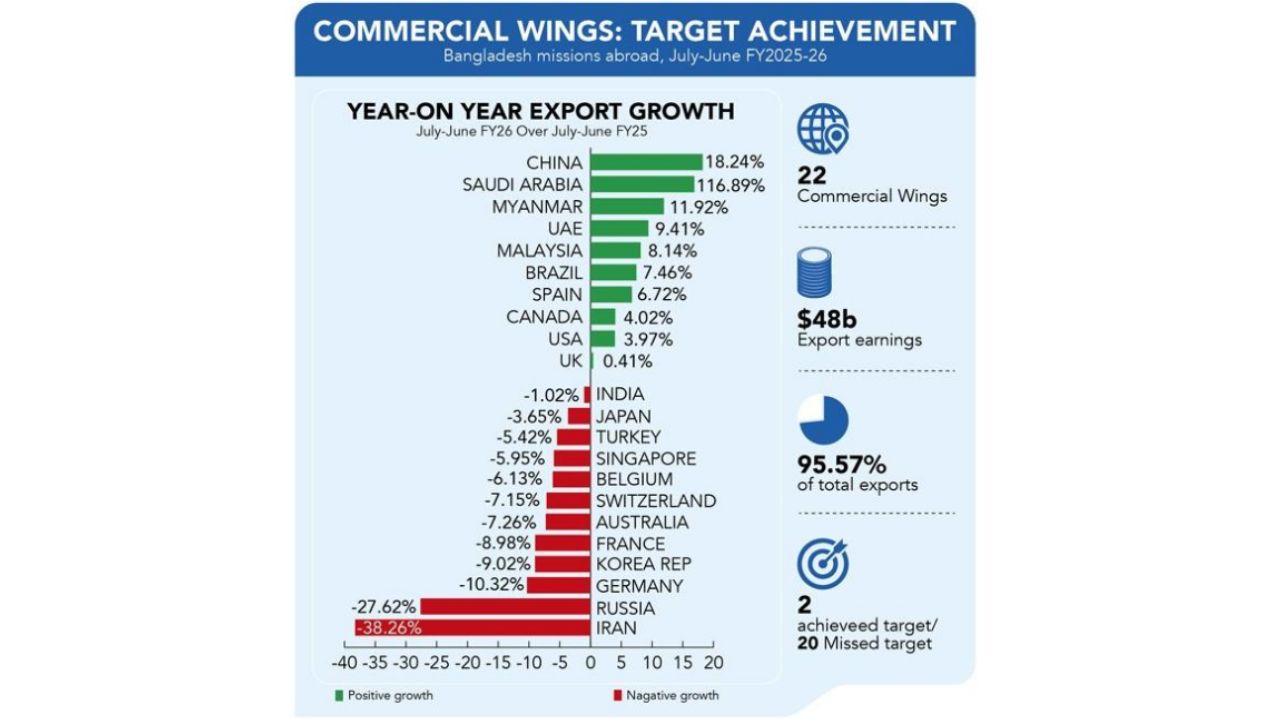
Among the 22 missions with commercial wings, China—covering Beijing and Kunming—and Malaysia’s Kuala Lumpur were the only two to exceed their annual targets.

Together, the commercial wings generated more than 73 per cent of the country’s merchandise export earnings, although their combined performance remained below the assigned target.
China recorded the strongest performance among the commercial missions, supported by a sharp year-on-year increase in exports. Malaysia also posted growth and marginally exceeded its annual target.
Commercial Counsellor at the Bangladesh High Commission in Malaysia Pranav Kumar Ghosh attributed the performance to rising demand for Bangladeshi products and sustained efforts to connect exporters with Malaysian buyers.
He told TIMES of Bangladesh that the mission had stepped up participation in trade fairs, B2B matchmaking and engagement with Malaysian ministries and business chambers, while also helping Bangladeshi exporters establish direct links with potential importers.




“Alongside ready-made garments, vegetables and potatoes, pharmaceuticals and agricultural products such as mangoes have strong potential in Malaysia. Halal fashion and halal-certified food products could also create new opportunities,” Ghosh said.
He said Malaysia’s large Bangladeshi expatriate community was also supporting demand for Bangladeshi food, clothing and consumer products, while efforts were being made to improve access to supermarkets and major retail chains.
Major markets struggle despite export growth
Several other commercial missions recorded year-on-year export growth despite missing their targets, including Saudi Arabia, Myanmar, the United Arab Emirates, Brazil, Spain, Canada, the United States and the United Kingdom.
The United States remained Bangladesh’s largest export-generating commercial mission and recorded growth during the year, although it fell short of its assigned target.
In contrast, exports under the Iran and Russia commercial missions fell sharply, while Germany, South Korea and France also recorded declines.
A commercial counsellor dealing with the Russian (Moscow) market Shah Mohammad Habibul Hasan told TIMES, the lack of a direct financial and banking transaction mechanism remained a major obstacle to expanding bilateral trade.
He said the problem had intensified amid the Russia-Ukraine war and international sanctions, which continued to complicate payments and trade settlements.
Minister (Commercial) at the Embassy of Bangladesh in Paris Md Mizanur Rahman said weaker consumer demand, cautious purchasing by buyers, stronger competition and price pressures had affected Bangladesh’s exports to France.
He said future growth would require greater emphasis on higher-value apparel, product diversification, sustainability, stronger buyer engagement and more efficient supply chains.
Performance among missions without commercial wings was relatively better, with the group recording marginal year-on-year growth. Nepal emerged as one of the strongest performers, while several other missions also surpassed their assigned targets.
Exporters seek stronger commercial diplomacy
Exporters said the overall results showed that Bangladesh’s overseas missions needed to become more commercially focused to turn market opportunities into sustained export growth.
Businessman Mohiuddin Rubel told TIMES, the failure to meet the national export target reflected a combination of domestic political and economic transition, geopolitical uncertainty and growing global competition.
He called for stronger coordination and accountability among government agencies, commercial wings and trade bodies including BGMEA, BKMEA and BTMA, backed by better market research and data-driven strategies.
Fazle Shamim Ehsan said high production costs and elevated interest rates had weakened exporters’ competitiveness.
He said commercial wings should play a more proactive role in identifying buyers, addressing payment-related problems and providing timely market intelligence to exporters.
The FY2025–26 performance shows that Bangladesh was able to preserve its overall export base despite an uncertain global environment. However, with most overseas missions missing their targets and several major markets recording declines, faster export growth will depend on stronger commercial diplomacy, greater product and market diversification and closer coordination between missions and exporters.