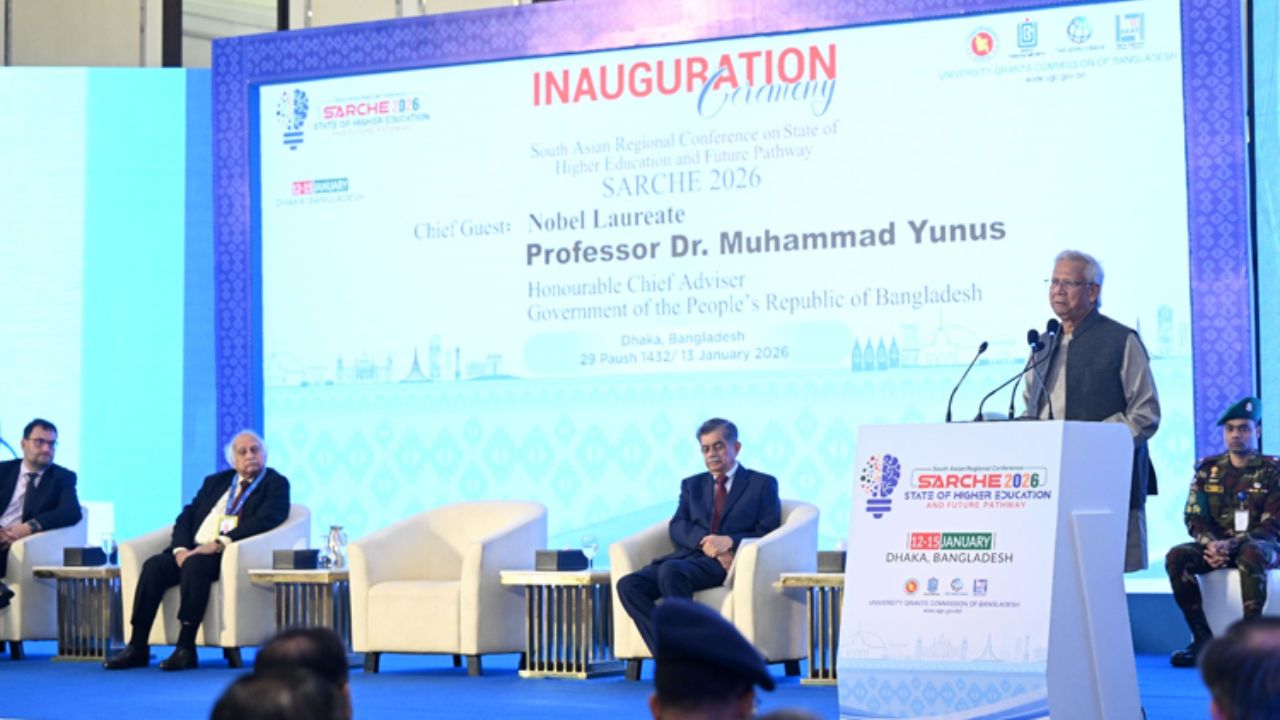



Chief Adviser Muhammad Yunus inaugurated a three-day South Asian Regional Conference on State of Higher Education and Future Pathway (SARCHE 2026) at a Dhaka hotel on Tuesday.
The event was organised by the University Grants Commission (UGC) of Bangladesh.
Education Adviser CR Abrar attended the event as the special guest, with UGC Chairman SMA Faiz presiding. Secondary and Higher Education Division Secretary Rehana Perven and World Bank (WB) Division Director Jean Pesme were present as guests of honour.
UGC Member Mohammad Tanzimuddin Khan delivered the welcome address.

The opening ceremony was attended by advisers of the interim government, vice-chancellors of public and private universities, academics, researchers, and members of the diplomatic corps.
UGC officials stated that the conference is arranged under the Higher Education Acceleration and Transformation (HEAT) Project. The project is being executed by the UGC with financial support from the Government of Bangladesh and the WB.



A delegation of 30 international representatives, including participants from the United Kingdom, the Maldives, Malaysia, Nepal, Pakistan, and Sri Lanka, along with WB officials, are attending the summit, which concludes on 15 January.
The conference also hosts representatives from UGCs and higher education commissions of SAARC nations, alongside vice-chancellors, academicians, and researchers from various countries.
According to the UGC, the conference aims to elevate Bangladesh’s higher education sector and reinforce the commission’s collaborative network among SAARC member states.
Over the three days, eight thematic sessions are scheduled. The first day’s agenda featured discussions on “The Current State of Higher Education in South Asia: Governance, Quality and Inclusion” and “Research, Innovation, Sustainability and Social Engagement”.
Sessions on the second day will cover “Artificial Intelligence (AI) Integration, Digital Transformation and Smart Learning Ecosystems”, “Increasing Employment for Graduates and Industry-Academia collaboration”, and “Future Pathways of Higher Education: Cooperation, Solidarity and Networking.”
A “Stakeholder Dialogue on Higher Education Transformation: Voices of Civil Society” and a “Dialogue with Vice-Chancellors: the Context of the HEAT Project” are also slated.
The final day will focus on gender issues in higher education. The conference will conclude with the formal adoption of the “Dhaka Higher Education Declaration.”