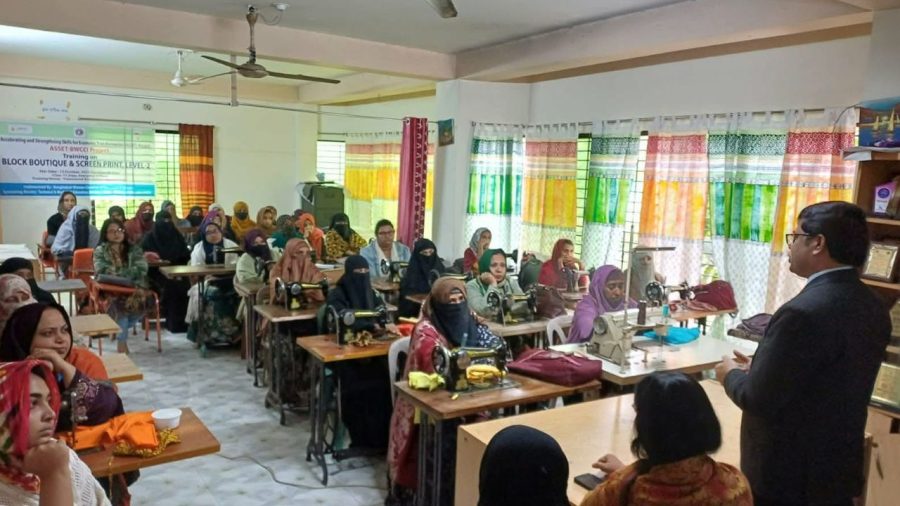



The Bangladesh Women Chamber of Commerce and Industry (BWCCI) has achieved significant progress under the ASSET project’s Enterprise‑Based Training (EBT) program, aimed at advancing women’s economic empowerment, skills development, and opportunities for employment and self‑employment.
As of August 2026, more than 46,000 women have received training in 1,939 batches under BWCCI. With 24 trainees per batch as the set target, the achievement represents 100 percent completion.
The EBT program is being implemented in cycles through the Apprenticeship Dual‑Mode Training Program (ADTP), Technical and Skills Training Program (TSTP), and Specialized Upskilling Training Program (SUTP).
Competency assessment
So far, 30,188 trainees have participated in competency assessments to verify skills acquired after training. Of them, 19,921 were evaluated as competent, reflecting a competency rate of about 66 percent.

Authorities noted the rate is not final, as training and assessment cycles remain ongoing. Progress is being tracked across enrollment, training, assessment, competency, and employment.
Employment and self‑employment
BWCCI has recorded employment or self‑employment for 11,848 women trainees to date. Compared with those assessed as competent, this represents about 59.5 percent. Officials stressed the figure is not final, as many trainees are still undergoing assessment and post‑training employment tracking. Employment includes not only jobs but also self‑employment, small enterprises, home‑based businesses, and income‑generating services.
Training covers skills such as tailoring and dressmaking, fashion design product development, food and beverage production, embroidery, hand stitching, block‑batik and screen printing, beautification, caregiving, ICT freelancing, and entrepreneurship development.




Breakdown by program
Updated data show ADTP accounted for the largest share, with 37,080 women trained across 1,545 batches. TSTP trained 6,192 women in 258 batches, while SUTP trained 3,264 women in 136 batches. Apprenticeship and workplace‑linked training have enabled participants to gain hands‑on experience in real work environments.
Inclusion of marginalised groups
BWCCI’s program has included 14 women with disabilities and 263 women from small ethnic communities. Of these, 8 persons with disabilities and 161 ethnic minority members participated in ASSET.
Competency assessments found 13 women with disabilities and 94 ethnic minority women competent. Employment or self‑employment has been recorded for 8 women with disabilities and 73 from ethnic communities.
Future opportunities
For the extended phase of the ASSET project, BWCCI has aligned training with NSDA competency standards under the “Future of Work” list. Occupations include primary healthcare services, ICT and freelancing, block‑batik and screen printing, hand stitching and embroidery, tailoring and dressmaking, caregiving for children, special‑needs persons and the elderly, fashion design product development and modeling, microfinance operations, food and beverage production, and entrepreneurship development.
NSDA CS‑aligned lists also include tailoring and dressmaking (Level‑3 and Level‑4) and entrepreneurship development (Level‑4).
BWCCI’s statement
BWCCI President Sangita Ahmed said, “If we can ensure skills, entrepreneurship development, market linkages, and access to low‑interest bank loans for women, new employment opportunities will be created across rural and urban areas. Entrepreneurs will also contribute to job creation. Through the ASSET‑BWCCI project, we believe the scope for exporting skilled manpower abroad will expand further.”
Deputy Sub‑Project Manager Sumanta Kumar Mohanta said, “Bringing more than 46,000 women under skills training through enterprise‑based training is a major achievement. But our goal is not just training, it is to ensure women can apply their skills in jobs, self‑employment, or their own businesses.”
BWCCI’s current priorities include accelerating assessments for graduates, raising competency rates, creating employment and self‑employment opportunities for competent women, and connecting female entrepreneurs with markets and business networks.