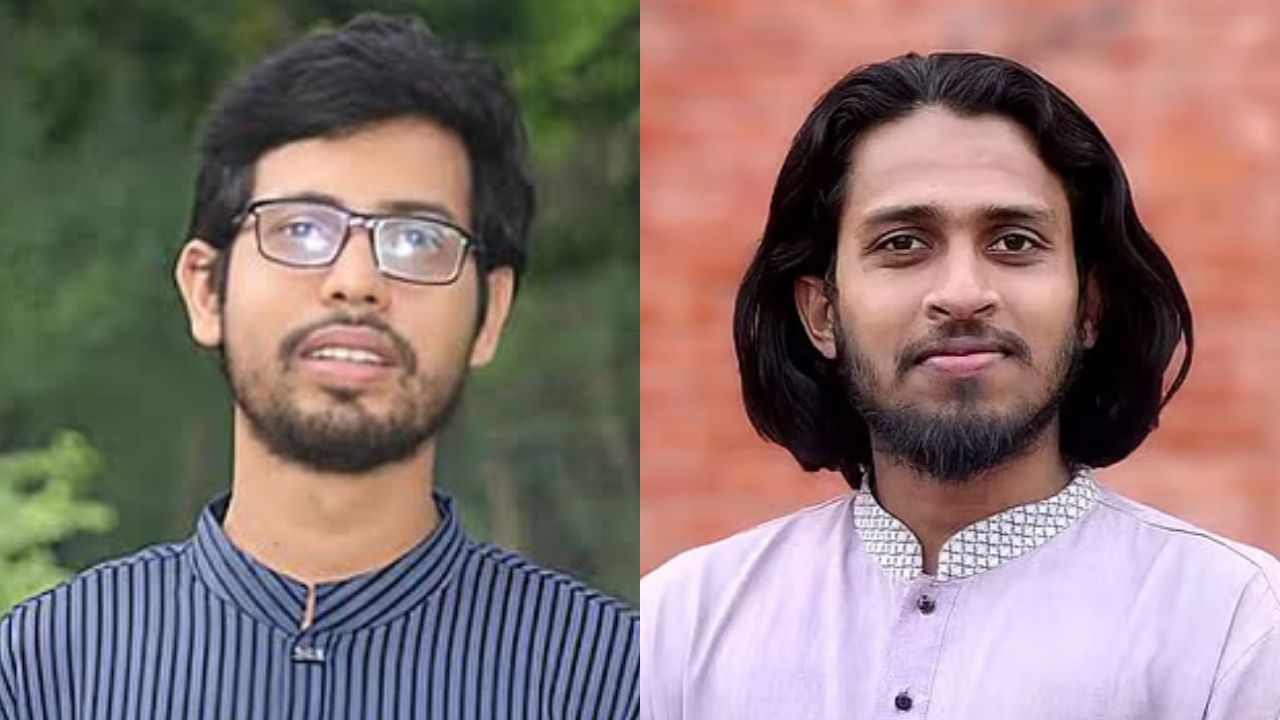

Ten months after taking office, the Rajshahi University Central Students’ Union (Rucsu) is making headlines for all the wrong reasons.
Instead of delivering on student welfare promises, its Vice-President Mostakur Rahman Zahid and General Secretary Salahuddin Ammar have found themselves at the centre of allegations over threats, intimidation and controversial conduct.
Following the July uprising, Rucsu held its long-awaited election on 16 October 2025, the first in nearly 35 years. The Islami Chhatra Shibir-backed “United Students’ Alliance” swept the polls, securing 20 of the 23 posts.
Salahuddin Ammar contested under an independent banner, though critics quickly dismissed it as a proxy panel backed by Shibir.
The biggest grievance on campus is simple: unfulfilled promises.
Ahead of the election, the Shibir-backed panel unveiled an ambitious manifesto, pledging to implement 24 reforms within a year.
Among its key commitments was a roadmap for ensuring 100 per cent residential facilities, along with accommodation subsidies for non-residential students until full housing was achieved.
Yet, nearly 10 months into its tenure, neither a roadmap nor any subsidy scheme has materialised.
The university administration has also cast doubt on the feasibility of the pledge.
Rajshahi University Vice-Chancellor Faridul Islam told TIMES of Bangladesh, “Ensuring residential facilities is primarily the responsibility of the university administration. It is not realistic to ensure 100 per cent residential facilities overnight or within a year.”

For a section of disappointed students, the vice-chancellor’s remarks reinforce their belief that unrealistic promises were used to secure votes, while campus reforms have taken a back seat to national political activities.
RUCSU VP Zahid told TIMES that implementing the initiative would not be possible from RUCSU’s own funds and would require support from the university administration and relevant government departments.
Asked why they had made a promise that they could not fulfil, Zahid said, “We have repeatedly discussed the non-residential allowance with the administration. A proposal for the construction of seven new halls has already been sent to the UGC.
Until that is implemented, we have demanded that the allowance be introduced at least. Although the administration was initially reluctant, it is now giving the issue importance.”
Rokeya Hall resident student Priyanti Pandit Tuli told TIMES, “In the case of Rucsu, the situation has now become one where ‘an empty vessel makes the most noise’. Before the election, a lengthy and attractive manifesto was presented. But there is little visible connection between that manifesto and the actual work being done.”
“Despite making major promises on issues such as introducing a teacher evaluation system, improving the quality of food at university and hall canteens, and announcing a roadmap for 100 per cent residential facilities, we are yet to see any visible implementation,” she added




Finance student Sheikh Tawheed Nayeem said, “Rucsu leaders presented students with such manifestos during the election mainly to serve their own political interests.
Many of those commitments were difficult to implement not only within a year but even over several years. More disappointing is that even the promises they have the capacity to fulfil are not being implemented with the expected priority and sincerity.”
Rucsu’s manifesto was not just ambitious, it bordered on the unachievable. The union lacked both the authority and the funds to overhaul the university medical centre into a 20-bed facility or recruit specialist doctors.
Yet, Shibir dangled these very promises to win votes.
Predictably, these grand pledges have stalled, alongside commitments to launch an administrative services app, create campus jobs, build a student education centre, and ensure uninterrupted electricity and Wi-Fi.
Nadia Haque, a third-year student, told TIMES, “It remains completely unclear when or how the most critical promises will ever be fulfilled.”
Critics argue Rucsu has shifted its focus away from core student needs.
Fuad Ratul, convener of the Samajtantrik Chhatra Front’s university unit, pulled no punches:
“Instead of building student-led movements to pressure the administration, Shibir used Rucsu as a platform to spread Jamaat ideology. Beyond spending student funds on qawwali nights, Islamic remembrance meets, and quizzes, no meaningful work has been done. They have proved their incompetence and diluted Rucsu’s appeal.”
Rucsu leadership, however, paints a very different picture.
Three months into their tenure, they touted a list of “103 achievements in 100 days.”
Yet, scrutinising the list reveals mostly graveyard visits, courtesy calls, photo ops, and memoranda, doing little to tackle fundamental campus issues.
Defending their record, Rucsu VP Mostakur Rahman Zahid claimed that 59 per cent of their 106 manifesto targets are either completed or underway.
He pointed to the challenges of reviving a union dormant for 36 years and placed the blame squarely on the university hierarchy, citing administrative delays over library air-conditioning and senate allocations.
Assistant General Secretary Salman Sabbir echoed this, blaming hand-over delays and a lack of official backing.
However, Vice-Chancellor Faridul Islam firmly rejected claims of administrative sabotage.
Speaking to TIMES, he countered, “We have not been uncooperative with a single Rucsu initiative. Issues raised in general meetings have been met positively. As Rucsu President, I will continue to extend all possible support within their jurisdiction.”
Personal conduct draws more attention
When Rucsu’s top leaders hit the headlines, it is rarely for student advocacy.
Vice-President Mostakur Rahman Zahid has faced intense criticism for prioritising national politics over campus duties, actively campaigning for Jamaat-e-Islami parliamentary candidates, despite previously preaching against party-affiliated student politics.
Worse still, allegations surfaced linking him to the incitement of violent attacks on the Prothom Alo and The Daily Star offices in Dhaka.
Salahuddin Ammar’s track record is equally contentious. Rather than highlighting progress on manifesto promises, media coverage has focused on his aggressive behaviour.
Ammar stands accused of threatening faculty, issuing intimidating public statements, and overseeing physical assaults, including an incident where students were severely beaten over alleged links to the Chhatra League.
When media scrutiny followed the recent beatings of three students under his watch, Ammar drew further outrage by threatening action against journalists.
Unsurprisingly, leaders across campus political groups are now openly condemning his conduct.
Addressing his turbulent role within Rucsu, Ammar struck a surprisingly defensive tone when speaking to TIMES, “As the Shibir-backed panel holds the majority, their decisions naturally take priority. The opinions of independent members and other panels are often brushed aside. Personally, I have always wanted to work for the students.”
Yet, after ten months dominated by political ambition, intimidation, and factional friction, campus critics argue that both leaders have systematically placed personal agendas ahead of student welfare.