


Bangladesh and the Netherlands have signed a memorandum of understanding (MoU) to promote circular economy practices in the textile and ready-made garment (RMG) sectors, aiming to reduce waste, improve resource efficiency and support greener production.
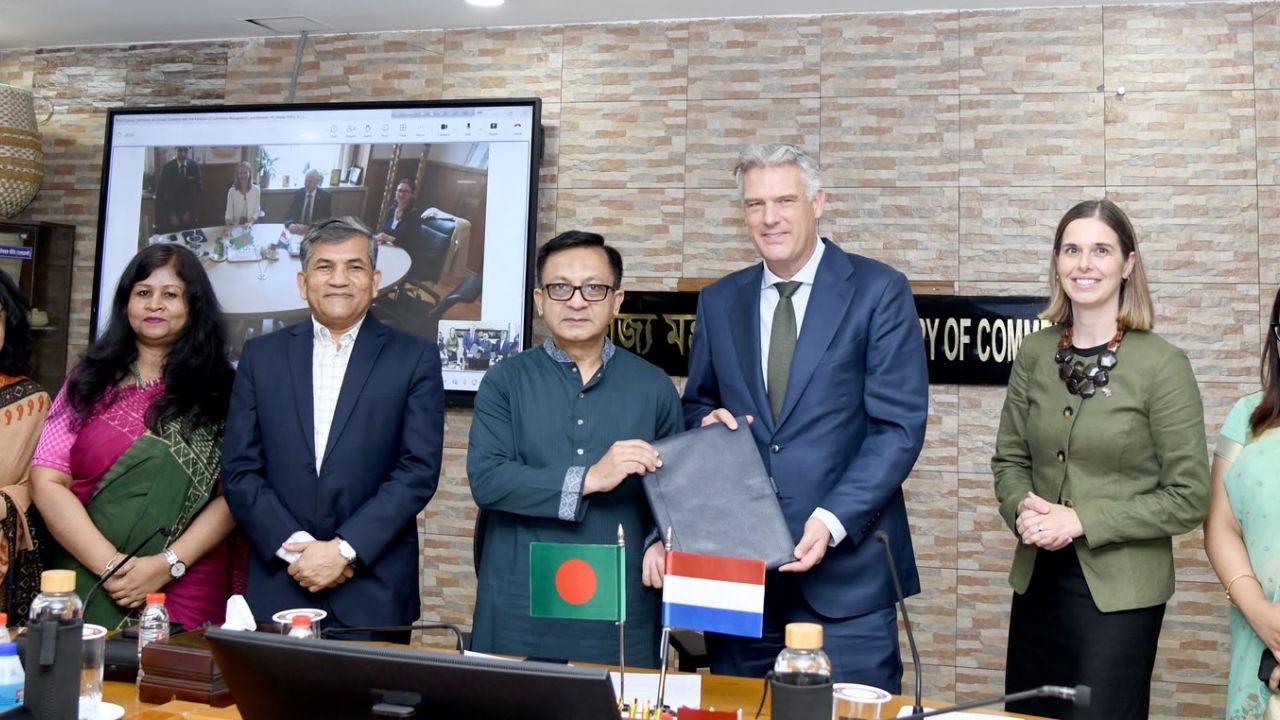
The agreement was signed on Monday between Bangladesh’s Ministry of Commerce and the Netherlands’ Ministry of Economic Affairs and Climate Policy, with both sides agreeing to expand cooperation on sustainable production systems, recycling and green industrial development.
Commerce Minister Khandakar Abdul Muktadir signed the MoU on behalf of Bangladesh, while Netherlands Minister of Climate and Green Growth Stientje van Veldhoven signed for the Netherlands through a virtual arrangement.
The partnership will focus on improving resource use across the textile value chain, reducing waste, promoting recycling and supporting production methods aligned with growing global sustainability requirements.

Khandakar Abdul Muktadir said circular economy practices had become essential for Bangladesh’s export-oriented textile sector as global markets increasingly demand environmentally responsible production.
He said the shift was not only about environmental protection but also about strengthening export competitiveness, attracting sustainable investment, creating green jobs and helping Bangladesh meet future trade requirements.



The minister said Bangladesh’s transition from a least developed country (LDC) status required stronger focus on sustainable industrial capacity, environmentally friendly production and compliance with international standards.
He said the circular economy transition would require cooperation among the government, industries, financial institutions, development partners, research organisations and consumers.
Under the agreement, the two countries will focus on knowledge exchange, multi-stakeholder cooperation and initiatives to support sustainable transformation across the textile value chain.
Van Veldhoven said no country could complete the circular economy transition alone and stressed the need for international cooperation, business partnerships and coordinated action across supply chains.
She said officials from both countries had already discussed priority areas and called for those discussions to move towards practical implementation.
The agreement is expected to support knowledge exchange, innovation and collaboration among stakeholders to help Bangladesh’s textile and RMG sector adopt greener technologies and sustainable production practices.
The signing ceremony was attended by Commerce Secretary Md Ataur Rahman Khan, Bangladesh Ambassador to the Netherlands Faiyaz Murshid Kazi and Netherlands Ambassador to Bangladesh Joris van Bommel.