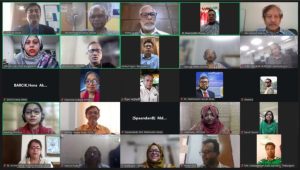



Friendship and Conservation International began a two-day national consultation in Dhaka on Sunday to identify coastal areas where mangrove restoration and protection could deliver the greatest benefits for communities, biodiversity and climate resilience.
The workshop, titled “Prioritising Nature-based Interventions for Resilient Coastal Bangladesh”, opened on 2 August at the Westin Hotel in Gulshan. Organised in collaboration with the Ministry of Environment, Forest and Climate Change, the initiative seeks to support a coordinated national blueprint for coastal resilience, the organisers said in a press release.
State Minister for Environment, Forest and Climate Change Shaikh Faridul Islam, MP, attended the inauguration as chief guest.
Former secretary Dr Md Faridul Islam and Economic Relations Division Additional Secretary A K M Sohel attended as special guests. Other guests included Chief Conservator of Forests Md Amir Hosain Chowdhury and Professor Dr Md Abdul Wahab of the Department of Aquaculture and Marine Fisheries at Bangladesh Agricultural University.
Friendship founder Runa Khan delivered the welcome remarks, while Conservation International Managing Director for South Asia Saurav Malhotra also addressed the opening ceremony.

Shaikh Faridul Islam praised the two organisations for undertaking the initiative and highlighted the distinct challenges facing coastal communities, whose livelihoods remain closely tied to nature.
He said government agencies, non-governmental organisations and international non-governmental organisations working in coastal areas needed to coordinate their activities to produce effective results.
“A lot of NGOs or INGOs are working in that area, but if you are working collectively, only then will it be very effective for the community,” he said.




Khan called for the finance, planning, disaster management, fisheries, agriculture and local government authorities, along with other key agencies, to align their policies, planning, financing, implementation and monitoring under a common framework.
The framework should have a clearly designated lead institution and defined responsibilities for each participating agency, she said.
Khan said civil society organisations, private companies, United Nations agencies and international partners should support and strengthen decisions taken by the government.
She also urged policymakers and development partners to move beyond fragmented projects and adopt coordinated action across entire coastal landscapes.
“This workshop should help all of us agree to prioritise coastal landscapes for mangrove restoration and protection,” Khan said.
Malhotra said Bangladesh had made significant investments to help coastal communities adapt to climate change. Restoring and protecting mangrove forests could reduce climate risks while supporting wildlife and community livelihoods, he added.
“Through our collaboration with Friendship and the Government of Bangladesh, Conservation International is committed to helping identify practical, science-based solutions that can be scaled to deliver lasting benefits,” Malhotra said.
Participants and technical experts are reviewing maps and technical data to determine where mangrove restoration could have the greatest impact on biodiversity, climate resilience and ecosystem-based livelihoods.
They are also assessing community readiness, institutional coordination and the availability of data in potential restoration areas.
The consultation is examining international practices involving coastal green-grey solutions, which combine natural systems with conventional infrastructure, as well as the role of mangroves as high-value blue-carbon ecosystems.
The discussions are expected to help establish priorities for coastal restoration, governance, monitoring, policy support and sustainable financing while strengthening coordination among the institutions involved.