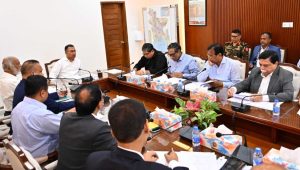
The International Crimes Tribunal-2 has begun reading the verdict in the crimes against humanity case over the killing of Abu Sayed, a student of Begum Rokeya University, Rangpur (BRUR), during the July uprising.
The tribunal, led by Justice Nozrul Islam Chowdhury, started reading the summary of the judgment at 12:13pm on Thursday.
The case involves 30 accused, including former BRUR vice-chancellor Hasibur Rashid and former proctor Shariful Islam.
Only six of the accused are currently in custody. They were produced before the ICT-2 on Thursday morning.

The six are former proctor Shariful, former ASI Amir Hossain, former constable Sujan Chandra Roy, and banned Chhatra League (BCL) leaders Imran Chowdhury, Rafiul Hasan Russell, and Anwar Parvez.
However, the remaining 24 accused are currently absconding.
The tribunal fixed the date for the judgement on 5 March, after the case had been awaiting a verdict since 27 January, following conclusion of arguments from both the prosecution and the defence.



ICT Chief Prosecutor Aminul Islam said the world witnessed the brutality of Abu Sayed killing, a fact also highlighted in United Nations reports. He expressed confidence that the prosecution has provided irrefutable evidence and expects a desirable verdict, saying that they have successfully proven the charges against the accused.
The prosecution’s case hinges on the principle of “superior responsibility”. According to formal charges, the killing was not an isolated incident but the result of a state-level directive.
It is alleged that, under the orders of ousted prime minister Sheikh Hasina, decisions were made to use lethal weapons against students. These instructions were later passed to the home minister, then to the inspector general of police (IGP), and subsequently through the entire police command structure.
This legal doctrine of superior responsibility has been applied to Sheikh Hasina, former home minister Asaduzzaman Khan Kamal, the then IGP, and senior police officials stationed in Rangpur.
Investigations also implicated the university administration and auxiliary forces, including the Awami League and Jubo League. The prosecution alleged that high-ranking university officials directly incited and instructed the police to suppress the movement.
The prosecution was represented by Prosecutors Mizanul Islam, Abdus Sobhan Tarafder, and Sheikh Moinul Karim, who sought the maximum penalty for the accused. On the other hand, the defence represented by lawyers including Aminul Gani Tito, Azizur Rahman Dulu, Salahuddin Regan, and Abul Hasan argued for an acquittal.
The trial began on 6 August last year when the tribunal framed charges against the 30 accused. A total of 25 witnesses, including the investigating officer, testified for the prosecution, while the defence produced no witnesses. For the fugitive defendants, the state appointed four lawyers on 22 July to participate in the proceedings.
Abu Sayed, a student of the English Department at Begum Rokeya University, was killed on 16 July 2024, in front of the university gates.
Footage of Abu Sayed standing with his arms outstretched before being shot by police went viral, sparking widespread public outrage. This event served as a catalyst, transforming the student movement into a mass uprising that eventually led to the fall of the Sheikh Hasina government and her subsequent flight to India.