AB Bank, once a market leader in the country’s banking sector, is now sinking deeper into crisis as default loans soar to alarming levels amid escalating management turmoil and sponsor interference.
The private lender has seen its default loans balloon to a staggering 84 per cent by the end of September. Despite the crisis, the bank’s loan portfolio swelled by nearly Tk2,900 crore in the last nine months, more than double the growth recorded in the whole of 2024 – Tk1,444 crore.
AB Bank continues to expand its loan portfolio in violation of a Bangladesh Bank directive to halt fresh lending, according to data obtained from the lender by TIMES of Bangladesh.
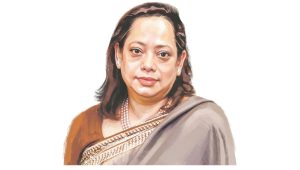
Amid this turmoil, Managing Director Syed Mizanur Rahman is preparing to step down just nine months into his tenure, allegedly under pressure from sponsor shareholders controlling the board.
Analysts have questioned why AB Bank was left out of Bangladesh Bank’s ongoing merger plan, despite having a much higher non-performing loan (NPL) ratio than two of the five Shariah-based banks being merged. Central bank officials explained that AB Bank was excluded because the current merger scheme covers only Shariah-based banks.
“I’m not comfortable with the kind of pressure I’m facing. It’s erratic and overwhelming,” Managing Director Rahman told TIMES, confirming his intention to move to Meghna Bank.
“Most of the bad loans are linked to Faisal Morshed Khan. That’s why recovery has become impossible,” added the frustrated top banker.
Faisal is the son of AB Bank’s founder chairman and former BNP-led government’s foreign minister M Morshed Khan. AB Bank has long struggled to get rid of the culture of political and sponsor dominance. Since its inception in 1982, it has remained under the influence of the Morshed Khan family.
After his father became minister in 2001, Faisal took over as chairman and served until April 2008 before resigning.
The current chairman, Kaiser A Chowdhury – once the bank’s managing director – joined the board as a nominee of the Khans’ family business, Millennium Holding.

Faisal told TIMES, “Kaiser was nominated because Bangladesh Bank rules do not allow a former executive of the very bank to be an independent.”
According to senior officials, the family continues to meddle in the bank’s operations.
“The MD is exasperated,” one AB Bank officer said.
“Every day new parties are being sent for loans. I reject them all but face pressure daily. Every rejection needs to be explained to Faisal – it’s impossible to justify everything every day,” said MD Rahman.
Currently, the Khan family and its entities hold about 28 percent of AB Bank’s total shares.
Faisal Khan, however, denied interference.




“I live abroad. How much influence can I exert from 12,000 miles away?”
He said he no longer wishes to join the board due to business and family engagements, but maintained, “As a shareholder, I have the right to be a board member.”
Faisal said the board is being restructured with “competent professionals,” claiming, “After the fall of Awami League, we have appointed capable people. Back when I was chairman from 2001 to 2008, Kaiser Chowdhury was the MD. Together we turned AB Bank from 28th to the second-largest bank in the country.”
On the MD’s planned departure, Faisal Morshed added, “He already had plans to move to Meghna Bank before joining us. I’ve also heard he is negotiating with Dhaka Bank, though he hasn’t told me directly.”
Questionable loan growth
Recently, AB Bank’s loans have risen abnormally. Internal figures show total disbursed loans reached to Tk 35,981 crore by September 2025, up from Tk 33,089 crore in December 2024 – a 9 percent increase in nine months. In contrast, loan growth was only 4.5 percent in 2024 and 1.6 percent in 2023.
“There’s no way loans can rise that much without new lending,” said another bank MD, requesting anonymity. “Interest accruals increase outstanding loans, but recoveries offset that.”
MD Rahman earlier said that Tk1,600 crore in loans had been recovered in this period, a figure reflected in the balance sheet. Between September 29 and 30 alone, defaults fell by Tk149 crore and total loans dropped by Tk7.37 crore while deposits decreased by Tk315 crore.
Mohakhali branch manager of the bank Chowdhury ANM Ali Beg confirmed lending activity: “We’re disbursing mostly retail loans, though corporate loans have slowed.”
However, Bangladesh Bank spokesperson Arief Hossain Khan said the central bank instructed AB Bank in August last year to halt fresh lending due to its weak condition.
TIMES learned that Tk40 crore was recently lent from the Mahakhali branch to a company named Transcom Auto, which the branch manager denied.
Rahman later explained the apparent loan rise as an accounting adjustment: “Some non-banking assets were reclassified as loans per Bangladesh Bank’s latest directive, inflating the loan figure.”
“No new loans are being issued,” he insisted. “We’re not even opening deferred LCs—only sight LCs and existing clients are supported. All nonsense lending has been stopped.”
From market leader to a crisis case
Once a top-tier private bank, AB Bank is now crippled by bad loans. As of September, its non-performing loans stood at Tk30,143 crore – 83.77 percent of total disbursed loans. Nine months earlier, it was Tk22,279 crore (67.33%). In December 2023, defaults were 30 percent (Tk 9,514 crore). Over 56 percent of its loans are concentrated among the top 20 borrowers.
Former chairman Faisal said, “The new loans aren’t defaulting. Old ones are worsening, and interest accumulation is inflating the figures.”
Due to massive financial irregularities, the bank recorded a record loss in 2024. Its audited report shows each share lost Tk21.28, translating into a total loss of Tk1,906 crore – compared with Tk90 crore profit in 2023. Its shares have traded below face value since September last year, closing at Tk6.10 on 6 October.
Excluded from central bank’s merger plan
Despite being in worse shape than some Islamic banks, AB Bank is not on Bangladesh Bank’s “fast-track merger” list. The plan currently targets five Shariah-based banks – Exim, Social Islami, Global Islami, Union, and First Security Islami – with default rates of 48, 62, 95, 98, and 99.5 percent, respectively.
Still, Bangladesh Bank spokesperson Arief Hossain Khan said that AB Bank remains outside the merger plan “for now.”
“As defaults rise, provisioning and capital shortfalls will deepen. Without fresh sponsor capital, liquidity stress will intensify,” he warned. “Unless recovery and rescheduling improve, the central bank may eventually have to intervene.”
A political-economic consideration behind choosing the five banks for merger may have played a role, believes economist M Masrur Reaz, chairman of the think tank Policy Exchange Bangladesh.
“Four of the five banks were controlled by S Alam, and nearly all of their funds were siphoned off. These banks were facing a severe lack of depositor confidence, and the merger process might help address this,” he said.
However, beyond the five, many other banks are in dire situations that must be addressed, he added.
What does the future hold?
Founded on 12 April 1982, AB Bank was the country’s first private sector bank and listed on the Dhaka Stock Exchange a year later. Once a model of customer service, it deteriorated due to internal corruption and sponsor abuse.
Faisal claimed sponsors are ready to inject capital. “We’ve already discussed recapitalisation with Bangladesh Bank,” he said.
“When I became chairman in 2001, I replaced family members with professionals. Under our leadership, AB Bank paid a 200 percent dividend in 2007, rare in the sector,” Faisal said, blaming “unqualified successors” for the decline.
“I’ve asked some good former officials who were sidelined to come back and steer the bank again,” he added.