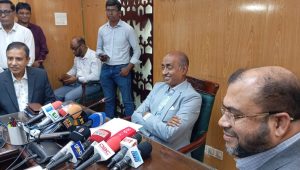
The Advisory Council on Thursday approved a proposal from the finance ministry to merge five troubled Shariah-based banks into a single entity following an extensive financial review that highlighted their unsustainable position.
The five banks involved in the proposed merger are First Security Islami Bank Plc, Global Islami Bank Plc, Union Bank Plc, Exim Bank Plc and Social Islami Bank Plc.
However, shareholders of these beleaguered lenders are set to leave empty-handed as measures for the merger do not include providing them with any payout or shares in the new bank.
After it is established, the United Islamic Bank will initially operate under state ownership before gradually becoming a private enterprise.
What lies ahead for depositors
Despite the financial instability of the merging banks, depositors are assured protection under the merger plan.
Their funds will be transferred to the new bank, ensuring seamless access to their savings.
To further safeguard depositors, the government has proposed utilizing the Deposit Protection Fund to compensate those with up to Tk 2 lakh in the banks.

The cost to the fund for this initiative will amount to Tk 12,000 crore.
Institutional depositors will receive shares worth up to Tk 15,000 crore through a bail-in plan, while the government will inject Tk 20,000 crore in fresh capital to build the new bank.
Nothing left for shareholders
Shareholders of the five banks will bear their losses according to the Bank Resolution Ordinance, 2025, with no payouts in the merger process.
Ordinary shareholders of the publicly traded banks have raised concerns over not receiving any shares in the new bank, despite not being responsible for the banks’ downfall.



The Bangladesh Bank and the government have stated that the five banks’ net asset values (NAV), following a detailed review, dropped into negative territory to the point where recovery is impossible, leaving no value for shareholders.
For example, at the end of September this year, First Security Islami Bank’s NAV stood at Tk -438.81 per share, with 98% of its loans classified as non-performing.
Similarly, Exim Bank, which is in a slightly better position, had a NAV of Tk -75.74 per share, reflecting liabilities 48 times its paid-up capital.
The shares of these banks, with a face value of Tk 10, are currently trading between Tk 1.9 and Tk 4.7 on the Dhaka Stock Exchange.
Why the merger is happening
The merger is deemed necessary due to the severe financial troubles of the five banks, as revealed by the Asset Quality Review (AQR).
“Despite receiving liquidity support over the past year, these banks have been plagued by increasing classified loans, capital deficits, and deepening liquidity crises. The AQR showed that the banks could not meet their obligations to depositors and creditors, necessitating urgent intervention,” a government official said.
How the resolution process will work
The merger will consolidate all assets and liabilities from the five banks into one new Shariah-based Islamic commercial bank.
The new bank will be capitalized with Tk 20,000 crore, with Tk 10,000 crore from the government and the remaining Tk 10,000 crore raised through Sukuk bonds.
Additionally, Tk 15,000 crore from institutional depositors’ funds will be converted into capital via a Bail-in process to help meet the new bank’s capital needs.
The total capital requirement is estimated at Tk 35,000 crore, with the authorized capital set at Tk 40,000 crore.
Further actions against the wrongdoers
Bangladesh Bank and the Ministry of Finance have confirmed that legal actions will be initiated against the owners, board members, and relevant officers responsible for the demise of the five banks.
The actions will focus on recovering bad loans and holding the wrongdoers accountable.
Legal challenges remain
Two separate writ petitions have been filed challenging the legality of the merger process.
One petition was filed by minority shareholders, supported by the securities regulator, while the other was filed by a group of sponsors from Social Islami Bank, who were removed from the board during the previous Awami League government’s tenure.
On 7 October, a high court division bench led by Justice Sardar Md Rashed Jahangir and Justice Dihider Masum Kabir issued Rule NISI regarding the legality of the merger procedure.
According to Mahmudul Hasan, the lawyer representing the Social Islami Bank sponsors, the court has asked the Bangladesh Bank, the government, and the current board to explain why their actions should not be declared illegal.
The court will hear the two writ petitions together.